*Why is the name of the city “Odesa” spelled with a single “s”?
We write the name of the city as “Odesa” with a single “s” in order to respect Ukrainian spelling and the original name. Traditional international forms with a double “s” may still be used, but the correct Ukrainian form contains only a single “s”.
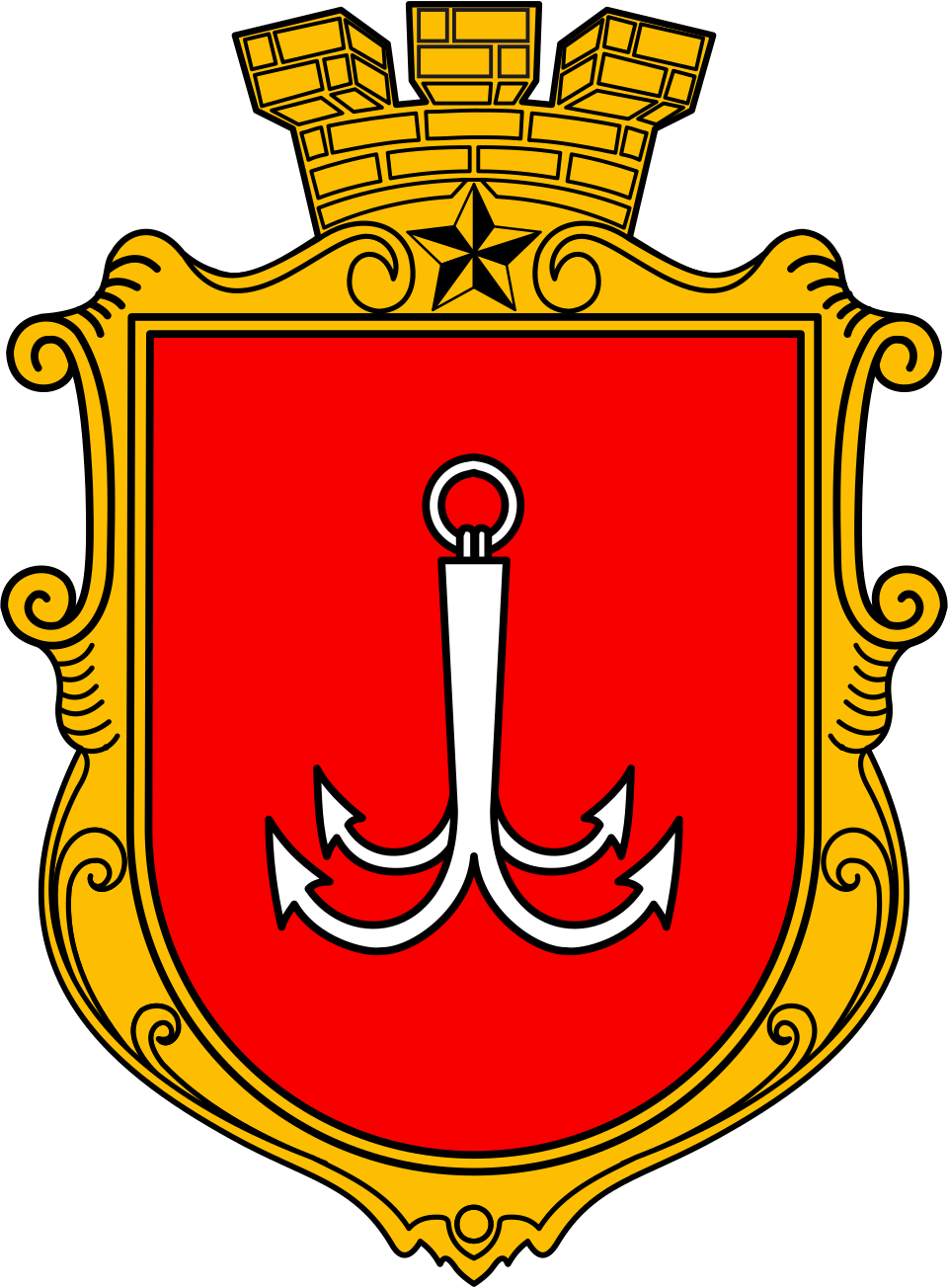
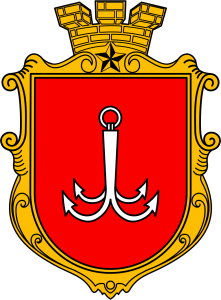
Coat of Arms of Odesa
Approved on 29 April 2011 by a resolution of the Odesa City Council
Description:
In a red rounded shield, there is a silver “cat” anchor with four flukes. The shield is enclosed in a gold stylized cartouche and crowned with a golden municipal crown with three battlements. Beneath the crown is the five-pointed Gold Star of the Hero City, faceted in gold and diamond.
Symbolism:
The anchor is a symbol of Odesa as a port city.
The Gold Star indicates Odesa’s status as a Hero City.
The red color symbolizes bravery, courage, generosity, love, fire, warmth, passion, and life-giving energy.
The silver color embodies purity, loyalty, hope, and kindness.
The gold color symbolizes solar energy, wealth, strength, resilience, and prosperity.
History:
The first design of the Coat of Arms of Odesa was approved on 22 April 1798. At that time, the coat of arms had the form of a horizontally divided French shield in gold and red. In the upper gold field was the image of a double-headed eagle—the official coat of arms of the Russian Empire, whose depiction was mandatory for coats of arms of that period—as well as a Maltese cross, an element used during the reign of Russian Emperor Paul I. In the lower red field was a silver anchor, which characterized Odesa as a port city.
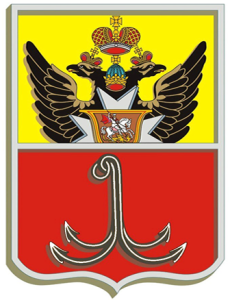
Immediately after the death of Paul I, the appearance of the coat of arms was slightly altered—the Maltese cross was removed from the eagle.
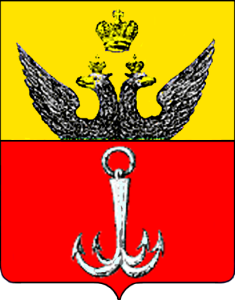
In 1875, Heraldmaster Boris Köhne developed a project for a new coat of arms of Odesa; however, it was never officially approved. The proposed coat of arms was a red French shield with a silver four-fluked anchor in the center. In the upper left gold field of the shield was an image of a double-headed eagle crowned with three crowns. The shield was topped with a gold crown with red seams and five towers. Behind the shield were two crossed gold anchors entwined with a red Alexander Ribbon.
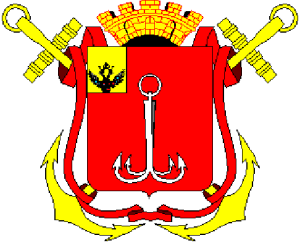
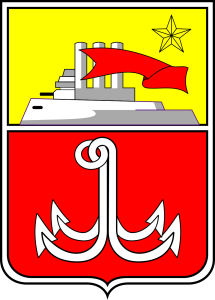
The Soviet-period coat of arms was approved on 19 October 1967 by a resolution of the Executive Committee of the Odesa City Council. The author of the coat of arms was Yu. Horiunov. It took the form of a horizontally divided yellow and red French shield. In the upper yellow field was a stylized image of the battleship Potemkin with a red flag. In the upper right corner was also depicted the Gold Star of the Hero City. In the lower red field was a silver anchor.
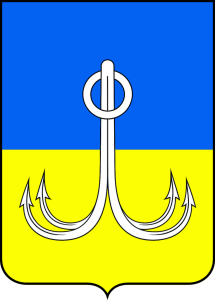
In 1992, a competition was held to select the best design for a new coat of arms of the city of Odesa. According to the results of the competition, the best design was recognized as the project by Yu. A. Horiunov: the proposed shield colors were blue and gold, with a silver “cat” anchor placed in the center.
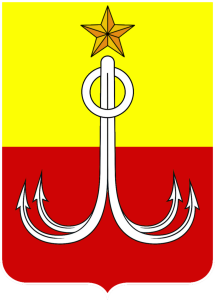
On 2 December 1993, the Executive Committee of the Odesa City Council approved a new official coat of arms of Odesa—already the first one adopted during the period of independent Ukraine, though in a different design. The resolution stated: “The coat of arms has a traditional heraldic shield shape with a silver frame. The field of the coat of arms is divided horizontally into two equal parts. The upper part is made of red gold, while the lower part is covered with hot enamel of a red-orange color. In the center of the coat of arms is a silver cat anchor. The anchor is crowned by the Gold Star of the Hero”.
On 29 July 1999, the Coat of Arms of Odesa was approved by the Odesa City Council (project authors: P. Bondarenko, Yu. Viazovskyi, M. Yemelianov, I. Kalmakan, V. Savchenko; artist H. Faier). The Coat of Arms of Odesa became a silver four-fluked cat anchor on a red field.
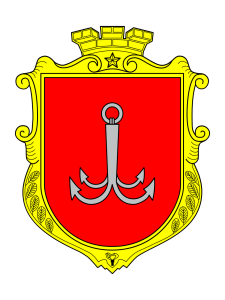
On 29 April 2011, during a session of the Odesa City Council, the deputies, by a majority vote, adopted a decision to introduce changes to the official symbols of the city of Odesa.
Why a Cat Anchor?
The cat anchor (or folding anchor) is a popular type of anchor featuring from three to five flukes (most commonly four), resembling hooks.
The cat anchor is one of the oldest types of maritime equipment.
Origin: The idea of using multi-fluked anchors is attributed to Scandinavian Vikings.
Evolution: During the 18th–19th centuries, they were actively used by the French and Ottoman fleets as auxiliary or primary anchors for small vessels. Due to their ability to “bite” into the seabed with several flukes simultaneously, they became indispensable in river navigation and on vessels with low displacement.
The Cat Anchor on the Coat of Arms of Odesa
The anchor has been the central element of the Coat of Arms of Odesa since its first approval on 22 April 1798.
Why this particular type of anchor:
Symbol of a port city: Since Odesa was founded as the principal seaport in the south, the silver anchor on a red field symbolized the maritime spirit, reliability, and strategic importance of the city as a major trade hub.
Uniqueness of design: Unlike the classical two-fluked anchor, the Coat of Arms of Odesa depicts a cat anchor with four flukes. This emphasizes the city’s special status: while a conventional anchor merely symbolizes a ship at rest, the multi-fluked “cat” is associated with firm anchorage under difficult conditions, symbolizing the resilience and steadfastness of the city.
Heraldic significance: In the modern version of the coat of arms (approved in 1999 and confirmed in 2011), the silver color of the anchor symbolizes purity and fidelity, while the red field of the shield represents the courage and heroic spirit of the people of Odesa.
It is noteworthy that this symbol has become so deeply rooted that the “cat anchor” appears even on historical artifacts of the city, such as stamps on old bricks.
Flag of Odesa
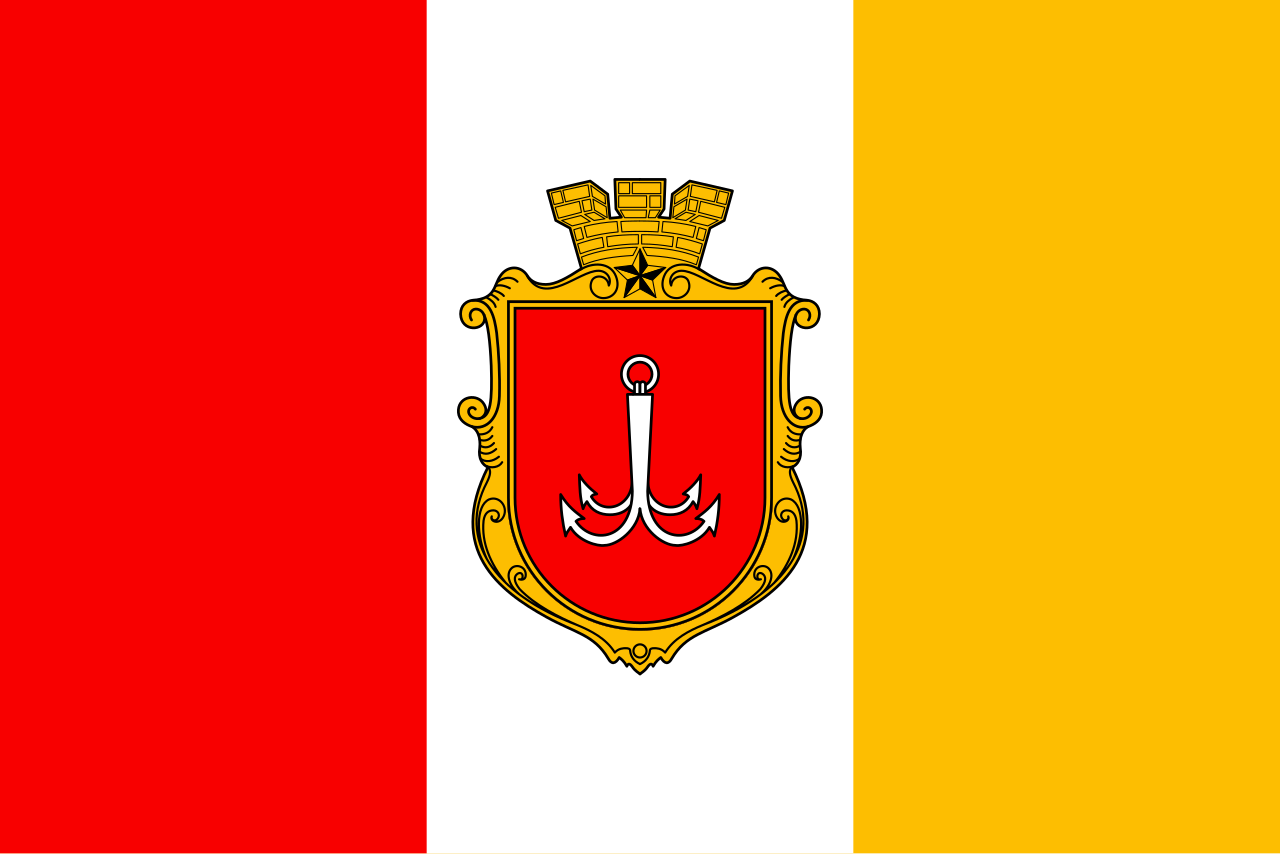
Approved on 29 April 2011 by a resolution of the Odesa City Council
Description:
The flag is a rectangular cloth consisting of three equal vertical stripes: red, white, and yellow. The white stripe bears the small Coat of Arms of the city (the ratio of the height of the coat of arms to the side of the flag is 2:3). Authors — Yu. Viazovskyi and H. Faier.
Symbolism:
The colors of the flag are “derived from the coat of arms” and correspond to the colors of both the current coat of arms and the historical coat of arms of 1798. In combination with the classical tricolor structure, they reflect the heroic spirit (red), pure soul (white), and wealth and prosperity (golden yellow) of Odesa and its residents. They also recreate the historical atmosphere of the late 18th century, with its high ideals of freedom, equality, and fraternity, emphasizing that Odesa is a cheerful European city imbued with a spirit of freedom, unity, and sovereignty.
Crimson (red) symbolizes bravery, courage, fearlessness, generosity, love, fire, warmth, passion, and life-giving forces.
Silver (white) symbolizes purity, innocence, loyalty, reliability, and kindness.
Gold (golden yellow) symbolizes solar energy, wealth, strength, resilience, and prosperity.
The silver cat anchor on a red field has been the heraldic emblem of the city of Odesa since 22 April (4 May) 1798, based on the coat of arms approved by Russian Emperor Paul I.
We recommend reading (follow the link below):