In addition to the beams and ravines that have survived to this day, ditches ran across all the streets of old Odesa, filled with water in the demi-season. Therefore, apart from the corresponding municipal structures, there were also private bridges and footbridges at all street intersections.
Every respectable entrepreneur considered it necessary to arrange a small bridge for crossing the ditch opposite the entrance of his establishment, since the wealthiest clients arrived there by carriage. Homeowners built such bridges opposite their main entrances, sometimes together with a canopy stretching from the door all the way to the cobblestones.
Perhaps the first large bridge in Odesa was the wooden bridge across the Quarantine Ravine. It is briefly mentioned in the collection “Odesa. 1794–1894”. In 1809, the streets had not yet received names, and this bridge was likely the only one. The second in chronological sequence was a bridge built at the intersection of today’s Lanzheronivska and Havanna Streets. The third in the same sequence was a stone bridge on Deribasivska Street, opposite today’s House of Books. Of the existing bridges across the Quarantine Ravine, three and a half have survived: the Stroganov Bridge on Hretska Street, the Kotsebu Bridge on Nina Strokata Street (until 2024 – Bunin, earlier – Policeіska), the Novikov Bridge on Sviatoslav Karavanskyi Street (until 2024 – Zhukovsky), and the half-bridge Sicard on Іevreiska Street.
There were at least eleven more municipal bridges in Odesa, whose existence in the past is now hardly known. They all shared a common purpose – they spanned the ditch of the second line of the porto-franco.
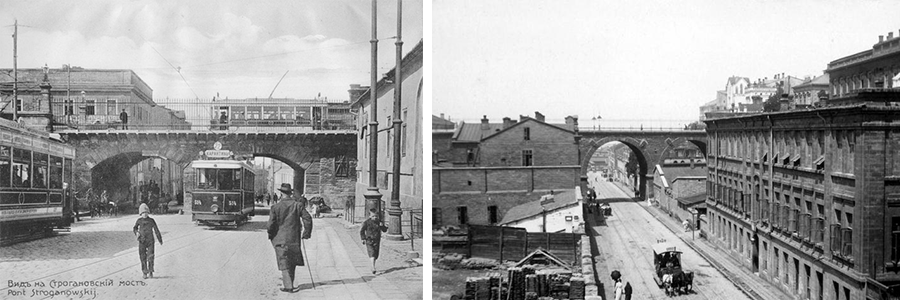
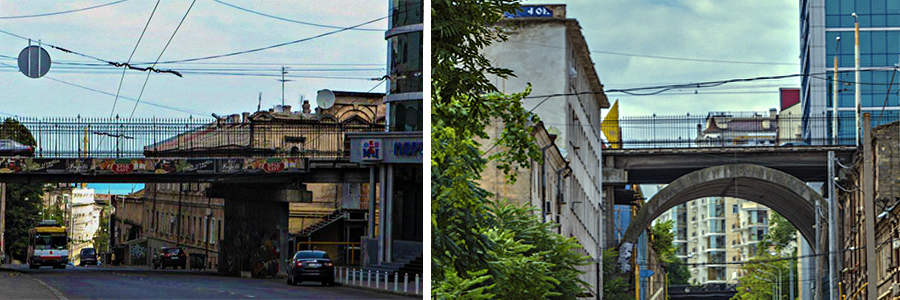
The Stroganovskyi (Stroganov) Bridge
Stroganov Bridge – the closest to the port, spanning over the Quarantine Ravine along Hretska Street (rising above the Polish and Devolan Descent). It was named after Russian Governor-General and the first honorary citizen of Odesa, Count A. G. Stroganov (yes, the very one whose cook invented the dish Beef Stroganoff).
The territory where Odesa was established is cut through by several large ravines: Vodyana (where Balkivska Street now lies), Viyskova (descending down from Deribasivska along Havanna and Viyskovyi Descent), and the large Quarantine Ravine leading down to the port. That is why there were many bridges in the city. In the early years, even Deribasivska Street had a small bridge, but it was later filled in. The largest bridge of pre-revolutionary Odesa, however, was the Stroganov Bridge.
Its construction took a long time – ten years, from 1853 to 1863 – a true long-term build. Under the supervision of architect Honsiorovsky, the construction was carried out by contractor Butyrsky. In fact, it consisted of two bridges connected by an embankment. The length of the arched stone-block span reached 120 meters.
The Stroganov Bridge held the record for height until quite recently, when the even taller Mother-in-law’s Bridge appeared. To it, Stroganov Bridge also passed on its grim reputation as the “bridge of suicides.” Suicides once became so frequent that a high fence had to be erected.
The infamous area under the bridge was called the “gully” – here, along with port workers, lived thieves, card sharps, and crooks of every kind. Later, the colorful surroundings of the Gully appeared many times in cinema when slums had to be depicted – in the films The White Sail Gleams, The Mexican, The Waves of the Black Sea, For Soviet Power.
A tram line was opened across the bridge in 1911. It is believed that after several decades, the load and groundwater destabilized the bridge made of fragile shell limestone, and in the early 1980s it was almost completely rebuilt, with shell stone replaced by reinforced concrete structures. Although specialists claimed that with the right approach, the bridge could have been preserved. Today, only the cast-iron railing and a fragment of the span on one side of Devolan Descent remain from the old Stroganov Bridge.
Built by architect Landesman between 1889 and 1892, its metal frame was manufactured in Paris and only assembled and installed in Odesa. Connecting Politseіska Street (now Nina Strokata Street, formerly Bunina, Roza Luxemburg, during Romanian occupation October 16, and earlier Kondratenko Street), it, like the Stroganov and Novikov Bridges, spans the Quarantine Ravine. The bridge was named in honor of Governor-General Pavel Kotsebu, who held this post from 1862 to 1874. Incidentally, he greatly contributed to Odesa, but, by a curious coincidence, rejected the project for the construction of a bridge on Politseyska Street during his administration.
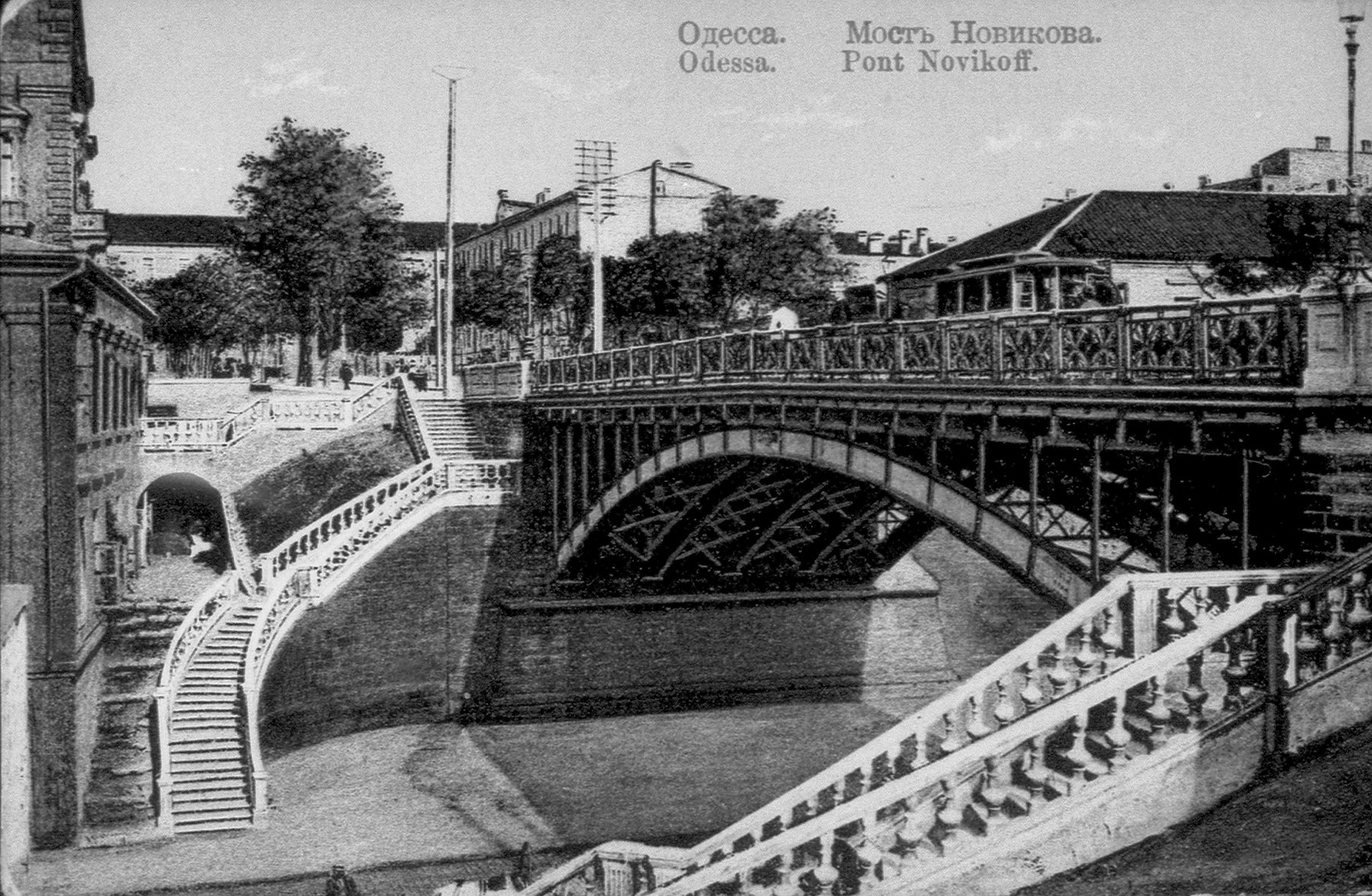
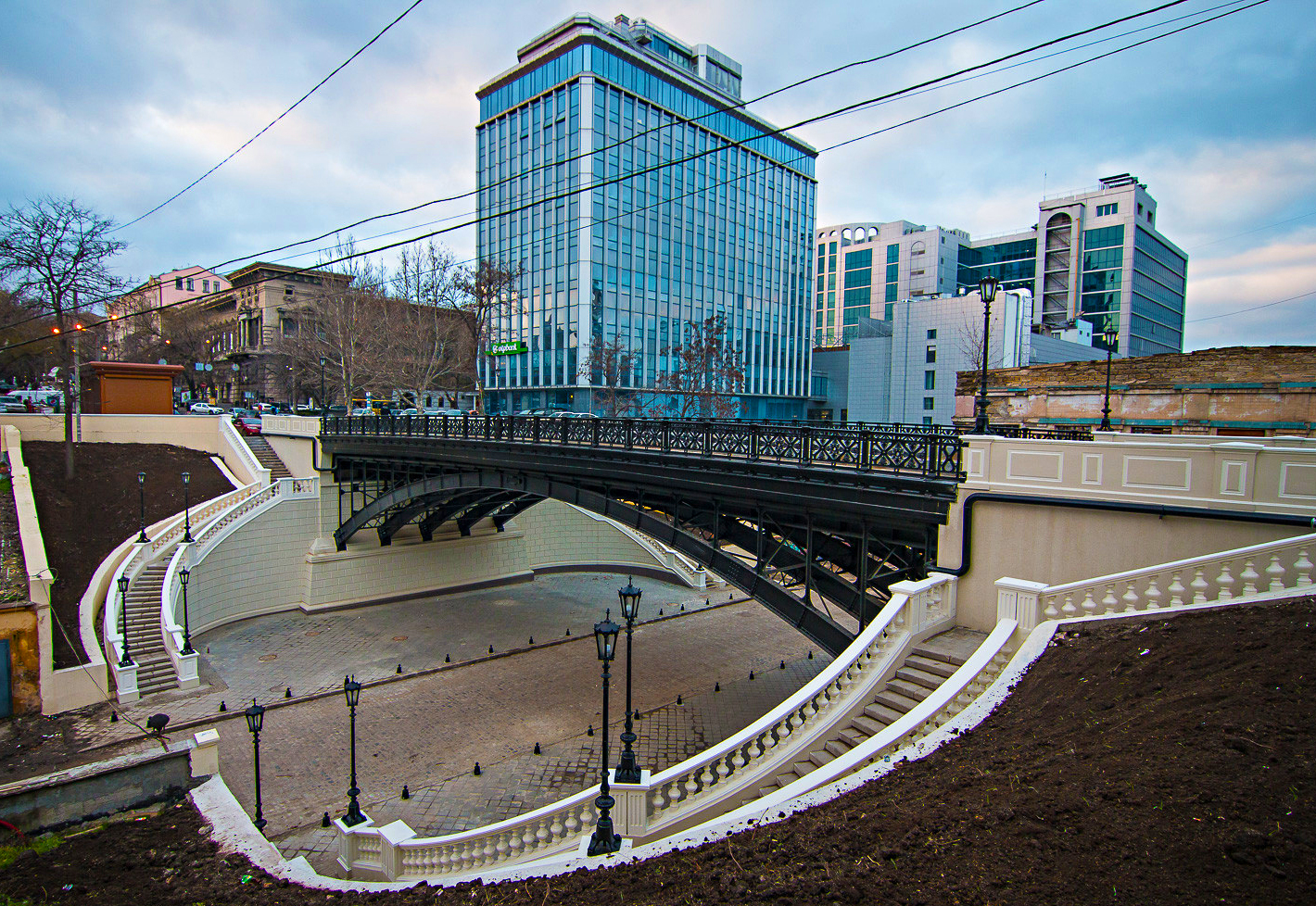
The Novikov Bridge
In 1822, in the presence of Governor-General Alexander Langeron and the Mayor of Odesa, Privy Councillor Mykola Tregubov, the first stone bridge was solemnly laid. It was intended to connect two sections of Poshtova Street (now Sviatoslava Karavanskoho Street, until 2024 – Zhukovskoho Street) across the Quarantine Ravine (Levashivskyi Descent, Vakulenchuka, and now Devolanivskyi), which led to the port. The bridge was under construction for two years and was opened in 1824, already in the “era of Vorontsov.” The author of the project was the well-known Odesa scholar and engineer Juste Haüy, while the construction was supervised by the equally renowned architect and builder Alexander Digby.
The bridge received its name in honor of the popular Odesa entrepreneur Illia Novikov, who not only actively initiated its construction but also acted as its contractor. Novikov, undoubtedly, pursued personal interests: nearby, on Kanatna Street, stood his rope factory, which, thanks to the bridge thrown across the ravine, obtained the shortest and most convenient road to the city center.
Having grown decrepit over less than two centuries of active operation, the Novikov Bridge was restored in 2009.
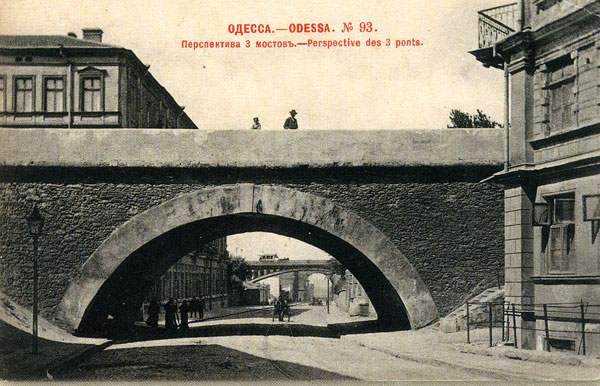
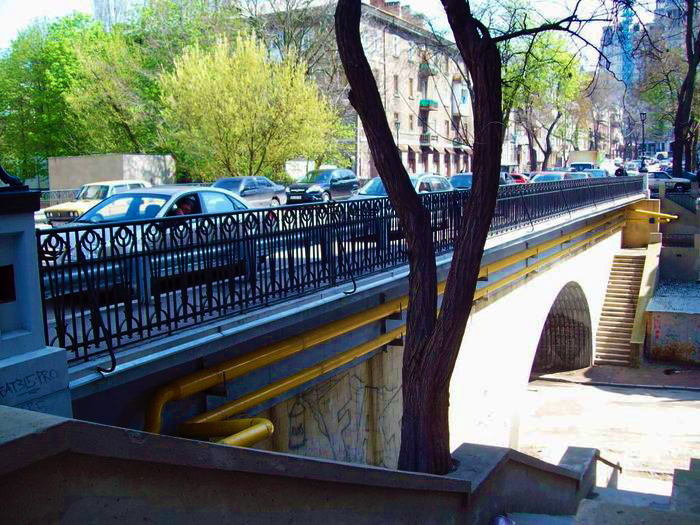
The Sabaneiv Bridge
On the proposal of the Governor-General Vorontsov bridge got its name in honor of the famous military leader, General of Infantry and one of the first Odesa bibliophiles I.V.Sabaneiev (1770-1825 (1829?)). Odesa Public Library has presented many of his books.
From the bridge we can overlook the sea and another bridge – Teshchyn. Outdoor the Sabaneiv Bridge located the House of Scientists. On the opposite side of the bridge adjacent the musical school named Stolarskyi and European Square.
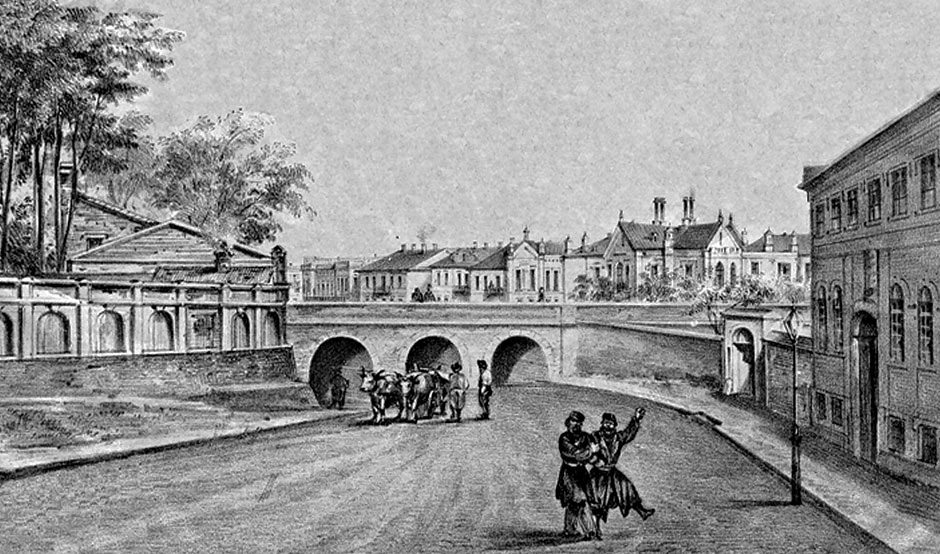
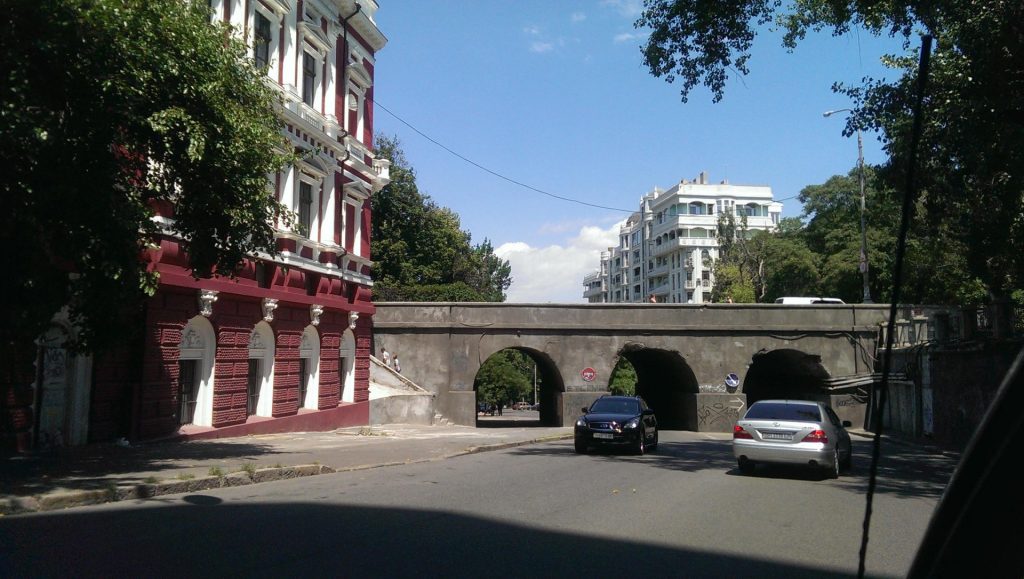
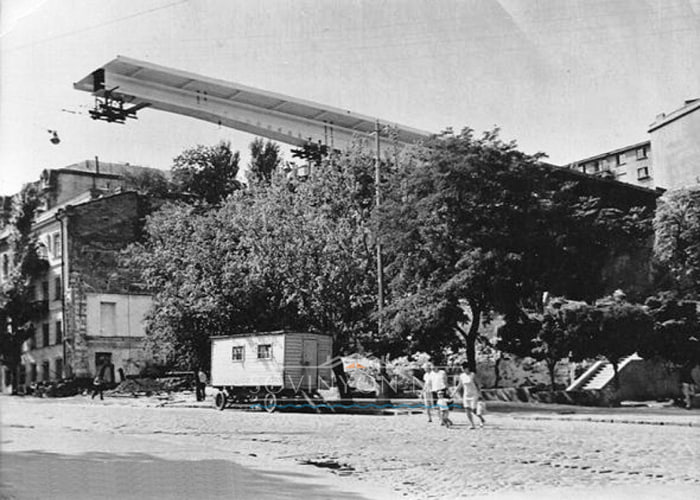
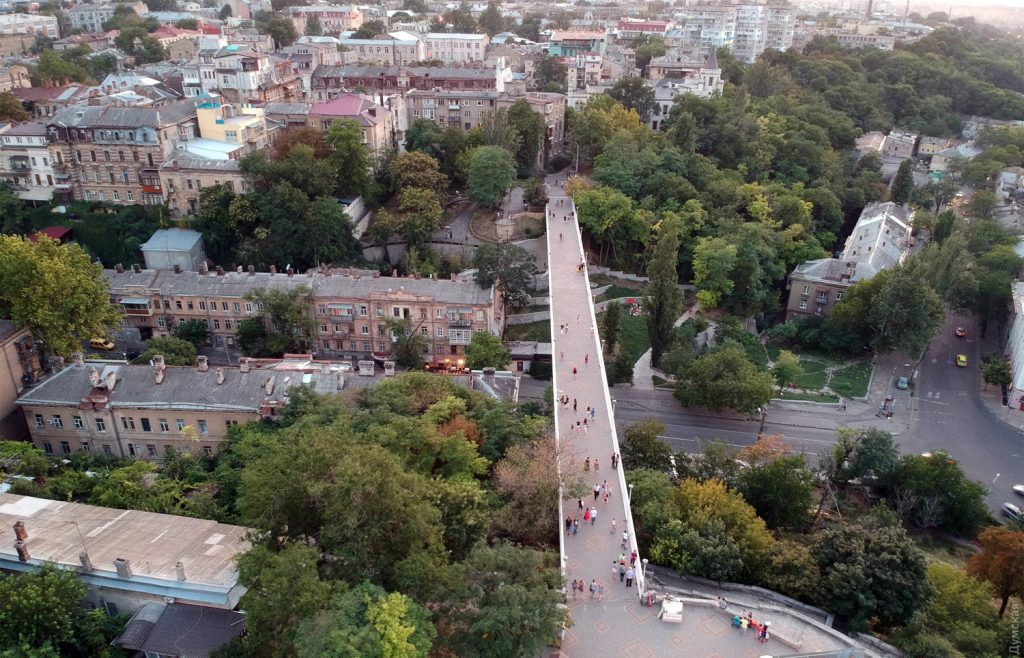
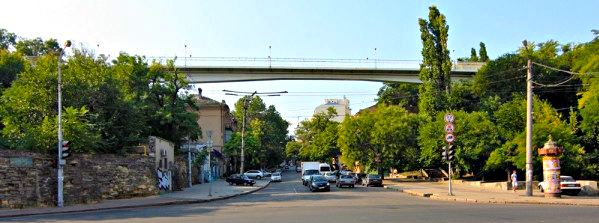
A pedestrian bridge, the highest in Odesa, stretched over the Viiskovyi Descent. “Mother-in-Law” is the name given to it by an urban legend, which will be mentioned further. The bridge connects two magnificent palaces — the strict and graceful Vorontsov Palace on Primorskyi Boulevard and the splendid neo-Gothic Brzozowski Palace on Gogol Street. From the bridge, there opens a beautiful view of the sea, the harbor, and the city.
Unlike the nearby Sabaneiev Bridge, the metal structure of the Mother-in-Law Bridge is a creation of the twentieth century. It was built in 1968 according to the design of the architect Volodymyrska and the engineer Kyriienko. Initially, the bridge was to be named the Captain’s Bridge or the Komsomol Bridge (as the boulevard beginning from the Shah’s Palace was once called). However, in the end, the bridge became the “Mother-in-Law Bridge.” According to one version, this was due to its length (“as long as a mother-in-law’s tongue”). According to another, more popular version, the bridge was decided to be built by Mykhailo Synytsia, head of the Regional Committee, whose beloved mother-in-law lived on the opposite side. Since it was too far to walk around, a short path was needed. However, Synytsia’s relatives insist that this is a fabrication and that it was closer to reach the mother-in-law through the City Garden. In any case, the legend about the beloved mother-in-law’s pancakes lives on.
Unlike the nearby Sabaneiev Bridge, the metal structure of the Mother-in-Law Bridge is a creation of the twentieth century. It was built in 1968 according to the design of the architect Volodymyrska and the engineer Kyriienko. Initially, the bridge was to be named the Captain’s Bridge or the Komsomol Bridge (as the boulevard beginning from the Shah’s Palace was once called). However, in the end, the bridge became the “Mother-in-Law Bridge.” According to one version, this was due to its length (“as long as a mother-in-law’s tongue”). According to another, more popular version, the bridge was decided to be built by Mykhailo Synytsia, head of the Regional Committee, whose beloved mother-in-law lived on the opposite side. Since it was too far to walk around, a short path was needed. However, Synytsia’s relatives insist that this is a fabrication and that it was closer to reach the mother-in-law through the City Garden. In any case, the legend about the beloved mother-in-law’s pancakes lives on.
Another, if one may put it this way, “tradition” often associated with tall structures in cities is the reputation of being a “suicide bridge.” As the highest bridge in Odesa, the Mother-in-Law Bridge inherited this reputation from the second-highest, the Stroganov Bridge. To nullify it, the bridge was equipped with a tall fence. And below, someone sometimes writes phrases for psychotherapeutic purposes, such as: “Do not jump, it is shallow here.” Smile, ladies and gentlemen, life is indeed so beautiful.
And finally, the last tradition of the Mother-in-Law Bridge. You may laugh, but in the middle of February, Mother-in-Law’s Day is celebrated here.
The “Horbatyi” (“Humpback”) Bridge
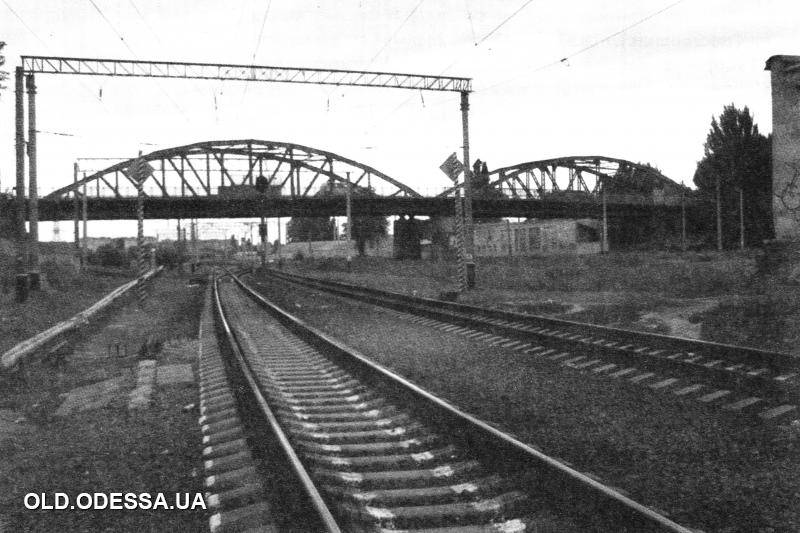
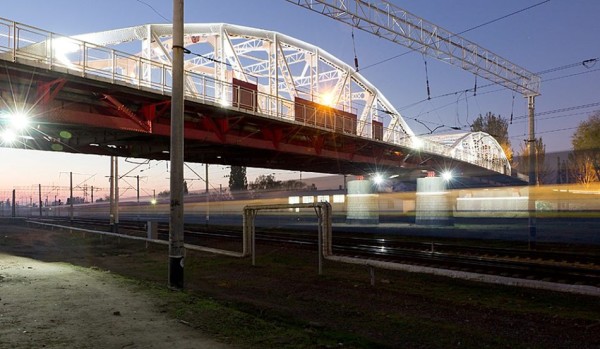
“Humpback” bridge, which was built in 1890, named Baronovskyi at the beginning. It was made on behalf of the Baron Ungern-Shternberg, which carried out the building of railway connection between Odesa and Balta.
Bridge received the name “Horbatyi” (“Humpback”) because of the character shape of semi elliptic metal power structures.
There are rails on this bridge. But there were no tram ever; those rails were laid to provide rigidity. Telling the truth, some citizens of Odesa asserting that personally went on a tram across the bridge, but it’s impossible to find evidences of an existence of this tram route in any documents.
They also say that at the beginning of the last century Utochkin has passed on a bike on a supporting arches. It is easy to believe.
General plan of Odesa provides the demolition of the bridge. Information about this appeared in 2008. Another bridge will take it’s role and function. Although this bridge was built long ago, but did not officially open to car traffic underneath, and “Humpback” bridge used as before. It is hoped that no one would endure this important landmark of Odesa ever.
The Sicard Half-Bridge
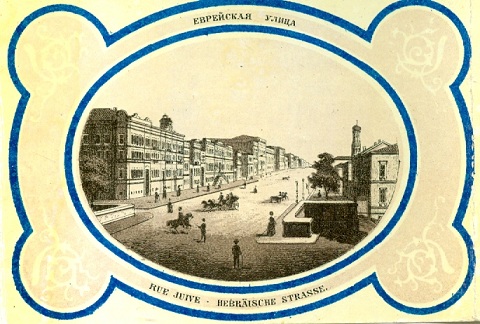
The Sicard Bridge is one of the bridges across the Karantinna Ravine in Odesa, located on Ievreiska Street. It is among the oldest bridges in Odesa. At the end of the 19th century, part of the Karantinna Ravine was filled in, and accordingly, a number of bridges lost their significance. The Sicard Bridge turned into a half-bridge — only a part of it has been preserved.
The bridge received its name from Charles Sicard, a native of Marseille. He tied his life to Odesa after visiting the city at the invitation of Armand de Richelieu. In 1807, he obtained Russian citizenship and entered state service, for a time even holding the position of Russian consul in Livorno. In addition, he began commercial activities in Odesa; in particular, he owned the Hotel du Nord on Italiiska Street. On the section of Yevreyska Street adjacent to the bridge, there were a number of houses that belonged specifically to Sicard.
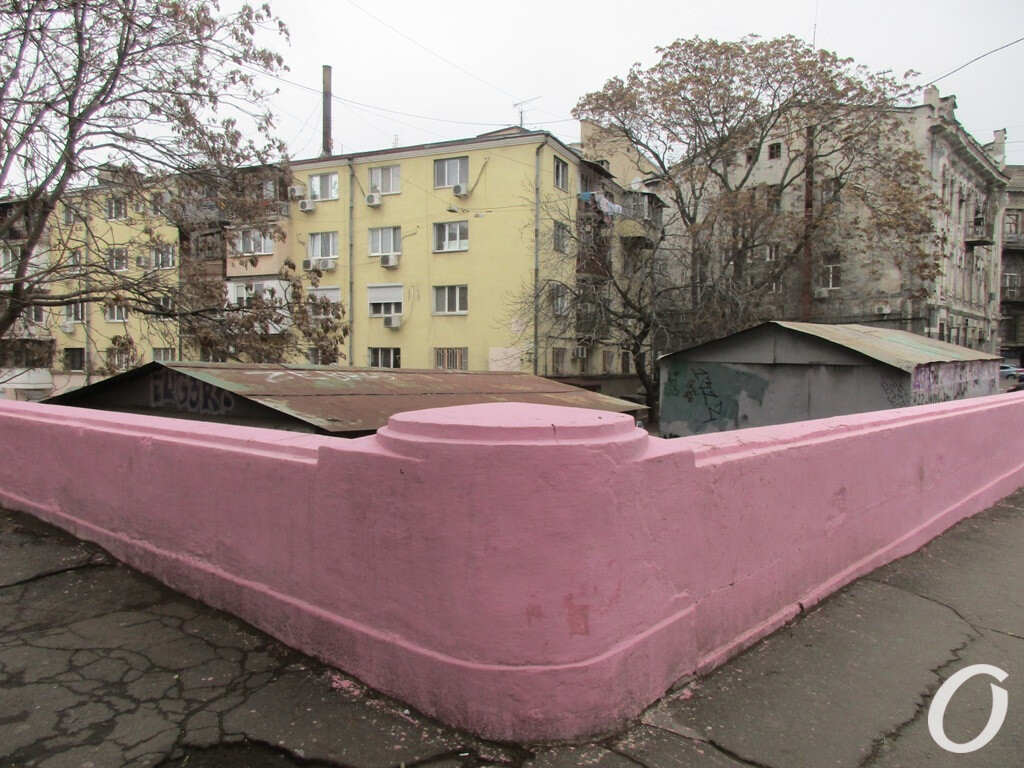
After the large-scale reconstruction of the Karantinna Ravine at the end of the 19th century, part of the ravine up to Yevreyska Street was filled in. Thus, the ravine now begins in the area of the Sicard Bridge on Yevreyska Street. Today, only one parapet of the bridge has survived, on the side of the Karantinna Ravine, at the intersection of Yevreyska Street and Devolanivskyi Descent. Under the bridge, there are garages, which are slightly elevated above the ravine.
Recommended reading (click the link):
Parks. Green Areas
Squares of the Historic Center
Monuments. Compositions
Famous Stairs and Descents
*Why Is the Name of the City Spelled “Odesa” with Only One “S”?
We write the name of the city as “Odesa” with only one “s” in order to respect the Ukrainian spelling and the original Ukrainian name. Traditional international spellings with a double “s” may still be encountered, but the correct Ukrainian form is spelled with only one “s”.