Menu Close

Museums, Galleries

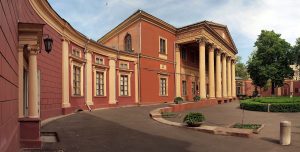
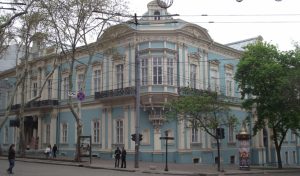
The building that houses the Odesa Museum of Fine Arts was constructed between 1824 and 1828. The author of the architectural project has not been identified. After construction was completed, the building was inspected by the renowned Odesa architect Franz Karl Boffo. The first owner of the palace was Countess Olga Naryshkina (née Potocka).
In 1888 the palace was purchased by the Mayor of Odesa, Grigory Marazli, an outstanding public figure, collector, and patron of the arts. In 1892 Grigory Marazli donated the palace to the city with the intention of establishing a museum of fine arts there. The museum was officially opened on 24 October (6 November, according to the Gregorian calendar) 1899.
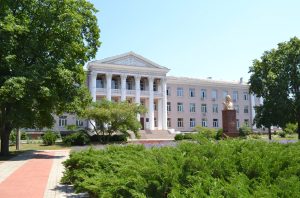
The architecture of the palace embodies the finest traditions of Russian classicism of the early nineteenth century. The central composition of the building consists of a two-storey main structure with a portico of six Corinthian order columns supporting a triangular pediment. On both sides are single-storey wings arranged symmetrically and connected to the main building by curved galleries. The overall composition is distinguished by restrained elegance and harmonious proportions.
A tribute to the Romantic era is the large grotto constructed beneath the central part of the main building. It features a vaulted ceiling designed to imitate a natural cave with an artificial waterfall. Underground galleries extend from the grotto and once led to a large garden that descended along the slope toward the seashore. A small exhibition placed before the entrance to the grotto presents the history of the palace and the creation of the museum.
In the basement of the main building, on the side facing the sea, there is a spacious gallery. Murals created during the “Home Exhibition” of 1895, which took place in the palace and its garden, are still preserved on the vaults and walls. Today this part of the palace houses the experimental gallery “Yellow Giants”.
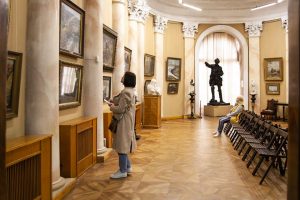
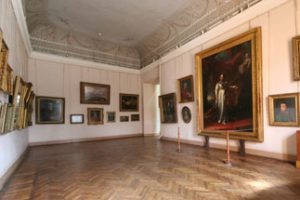
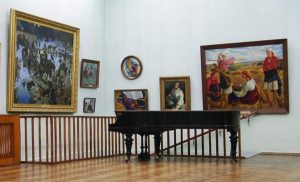
The museum exhibition begins with works of icon painting from the sixteenth and seventeenth centuries, imbued with the distinctive spirit of early secular portraiture.
Academic painting is represented by works reflecting its traditional grandeur. Among them are paintings by the outstanding marine painter Ivan Aivazovsky.
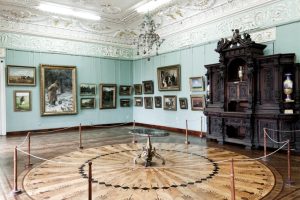
The museum also holds comprehensive collections of works by artists associated with the democratic artistic movement of the Russian Empire in the second half of the nineteenth century, especially members of the Society for Traveling Art Exhibitions (an association of artists who organized mobile exhibitions throughout the empire). Visitors can see works by such masters as Alexei Savrasov, Isaac Levitan, Ivan Shishkin, Arkhip Kuindzhi, Ilya Repin, and Vasily Surikov.
The exhibition further includes works created at the turn of the nineteenth and twentieth centuries, reflecting the diversity and intensity of the search for artistic ideals during that complex historical period. This section presents works by renowned masters such as Valentin Serov, Mikhail Vrubel, Nicholas Roerich, Boris Kustodiev, Alexandre Benois, Konstantin Somov, and Wassily Kandinsky.
A unique collection of paintings by masters of the Society of South Russian Artists is also displayed. This artistic association, founded in Odesa in 1890, is often abbreviated as TYURJ, which stands for “Society of South Russian Artists.” Among its representatives are Kyriak Kostandi, Grigory Ladyzhensky, Grigory Golovkov, Pyotr Nilus, Nikolai Kuznetsov, and Timofey Dvornikov.
The Decorative and Applied Arts Hall contains more than two hundred objects that reflect traditional Ukrainian folk art. These include ceramics and glassware, embroidery and woven textiles, wood carving, metal and leather objects, and painted Easter eggs known as pysanky, a traditional Ukrainian form of decorated eggs created using wax-resist techniques.
The Department of Contemporary Art displays works created from the 1920s of the twentieth century onward.

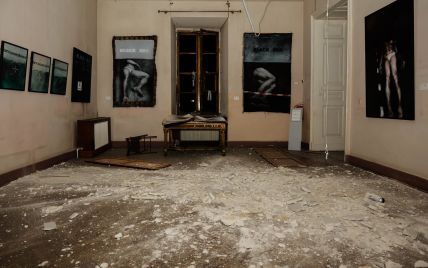
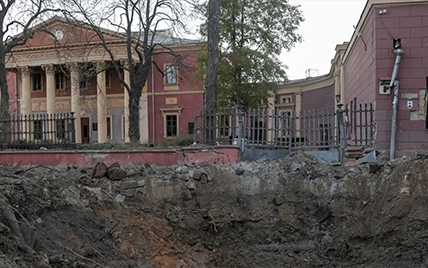
En 2023, el edificio fue parcialmente destruido como resultado de un ataque con misiles por parte del agresor ruso.
The museum was founded in 1924 on the basis of private collections assembled by the local Committee for the Protection of Monuments of Art and Antiquity, as well as items transferred from the Municipal Museum of Fine Arts and the Art History Cabinet of Novorossiysk University.
In subsequent years the collection was enriched by contributions from major national museums, including the State Hermitage Museum and the Kyiv Museum of Western and Eastern Art.
The museum building is an architectural monument dating from the mid-nineteenth century. It is a palace constructed between 1856 and 1858 according to the design of the architect Ludwig Otton. Its architectural style reflects the eclecticism characteristic of that period: Baroque features coexist with elements of the Empire and Rococo styles.
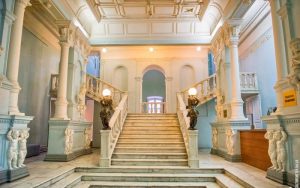
From an architectural perspective, the most remarkable part of the building is the entrance hall with its main “floating” staircase carved from Carrara marble. The construction of the staircase is highly original: it was built without supporting beams (stringers), and together with the landings forms a spectacular suspended structure. The palace interiors are distinguished by their rich stucco decoration, ornamental carvings on the doors, and bronze fittings.
The Odesa Museum of Western and Eastern Art is one of the most important art museums in Ukraine, and its collection contains numerous works of exceptional artistic and cultural value. The exhibition presents works of Western European art from the fifteenth to the twentieth century, art from the countries of the East, and works of ancient art. The museum is housed in the palace of Count Oleksandr Ageievych.
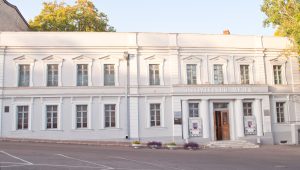
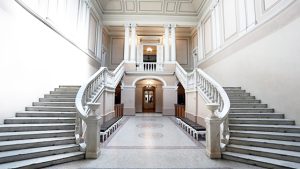
Literary Odesa is not merely a list of writers who were connected with the city either through their biographies or their creative work. It is also an artistic image that has enriched world culture. A reflection of all the distinctive features of the city—a kind of mirror of Odesa—is the Odesa Literary Museum.
The Odesa Literary Museum is one of the largest literary museums in the world. It was founded in 1977 and opened to the public in 1984. The principal author of the exhibition design was the outstanding Ukrainian designer and Shevchenko Prize laureate, the artist Anatolii Haidamaka. The founder and first director of the museum was Nadiia Bryhin.
The building that houses the Odesa Literary Museum was constructed in the mid-nineteenth century according to the design of the architect Ludwig Otton. The palace belonged to one of the earliest citizens of Odesa, Prince Dmytro Gagarin, a member of the high Russian aristocracy, and to his wife Sofia. The palace interiors impress visitors with their unexpected combination of styles—Classicism, Baroque, and Empire—characteristic of the southern regions of the Russian Empire in the mid-nineteenth century, a style often referred to as “free southern eclecticism”.
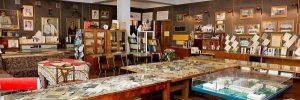
The Odesa Literary Museum is simultaneously a museum of the history of the book and, in part, a memorial museum displaying the personal belongings of writers. It is also a museum dedicated to the history of the city’s literature and culture.
The museum exhibition is organized as a system of symbols and signs that incorporates authentic historical documents: books, manuscripts, newspapers, journals, photographs, personal belongings of writers, and period objects. The design of the museum combines striking artistic solutions with accurate literary and historical content.
The museum presents more than three hundred writers whose lives and works were connected with Odesa, ranging from Ivan Kotliarevskyi, Alexander Pushkin, and Adam Mickiewicz to Heinrich Böll, Georges Simenon, and Boris Pasternak. Alongside the great masters of literature—Nikolai Gogol, Leo Tolstoy, Mykhailo Kotsiubynskyi, Lesia Ukrainka, Sholem Aleichem, Anton Chekhov, Ivan Bunin, Ivan Franko, Anna Akhmatova, Isaac Babel, Ilya Ilf, Yevgeny Petrov, Valentin Kataev, and Mykola Kulish—many authors of the so-called “second tier,” who nevertheless played an important role in shaping national culture, are also represented.
Twenty museum halls, arranged in an enfilade layout across two floors of the palace, present the history of literary Odesa in chronological order. The atmosphere of each hall conveys the spirit of the city during a particular period, revealing the secrets, legends, and realities of the “pearl by the sea”.
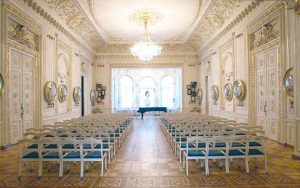
Today the Odesa Literary Museum serves as a cultural calling card of the city and as a major scientific, publishing, and cultural center. In addition to its permanent exhibition, the museum is well known for its literary and art exhibitions, classical music concerts, book presentations, lectures, and cultural events. The magnificent Golden Hall of the museum, with its splendid interior and excellent acoustics, is considered the finest chamber concert venue in Odesa.
Next to the museum building there is an Italian-style courtyard that continues the long-standing tradition of Odesa courtyards, known for their welcoming charm and distinctive character. Decorated with flowerbeds and a central fountain, the courtyard is inhabited by original sculptures. In 1995 the creation of the Sculpture Garden began there—an open-air exhibition and a unique cultural site without analogues.
Today the Sculpture Garden contains seventeen humorous sculptural compositions dedicated to writers, literary heroes, and iconic figures of urban folklore. These works were created by contemporary sculptors and include: “The Hero of Odesa Jokes Rabinovich”, “The Gnu Antelope”, “Monument to the Future Genius”, “Sashka the Musician”, “The Denim Duke”, “The Green Van”, “Odesa Mama”, “Misha the Odesite”, “Boats Full of Mullet”, “Monument to the Unknown Reader”, the monument to Ilya Ilf and Yevgeny Petrov, the monument to Nikolai Gogol titled “The Troika Bird”, the monument to Kostiantyn Paustovskyi titled “The Time of Great Expectations”, “The Odesa School”, the monument to Volodymyr Vysotskyi titled “Heart of Gold”, the sculpture “The Silver Age” and “The Brotherhood of the Museum”.
The garden also displays ancient sculptures from the northern Black Sea region—Scythian and Cumanian stone figures from the collections of the Archaeological Museum. Year after year the Sculpture Garden transforms into an exhibition of contemporary sculpture. Humor and irony expressed in bronze and marble have become a visual guide to a wide variety of sculptural solutions. Sculptors representing diverse artistic movements—both traditional and entirely unconventional—have worked on these statues.
The entire exhibition conveys the unique image of Odesa, a city built upon ancient land yet eternally young. The author of the “Sculpture Garden” project is Leonid Liptuga.
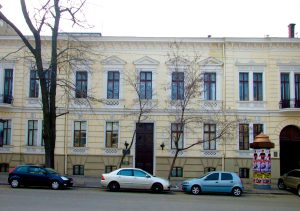
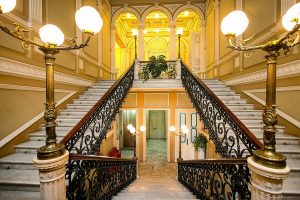
On 6 May 1956, the Odesa State Historical and Ethnographic Museum warmly opened its doors to its first visitors. The museum was created on the basis of the Museum of the Defense of Odesa and the Odesa Regional Museum of Local History.
Documents, printed publications, objects of decorative and fine art, numismatic collections, and weapons dating from the seventeenth to the nineteenth centuries related to the history of the city and the region became part of its holdings. Many of these items had previously belonged to the collections of the Odesa Society of History and Antiquities, the Museum of the Book, the Museum of Old Odesa, and several other institutions.
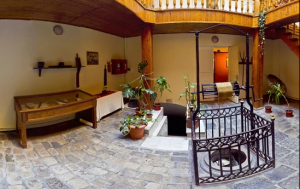
In 1983 the museum closed for a major renovation that lasted eleven long years. As a result of extensive restoration work carried out by Odesa’s artistic and restoration workshops, the palace interiors of the mansion were restored to their original appearance. The museum’s inner courtyard—essentially a small miniature park with an elegant fountain known as “The Grotto”—was also transformed and quite literally brought back to life. The courtyard owes its intimate and welcoming atmosphere to the traditional trees typical of Odesa—acacia, chestnut, and linden—as well as some species less common for the region, such as Crimean pine and evergreen boxwood.
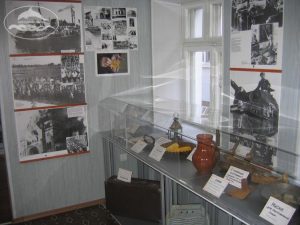
Today the museum features several permanent exhibitions, including “Old Odesa” and “Odesa and the Region during the German–Soviet War of 1941–1945,” as well as temporary exhibitions such as “The Multicultural Character of the Odesa Region,” “Sister Cities of Odesa,” and “The Culture of Odesa.” As new materials are gathered through ongoing scholarly research and collection work, additional exhibitions will be created to reveal the many different aspects of the life of our city and region.
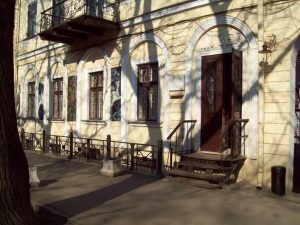
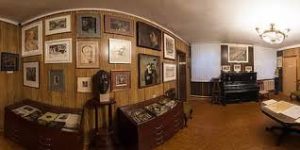
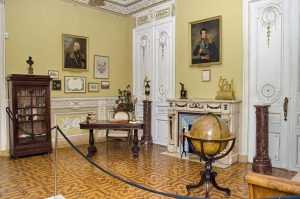
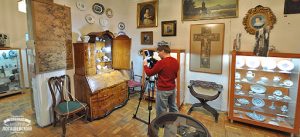
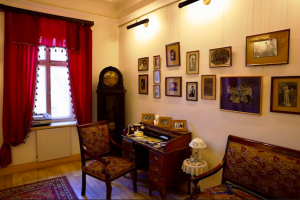
The museum exhibition “Memorial Hall of A. Bleshchunov” recreates the study of the collector himself. Here visitors can see the objects that were most valuable to the founder of the museum—family relics, photographs of friends and students—as well as materials connected with the military and mountaineering periods of his life.
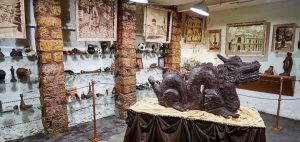
The “Buddhist East” Hall presents works of art from the peoples of Japan, China, Mongolia, and Tibet. The name of the hall is somewhat conditional: although Mongolia and Tibet are historically Buddhist countries, China and Japan are only partly associated with Buddhism. Among the most notable objects displayed here is a seventeenth-century Coromandel lacquer screen distinguished by its exceptional artistic quality. The hall also includes small but fascinating collections of Chinese and Japanese porcelain and snuff bottles made of semi-precious stones. In addition, a small pantheon of Buddhist deities created using the traditional lost-wax casting technique is exhibited.
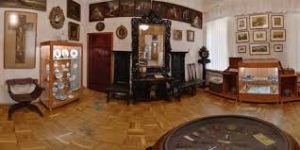
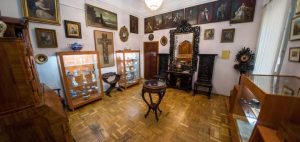
The “Western Europe” Hall displays furniture, porcelain and glass objects, as well as paintings dating from the eighteenth and nineteenth centuries. The compositional center of the hall is a Venetian mirror set in a carved wooden frame, above which hangs a gallery of portraits of sovereign rulers of the seventeenth and eighteenth centuries. The hall contains a wide range of European porcelain, including works produced in Meissen, Vienna, Berlin, and Limoges. A remarkable collection of miniature portraits is also displayed here, including images of Richard Wagner, Napoleon Bonaparte, Empress Joséphine, and Marie Louise of Austria. Another highlight of the Western art collection is a unique assortment of fans made from a variety of materials such as tortoiseshell, ivory, and ostrich and rooster feathers.
The staircase landing is decorated with a small collection of works by Boris Smirnov-Rusetsky, one of the disciples of the renowned painter and philosopher Nicholas Roerich.
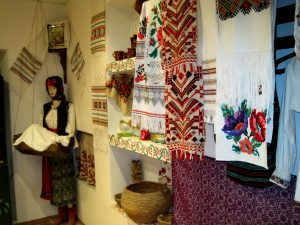
The museum’s collection of Ukrainian art is relatively small but notable for the careful selection of its objects. It presents examples of traditional Ukrainian folk crafts. The hall is adorned with several paintings dedicated to Ukraine, as well as a beautiful nineteenth-century lubok print depicting the classic scene “At the Fountain.” Of particular interest are examples of icon painting, especially the well-known Ukrainian folk icons which, unlike traditional Russian icons painted on wooden boards, were created on canvas. The hall also features a collection of nineteenth-century linen ritual towels from Krolevets decorated with stylized representations of the Russian imperial coat of arms typical of that period.
The “Muslim East” Hall mainly presents household objects from Central Asia and the Caucasus. One of the most interesting collections in this hall is the carpet collection, which includes a famous Persian carpet depicting a flowering tree with birds, as well as hurchumi, small bag-shaped carpets. The collection of utensils from Central Asia and Iran—used for washing, tea preparation, and smoking—creates a particularly exotic impression.
The “Odesa” Hall is dedicated to the native city itself, and therefore its exhibition is highly diverse. It includes memorial objects, books that have become bibliographic rarities, old newspapers, photographs, and works by Odesa artists.
In the “Christianity” Hall visitors can see a very interesting collection of icons created by Old Believers, valuable collections of Rostov enamels, as well as a varied assortment of church utensils such as altar cloths, chalices, patens, lamps, and censers.
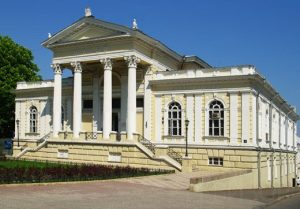
The Odesa Archaeological Museum is the oldest museum in Ukraine. Since its founding in 1825, it has changed location four times.
Initially, the museum was located at 2 Kanatna Street, in the courtyard of the house of its founder and first director, Ivan Blaramberg, an official entrusted with special assignments under Count Mikhail Vorontsov, a corresponding member of several foreign academies, as well as a scholar, collector, and patron of the arts. Most of the objects displayed in the newly created museum came from Blaramberg’s personal collection, which he donated to the city.
Several years later, thanks to numerous donations—including those from Count Vorontsov and his wife—the collection grew so large that it had to be moved to the new building of the Odesa government institutions located on the semicircular square of Prymorsky Boulevard, directly opposite the famous monument to the Duke de Richelieu. In 1858, the collections of the municipal museum and the Society of History and Antiquities were united under the roof of a specially constructed building near the Opera House, designed by the architect Grigory Torichelli.
In 1883, by decision of the Mayor of Odesa, the wealthy philanthropist Grigory Marazli, the present “sanctuary” of antiquities was built on the same site (2 Lanzheronivska Street) according to the design of the architect Gonsiorovski. The main funds for its construction—thirty thousand gold rubles—were provided personally by the mayor from his own savings.
Among the benefactors of the museum, in addition to the Vorontsov family, Blaramberg, and Marazli, were the archaeologist Stempkovsky, Prince Cantacuzino, Count Potocki, the Collegiate Counselor Marini, the merchant Sazonov, and many other admirers of antiquities.
The Odesa Archaeological Museum is famous not only for its unique exhibitions. The building itself has independent historical value. Despite its relatively modest size, it impresses with its grandeur, as it was constructed in accordance with the traditions of ancient classicism. Over time, however, the organic connection between the exterior and interior of the building deteriorated. The decoration of the halls appeared outdated, and the old shelves and display cases became obsolete. They were eventually replaced with new ones ordered in Kyiv and designed specifically for archival storage.
In 2003 the museum underwent a complete renovation and partial restructuring thanks to the efforts of the Hellenic Cultural Foundation, financial support from the Anastasios G. Leventis Foundation, and sponsorship from the company Coca-Cola Beverages Ukraine Limited. A modern refurbishment was carried out using contemporary finishing materials. Suspended ceilings were installed in four exhibition halls, the entrance hall, and the restoration laboratory; the floors and walls were repaired; and the roof of the museum was renewed. With the assistance of Professor Vassos Karageorghis, a renowned Cypriot archaeologist and adviser to the Leventis Foundation, a catalogue of the Odesa museum was published.
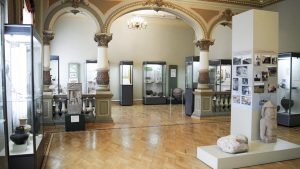
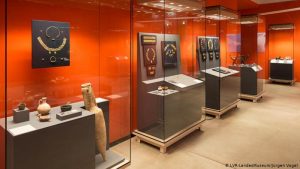
The museum’s collection includes more than 160,000 ancient artifacts. Among them are true precious relics: the legendary Scythian gold and a unique numismatic collection preserved in the so-called Golden Chamber. Visitors can see rare gold and silver coins, jewelry from Scythian and Sarmatian burial mounds, medieval graves of nomadic peoples, and works created by Slavic craftsmen. Although “ancient gold rarely shines,” thanks to the careful work of restorers these treasures are presented in all their brilliance.
Artifacts obtained during excavations in Olbia, Chersonesus, Panticapaeum, Tyra, and other ancient Greek colonies of the Black Sea region date from the sixth to the first centuries before Christ.
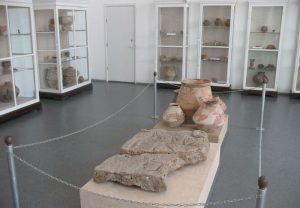
Visitors to the Odesa Archaeological Museum are also drawn to its extensive collection of classical antiquities. The museum’s Cypriot collection is one of the largest in Eastern Europe and the only one of its kind in Ukraine. The collection of exceptionally beautiful Greek ceramic vessels was donated to the museum by the Vorontsov governor’s family.
The museum also preserves the largest collection of antiquities from the northern Black Sea region. The material evidence of distant historical epochs—from the cultures of the Scythians, Sarmatians, and early Slavic peoples—is particularly fascinating.
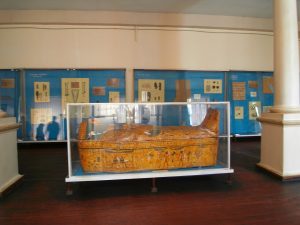
Another unique feature of the Odesa museum is its collection of monuments from Ancient Egypt, which is the third most significant such collection in the former Union of Soviet Socialist Republics and the only one in Ukraine. It includes sarcophagi decorated with intricate patterns, funerary equipment, stone slabs, fragments of papyrus with hieroglyphic inscriptions, and even mummies.
Out of approximately 50,000 coins preserved in the museum, the rarest examples of gold and silver are displayed—coins minted in Ancient Greece, Rome, and Byzantium. The later numismatic section presents coins ranging from the zlatnik of Prince Volodymyr to the coinage of the last Russian emperors, as well as commemorative medals.
The jewel of the museum’s collection is a treasure hoard of electrum coins—an alloy of gold and silver—dating from the sixth century before Christ, discovered in the village of Orlivka in the Odesa region. These coins originated from the city of Cyzicus, known as the “minting center” of the ancient cities of the northern Black Sea region. This hoard is the second largest discovery of its kind in the world and possesses enormous historical value.
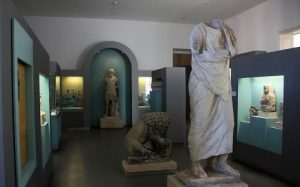
Conveniently located near Primorsky Boulevard and the Opera House, the Archaeological Museum attracts both adults and children. It is easy to find: in front of the classical building with its columns stands the sculpture “Laocoön.” This is a copy of the famous ancient Greek composition whose original is preserved in the Vatican Museums.
Since the beginning of the active phase of the Russian-Ukrainian war, almost the entire museum collection has been evacuated for safety. Since 2022 the museum has remained temporarily closed to visitors.

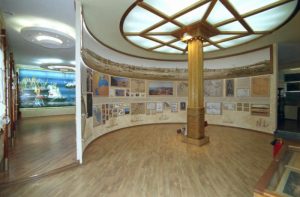
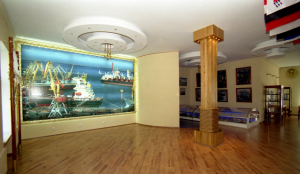
The Museum of the Odesa Port named in honor of Franz De Volan was founded on 10 April 1990 and opened to visitors on the occasion of the two-hundredth anniversary of Odesa. It is located in one of the historic buildings on Langeron Descent which, before the Revolution, housed the so-called “barjanes”—night shelters for homeless dock workers.
The principal purpose of establishing this museum was educational activity and the creation of an exhibition that would inform visitors about the past and present of the Odesa Port, which is inseparably connected with the history of the city.
The museum’s extensive collection was initiated by its founder and first director, Mykola Hleb-Koshansky, a career officer and participant in what was then known as the Great Patriotic War (the term used in the former Union of Soviet Socialist Republics for the Eastern Front of the Second World War from 1941 to 1945). He followed a combat path from Kharkiv to Stalingrad and later to the walls of Berlin.
Within only a few years, the museum became a unique center reflecting the history of the country’s principal port which, like all ports of Ukraine, has deep historical roots. At the same time, its exhibition reveals the thousand-year history of Odesa and the entire Northern Black Sea region, placing it on a level with other major museums of the city.
Museum Exhibition
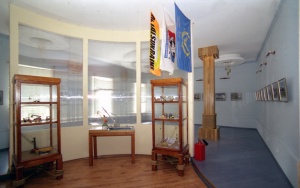
Today the museum exhibition consists of five halls with a total area of 490 square meters. The exhibition presents the many facets of port activity. Visitors can see rare archaeological discoveries, diagrams, maps, and old engravings that tell about the life, customs, and culture of the peoples who inhabited the Northern Black Sea region during Antiquity and in later periods, about the complex history of the region, and about the founding of Odesa and its development.
The third hall alone presents around five hundred exhibits and copies of unique documents. Most of them are little known to the general public because they are preserved in the collections of museums in other cities, in archival repositories, or in private collections. Paintings and graphic works by artists of earlier periods are also displayed, including works by Ivan Aivazovsky, Maxim Vorobyov, and others. Today any visitor can come here and imagine what this land looked like in the past and how ancient cities and settlements once appeared.
The museum also displays objects discovered by the staff of the Archaeological Museum during excavations in Luzanivka, on Primorsky Boulevard, and beneath Chersonesus. Archaeological excavations continue near Bilhorod-Dnistrovskyi, in the village of Roksolany. In the village of Koshary, near the Tylihul Estuary, remains of the ancient settlement Odessos were discovered—the settlement whose name later inspired the name of the modern city.
A unique map is also displayed here, illustrating what the area surrounding the Odesa Bay looked like in ancient times. The Kuyalnyk and Khadzhibey estuaries were once freely connected with the sea and served as harbors for ancient Greek sailors. Over time these estuaries became filled with sand, and the area where Turkish ships once anchored later became the site of the modern port. A view of Khadzhibey during the period of Ottoman rule is depicted in a painting by the artist Grigory Ladyzhensky.
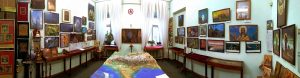
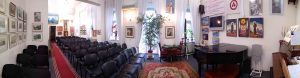
The Odesa House-Museum named after Nicholas Roerich was opened on 10 March 2000 with the status of a public organization. Its founders were the Odesa Committee of the Roerich Pact for Culture and Peace—a public organization that at the time of the museum’s creation was celebrating its tenth anniversary—and the South Ukrainian Charitable Foundation named after Nicholas Roerich. The principal mission of the museum is the scholarly study and comprehensive dissemination of the creative legacy of the entire Roerich family: the world-renowned painter Nicholas Roerich (1874–1947), the philosopher Helena Roerich (1879–1955), wife of Nicholas Roerich, and their sons—the orientalist scholar Yuri Roerich (1902–1963) and the painter Svetoslav Roerich (1904–1993). The museum’s activities are devoted primarily to the study of the Roerich family heritage. However, the principles for organizing and operating the museum were originally established by Nicholas Roerich himself when he founded the first Roerich Museum in New York. These principles encourage openness to broad cooperation with cultural figures and organizations throughout the world. The development of the museum was strongly influenced by the disciple of Nicholas Roerich, the painter and scholar Boris Smirnov-Rusetsky (1905–1993), as well as by the professor and Indologist Natalia Sazanova (1931–2006).
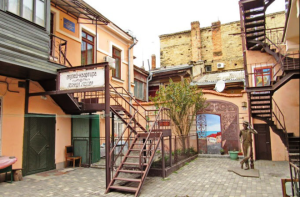
A museum has been opened in the house where the youth of the famous Odesa native Leonid Utyosov passed. This attraction is located in a small and cozy courtyard of building number 11 on Utyosov Lane. The idea of creating the museum first appeared more than twenty years ago, but for a long time it proved impossible to realize.
“Utyosov is the soul of Odesa. There is no other singer who performed so many songs about his native city. We waited a long time for a place where everything that formed part of Utyosov’s life and the people with whom he was connected could be shown. It is a major event”, noted Natalia Oliinyk, Chairwoman of the Association “House of Utyosov”.
The museum presents rare personal belongings that once belonged to Leonid Utyosov, along with numerous archival documents and photographs. Most of the exhibits come from the collection of a devoted admirer of Utyosov’s talent and former owner of the apartment, Eduard Amchinsky, who returned specially from the United States of America for the opening of the museum.
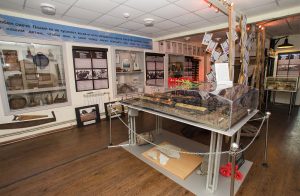
The “Steppe Ukraine” Museum is a branch of the Odesa Museum of History and Regional Studies. It is located near the main exhibition building (4 Havanna Street), at 24a Lanzheronivska Street. The museum was established in 1925; however, after the end of the policy of “Ukrainization” in 1931, it was closed. The exhibition was reopened to the public only in 2006. Today, it presents the general history of southern Ukraine, the emergence and development of Odesa, and the historical figures who contributed to the development of the Odesa region.
To date, the museum has assembled more than 1,000 museum objects.
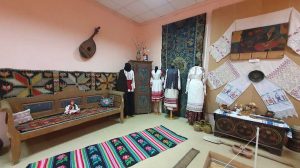
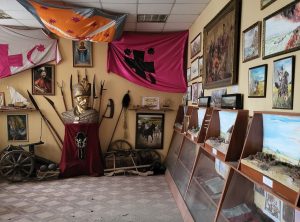
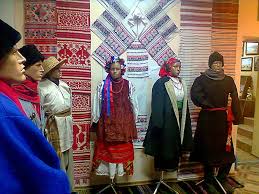
The museum’s exhibition area covers 120 square meters. A permanent exhibition is presented here, featuring dioramas, models of Cossack ships, sculptures, paintings, a collection of Cossack costumes, and temporary exhibitions dedicated to the history of Cossackdom.
Extensive scholarly and research work is conducted at the museum. Researchers study the history of settlements in the Odesa region, collect objects and documentary materials related to the history of the region, investigate the cultural traditions of the Cossacks, record examples of oral folklore, rituals, and songs, and carry out historical reconstructions of Cossack ceremonies (weddings, military send-off rituals, Cossack games, and others) and traditional celebrations (Trinity, the Feast of the Protection of the Mother of God, Saint Andrew’s Day, Christmas, Christmas Eve, Maslenitsa, and many others). All of this creates a unique atmosphere and conveys the authentic spirit of the Cossack land.
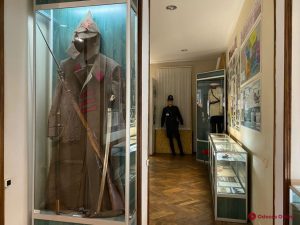
Together with the cultural and educational center “Cossack Center” of the youth organization MGO “Black Sea District of the Zaporizhzhia Cossack Host” (MGO — International Public Organization), the museum organizes and co-organizes more than thirty cultural events in Odesa and the region. It actively cooperates with the Odesa Regional Humanitarian Center for Education and Extracurricular Training, the Faculty of History of Odesa I. I. Mechnikov National University, the Odesa Museum of Local History, the Departments of Culture of the Odesa City Council and the Odesa Regional State Administration, the I. Honchar Museum in Kyiv, and other institutions.

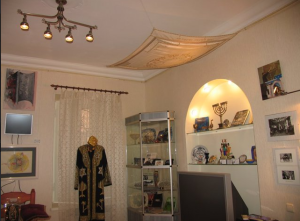
The Odesa Jewish History Museum opened in November 2002 at 66 Nizhynska Street, established by the Odesa Jewish Community Center “Migdal.” Every year, thousands of visitors come to the museum, where hundreds of guided excursions are conducted. The museum plays a coordinating role in the study of Jewish history.
Most of the objects in the museum are donations. Among the donors are many well-known figures of local culture, representatives of Jewish organizations, and ordinary residents of Odesa, including those who still cherish their love for their native city while living today in the United States, Israel, Australia, Germany, and other countries.

The “Filiki Eteria” Museum (“Society of Friends” in Greek) has been operating in Odesa since 1979, initially as a section of the city’s Historical and Ethnographic Museum. In September 1994, during the celebrations marking the 200th anniversary of the founding of the city, the branch of the Greek Cultural Foundation (headquartered in Athens) was solemnly opened in the buildings located at Nos. 16–20 Krasnyi Lane./span>
These buildings were granted to the branch by the city municipality on favorable terms, and since that time they have housed the “Filiki Eteria” Museum. This is its historic location. In the past, these buildings belonged to Greeks, and it was here that in 1814 the secret patriotic organization “Filiki Eteria” was founded. The society prepared the Greek people for the struggle for independence and forever linked the history of Odesa with the history of Greece’s national and state revival./span>
The museum was created by the Greek Cultural Foundation in cooperation with the Odesa Historical and Ethnographic Museum, which provided a number of exhibits dedicated to the history of Filiki Eteria, supplemented by exact copies of objects from museums in Greece, particularly from the ethnological and historical societies of Greece.

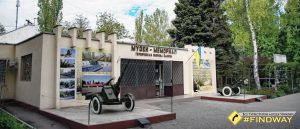
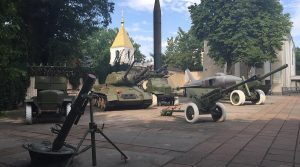
he Memorial of the Heroic Defense of Odesa was established in 1975, ahead of the 30th anniversary of the victory in the Second World War, on the site of the 411th Coastal Battery, which from August to October 1941 resisted the assault of Nazi forces on the southern outskirts of the city and was blown up during the retreat of Soviet troops.
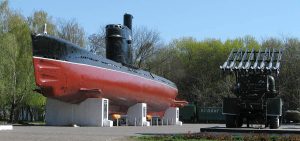
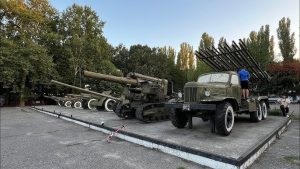
The museum exhibition consists primarily of documents and personal belongings of soldiers who participated in the defense of Odesa. Many of these items had already been presented in the first exhibition organized after the liberation of the city in 1944. In addition, more than one hundred examples of military equipment from the period 1941–1945 are displayed outdoors on the grounds of the memorial complex.
On the territory of the Memorial of the Heroic Defense of Odesa visitors can see:
• examples of artillery equipment, including coastal installations and anti-aircraft systems;
• tanks and aircraft;
• naval military equipment;
• examples of firearms;
• personal belongings of soldiers, archival documents, letters, and military maps.

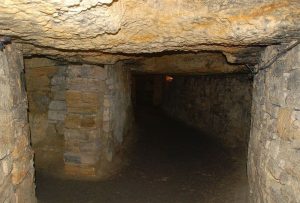
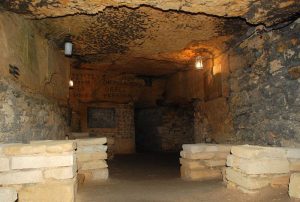
The only underground museum in Ukraine was established in 1969 in the oldest section of the catacombs of the Odesa region — the Nerubayske Catacombs. For several centuries, shell limestone was extracted here for the construction of Odesa, which is why the catacombs consist of three levels and extend 12–14 meters underground.
During the Second World War, the catacombs near the village of Nerubayske became the base of one of the largest partisan detachments in the region. The museum is dedicated to the partisan movement in the Odesa region and, in particular, to the fighters of the detachment led by Volodymyr Molodtsov-Badayev, Hero of the Soviet Union. For an entire year, seventy members of this detachment who remained in the Nerubayske catacombs carried out intensive sabotage and reconnaissance operations. The Romanian occupying forces eventually sealed the underground passages, and almost all of the partisans perished.
Today, the original camp of the so-called Badayev partisans, located two kilometers from the main entrance to the catacombs, is flooded with groundwater. However, thanks to archival documents and eyewitness testimony, enthusiasts from the historical search club “Poshuk” (“Search”) succeeded in reconstructing its original appearance.
At the Museum of Partisan Glory visitors can see:
• everyday items used by the partisans;
• examples of weapons and command equipment;
• archival documents, photographs, and personal belongings of Odesa partisans;
• examples of artistic works created by members of the Molodtsov-Badayev detachment.
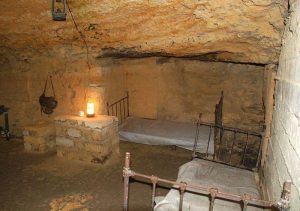
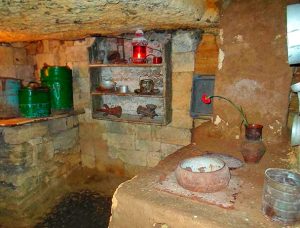
The exhibition of the Museum of Partisan Glory consists of both an underground and a surface section, with a total exhibition area of approximately 1,000 square meters. The underground section, located in a specially protected part of the catacombs, recreates a reconstructed partisan camp where visitors can learn about the living conditions and daily life of the Badayev fighters. According to eyewitness accounts, the detachment’s base included not only a bathhouse and kitchen but also a shooting gallery, headquarters, separate dormitories for men and women, a recreation room, and an armory.
One of the branches of the catacombs contains a memorial hall with a sculptural composition, as well as original graphic works created by the partisans themselves.
The above-ground part of the museum displays archival documents and photographs of members of the underground resistance in Odesa. This is the most comprehensive exhibition dedicated to the partisan movement in the Odesa region. It tells not only about the commanders of partisan detachments but also about heroic fighters such as the sniper Liudmyla Pavlychenko, the machine gunner Nina Onilova, and the young communist Yasha Hordiienko.
One of the museum panels is devoted to distinguished visitors to the Nerubayske catacombs, and among its unusual exhibits is a letter of appreciation from the Cuban leader Fidel Castro.

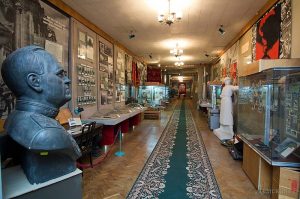
The Military History Museum of the Operational Command “South” is a military history museum in Odesa. Previously, it was known as the Museum of the History of the Odesa Military District, awarded the Order of the Red Banner. The museum was opened on 6 November 1967. In the early 1980s it underwent reconstruction and reopened to the public on 8 May 1985, on the eve of the 40th anniversary of Victory in the Second World War. The museum is located at 2 Pyrohovska Street.
Its collection contains documents and artifacts illustrating the history of military art from the mid-nineteenth century to the present day. The museum currently includes thirteen exhibition halls, whose displays are devoted to various stages of Russian, Soviet, and Ukrainian military history. Special attention is given to the period of the Second World War.
The exhibition hall dedicated to the Air Force of Ukraine has been steadily expanded since the dissolution of the Union of Soviet Socialist Republics (USSR). Near the museum there is an equipped observation площадка where thirteen units of military equipment are displayed, including examples from the Second World War and the post-war period.
During the period of martial law, the museum is not open to visitors.

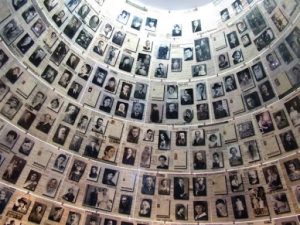
The Holocaust Museum was established in accordance with the decision of the Council of the Regional Association of Jews of Odesa — former prisoners of Nazi ghettos and concentration camps — and was officially opened on 22 June 2009.
“The main task of the museum is to collect, preserve, and pass on to future generations the history of this unprecedented tragedy; to safeguard the memory of those who suffered; and to educate a new generation of young people who, in the twenty-first century, will be able to resist fascism”.
In accordance with this mission and these objectives, the Holocaust Museum is based on the following principal thematic concept for its collections:
• the rise of fascism;
• the beginning of the Great Patriotic War (the term traditionally used in the former Soviet Union for the Eastern Front of the Second World War, 1941–1945);
• the defense of the city of Odesa;
• the occupation of the city of Odesa;
• the establishment of Transnistria;
• camps and ghettos in Transnistria;
• Jewish resistance in the occupied territories of Transnistria;
• sites of mass executions of Jews in Transnistria;
• the “Black Books” of remembrance of those who perished in the camps and ghettos of Transnistria;
• the liberation of Odesa and the liberation of prisoners from Transnistria;
• the Righteous Among the Nations;
• the Nuremberg Tribunal (the International Military Tribunal held in Nuremberg after the Second World War to prosecute major Nazi war criminals);
• the Bucharest Trial;
• documents, memoirs, and personal belongings of former prisoners of Transnistria;
• prisoners of Transnistria who fought on the fronts of the Great Patriotic War.
The museum also carries out the following activities:
• public outreach related to the work of the Association of Jews — former prisoners of Nazi ghettos and concentration camps of the Odesa region;
• development of the library collections of the Holocaust Museum;
• scholarly research within the framework of the museum’s established objectives;
• guided tours and lecture programs for visitors to the Holocaust Museum;
• meetings between former prisoners who survived the Holocaust, those who were rescued, and their rescuers — the Righteous Among the Nations;
• cultural meetings and book presentations;
• screenings of thematic films;
• educational work with university students and school pupils;
• compilation of lists of the deceased and identification of sites of mass extermination of Jews during the Great Patriotic War in the territory of Transnistria;
• publication of the thematic bulletin “The Holocaust Museum Tells”.

The initiator, driving force, and organizer of the work to establish the museum was the public activist, historian, lawyer, Candidate of Philosophical Sciences (a postgraduate academic degree equivalent to a doctorate in philosophy), Honored Worker of Culture of Ukraine, and Chairman of the Council of the Non-Governmental Organization “Odesa Holocaust Studies Center,” Pavlo Kozlenko, together with his team.
“…From one panel to another… Every step brings not only pain and despair, but above all understanding… As if providing an answer to another difficult question: ‘How—how could this have happened?’…”
From a review of the new museum by Serhii Hutsaliuk, Director of the Southern Interregional Department of the Ukrainian Institute of National Memory:
“In Odesa, thanks to committed and responsible people, the Genocide Museum ‘Territory of Memory’ was opened. The exhibition reflects crimes committed against the peoples who form part of the modern Ukrainian political nation, which is fighting for the independence of Ukraine. Among the exhibition panels are the Holodomor of the Ukrainian people, the deportation of the kirimli (Crimean Tatars), the Holocaust of Jews and Roma, the Armenian genocide, and the genocide of Ukrainians carried out by Putin’s Russia in our time”.
Pavlo Kozlenko and his team have carried out an extremely important task for our society. I highly value and take pride in the cooperation and collaboration with these people since the establishment of the Southern Interregional Department of the Ukrainian Institute of National Memory. My respect and deep gratitude to them…”

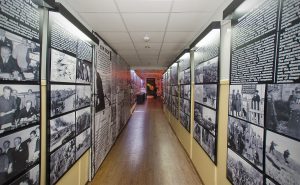
The Cinema Museum of the Odesa Branch of the National Union of Cinematographers of Ukraine is located on the grounds of the Odesa Film Studio, in a mansion that, before the Bolshevik seizure of power, belonged to Demidova-San Donato. The museum houses more than ten thousand items in its collection: materials documenting cinematic activity in Odesa from the invention of cinematography to the present day.
The exhibition accessible to visitors occupies only one hall of 28 square meters. It presents a wide range of exhibits — from the invention by the Odesa-born Yosef Tymchenko of the first device for filming and projecting moving images (two years before the Lumière brothers), through the earliest Odesa film studios such as Mirograf, Mizrakh, Borisov, Kharitonov, and others, to the work of the Odesa Artistic Film Studio up to 1941, when the Second World War began for the Soviet Union.
The remaining premises are filled with floor-to-ceiling shelves preserving rare objects, artifacts, and historical materials related to cinema in Odesa that, because of limited exhibition space, cannot yet be fully displayed to the public.
The museum provides individual research access passes for students working on topics related to film history and cultural development in Odesa. In recent years, a catalog of films produced in Odesa between 1917 and 2004 has been compiled, with illustrations and descriptions. The museum is highly valued by historians and by visitors interested in the history of cinema.

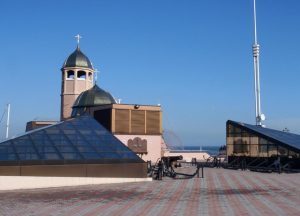
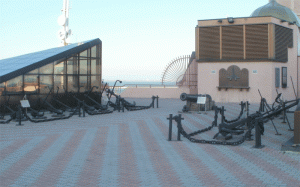
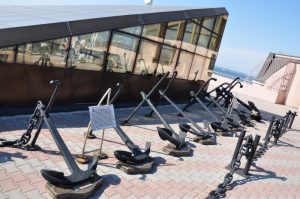
The exhibition of the Open-Air Anchor Museum is located on the seafront pier, behind the building of the marine terminal and the Odesa Hotel, opposite Saint Nicholas Church and near the Odesa Yacht Club. Previously, most of the anchors were housed in the Museum of the Merchant Marine Fleet (which was damaged by fire several years ago), but in 2007 they quite literally “dropped anchor” in their new location. Over time, the exhibition has been expanded with additional anchors discovered by enthusiasts near Odesa, Zatoka, and Berdiansk.
A specialist will immediately notice the diversity of anchors displayed in the exhibition: grapnel anchors with different numbers of flukes — three, four, and five; pivoting anchors forged from a single piece of iron; the Matrosov anchor, the Admiralty-pattern anchor, the Hall anchor, and others.
An interesting detail: the coat of arms of Odesa features a four-fluked grapnel anchor.
Ordinary visitors can navigate the exhibition thanks to explanatory plaques, and on weekdays during daytime hours, curious “guides” — loudspeakers installed on site — provide additional commentary.
It is interesting to know that grapnel anchors were used by the Vikings as boarding hooks, and that the first iron anchors replaced wooden ones in the Mediterranean as early as the seventh century BCE.
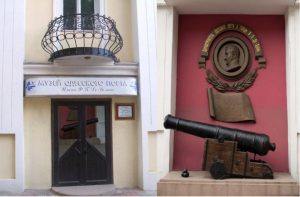
During the reconstruction of the Odesa port warehouses in that same year, 2007, when the anchor museum was established, this cannon was discovered. It is one of four cannons from the sixth artillery battery under the command of Ensign Oleksandr Shcheholiev. During the military operations of 1854 against Anglo-French forces, this battery repelled an attack by the enemy squadron during the bombardment of the city.
During martial law, the museum is not open to visitors.

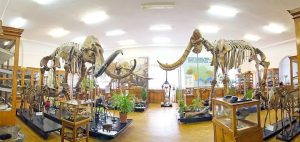
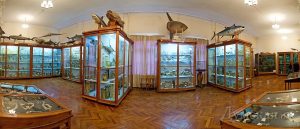
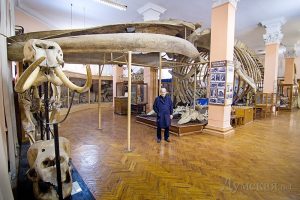
The Zoological Museum of Odesa I. I. Mechnikov National University is one of the oldest museums in Ukraine. At the opening of the Imperial Novorossiysk University in Odesa on 1 (13) May 1865, the basis of its exhibition and collections consisted of the unique collections of Professor Alexander Nordmann, transferred by him to the Richelieu Lyceum in 1849.
The first curator of the zoological museum of Imperial Novorossiysk University from 1865 to 1869 was Professor Ivan Markusen. He not only resumed the study of local fauna, especially marine fauna, but also actively promoted the acquisition of new specimens for the museum. In 1865 he acquired many representatives of different systematic groups of invertebrates, as well as taxidermied mammals. Between 1867 and 1868, on Professor Markusen’s initiative, valuable collections of exotic birds and fish were purchased.
Professors Ilya Mechnikov, Oleksandr Kovalevskyi, Nikolai Bernstein, and others also made significant contributions to the development of the museum.
The museum’s exhibitions and collections are used by students in preparing coursework and degree theses, and they serve to reinforce knowledge acquired during academic classes. In addition to educational activities, the museum organizes guided tours for schoolchildren, visitors from health resorts, and participants in academic competitions. The annual number of visitors reaches approximately ten thousand.
Today, the Zoological Museum is a structural unit of the Faculty of Biology, serving as both a scientific and educational base. It occupies three exhibition halls with a total area of 1,200 square meters. Its collection contains 56,000 stored items, of which 7,500 are on public display.

On 23 November 1999, the Academic Council of the Institute adopted a decision to perpetuate the memory of the founder and first director of the Institute. A new plaque appeared on the pediment of the Institute building: “V. Filatov Research Institute of Eye Diseases and Tissue Therapy”, and in his former office the Memorial Study-Museum of Academician V. Filatov was recreated, where everything has been preserved to this day exactly as it was during the scientist’s lifetime…
Today, the “Academician V. Filatov Museum and Exhibition Complex” includes the Memorial Study-Museum, the memorial House-Museum at 53 French Boulevard — the house where Academician Volodymyr Filatov lived — and the museum located on the second floor of the laboratory building.
The complex presents exhibitions devoted to the life and work of the outstanding ophthalmologist, Academician Filatov, as well as to the development of the Odesa school of ophthalmology and ophthalmic science in general. The exhibition includes unique photographs, manuscripts, letters, rare editions, personal belongings, and photographic materials from the Filatov family archive. In the exhibition hall, visitors can also see restored examples of his artistic work and his literary heritage.

The museum was opened on 5 November 1980 within the structure of the Department of Internal Affairs (today the Main Directorate of the Ministry of Internal Affairs of Ukraine in Odesa Region).
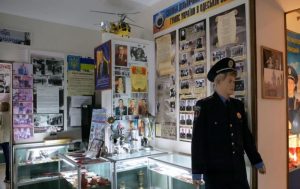
Its exhibitions present the history of the internal affairs bodies from their establishment to the present day. Among the exhibits are weapons confiscated from criminal gangs, firearms and militia uniforms from the period of the Civil War, photographs and documents related to the first officers of Odesa criminal investigation, archival documents, and personal belongings of staff members. Also on display is the taxidermied body of a service dog named Rim, who contributed to solving more than 200 crimes and assisted in the detention of 526 offenders. The museum also preserves documents related to former officers of the Odesa criminal investigation service who later became well-known writers: Yevhen Kataiev (Petrov) and Oleksandr Kozachynskyi. In total, the museum houses 7,637 items.
The museum is located in the former income-producing apartment building of Anatra, constructed in 1892 by architect Oleksandr Bernardazzi. Between 1909 and 1915, the cellist, music teacher, and professor E. F. Brambilla lived and worked in this building.

he museum operates on the basis of Fire Station No. 3, where for twenty years a fire-technical exhibition had previously been displayed. Among the exhibits are a horse-drawn water tanker, a nineteenth-century manual fire pump, models of historical and modern equipment, authentic firefighting apparatus, and archival photographs. In the memorial hall dedicated to the Chornobyl disaster, a diorama entitled “Explosion at the Fourth Power Unit of the Chornobyl Nuclear Power Plant” has been installed.

In 1985, the Museum of the History of the Odesa Railway was opened on the basis of preserved historical artifacts.
According to information provided by the company’s press service, the museum’s collection currently contains approximately 1,200 historically valuable items, including old archival documents, maps, photographs, various awards, railway tools, corporate uniforms from previous years, and other valuable objects representing important spiritual and material heritage.
The search for documentary and historical materials and the expansion of the museum’s collection remain an ongoing process.

The municipal enterprise Odesmiskelektrotrans is one of the oldest transport enterprises in Ukraine.
Its history began in 1880, when the Belgian Odesa Horse Railway Company started the construction and operation of horse-drawn, and later steam-powered, tramcars. For more than thirty years, horse trams operated along the streets of Odesa. The total length of the tracks reached 47.3 versts (an old East European unit of distance equal to approximately 1.07 kilometers per verst). Only on 24 September 1910 did Odesa launch its first electric tram service.
On 7 November 1945, the trolleybus service in Odesa was officially inaugurated. In fact, the first line had already been built in 1941, but its opening was prevented by the war. The Romanian occupying authorities removed all the equipment prepared for launching the first section of the network, including 10 new YTB-4 trolleybuses manufactured at the Yaroslavl Automobile Plant. Only in 1944, after the liberation of the city, did the equipment stolen during the occupation begin to return to Odesa. However, instead of new trolleybuses, what arrived were damaged bodies that had been destroyed in Romania — broken, burned, and stripped of components…

In September 2010, the company AVK opened its first Chocolate Museum in Cherkasy. The museum concept was received so enthusiastically by visitors that from 2011 onward similar museums began opening in many cities across Ukraine. Visitors are offered not only an educational guided tour and chocolate-made exhibits, but also a tasting of products created by master chocolatiers.
The Chocolate Museum in Odesa tells the story of chocolate, presents a rich and fascinating collection of souvenirs and gifts, features an impressive exhibition of chocolate figures, and also invites visitors to taste chocolates and confectionery.

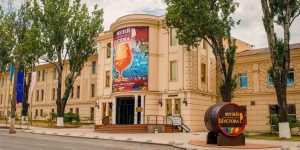
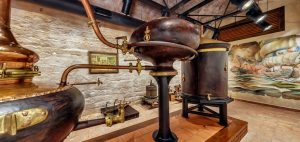
Cognac is, without doubt, a divine drink. For almost four centuries, its production has remained surrounded by numerous secrets. A grand legacy of generations… Knowledge carefully accumulated… Craftsmanship refined over years and centuries… All of this is hidden within cognac — a drink of history, a drink of legend — concealed from the uninitiated eye.
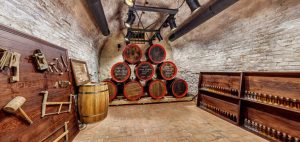
To uncover the mystery of how cognac is born, visitors are invited to the only Cognac Museum in Ukraine, named in honor of Mykola Shustov. It is located in the historic center of Odesa, in the former cellars of the Odesa Cognac Factory. The objects in its unique collection date from the late nineteenth and early twentieth centuries.
The Shustov Cognac Museum offers the following services:
• guided tours with tasting
• cinema hall rental
• art space rental
• tasting room rental
• cognac boutique
• souvenir products
• facilities adapted for visitors with disabilities
• Wi-Fi

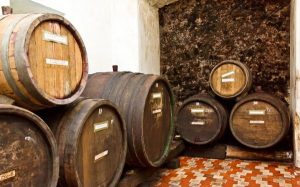
The V. Tairov Institute of Viticulture and Winemaking was founded in 1905 as an experimental estate called the Station of Russian Viticulturists and Winemakers. The initiator of its establishment was Vasyl Tairov, editor of the journal Herald of Winemaking and an enthusiastic promoter of viticultural culture.
At the initial stage, a small winery was equipped and a library was assembled. Between 1910 and 1912, construction of the station’s building complex on the shore of the Sukhyi Liman was completed, an experimental vineyard of three hectares was planted, and a grafting workshop was built.
In 1931, the station was reorganized into the Ukrainian Scientific Institute of Viticulture and Winemaking.
To mark its centenary, a Museum of Viticulture and Winemaking was opened, presenting the principal directions in the development of the national school of viticulture and winemaking.

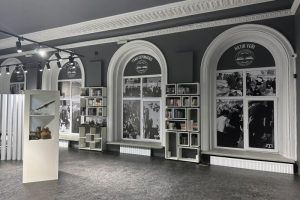
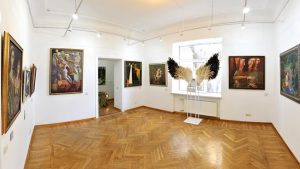
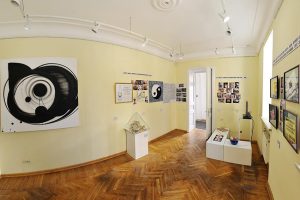
The museum was established in 2008 by entrepreneur, intellectual, and patron of the arts V. Morokhovskyi, on the basis of a unique collection of works by masters of the second wave of the Odesa avant-garde, assembled by the renowned collector M. Knobel.
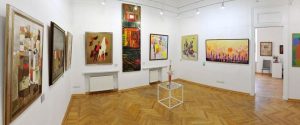
The Odesa Museum of Modern Art presents some of the finest works of Odesa visual art created at the turn of the twentieth and twenty-first centuries.
The pride of the museum lies in its halls devoted to unofficial Odesa art: the first Soviet abstract artist from Odesa, painter, poet, and dissident O. Sokolov; the famous fence exhibition by V. Khrushch and S. Sychev in 1967, considered the first unsanctioned art action in the Soviet Union; reconstructed apartment exhibitions of the nonconformists of the 1970s; the Odesa Conceptual Group of the 1980s; the South Russian trans-avant-garde of the 1980s and 1990s; and the contemporary dialogue between artist and city.
The section dedicated to the newest artistic movements demonstrates that visual art in Odesa continues to develop actively, as befits the cultural capital of Ukraine.
The museum includes an exhibition hall where contemporary art exhibitions, academic lectures, and various artistic projects are held. The Museum Aesthetic Club and the youth exhibition space “Arteria” are also open to visitors.
The museum’s permanent exhibition occupies two floors of a historic mansion that is recognized as an architectural monument.

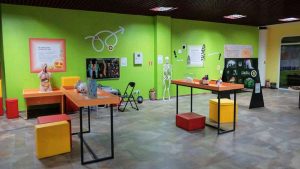
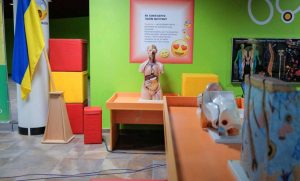
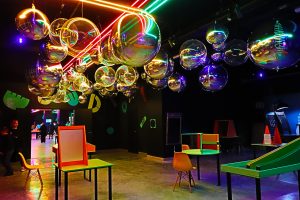
The Museum of Interesting Science is the first interactive science and entertainment museum in southern Ukraine, featuring a large number of unique exhibits from the world of science, each of which can truly be called fascinating and is certain to surprise visitors. Here, you can discover from a completely new perspective things that may once have seemed dull or difficult to study.
Unlike traditional museums, where valuable objects must not be touched, here touching is not only allowed — it is encouraged. Visitors can touch, test, and observe how scientific wonders emerge directly in their own hands. Both children and adults enjoy unusual and engaging experiments within the walls of the Museum of Interesting Science.
The museum’s main mission is to show schoolchildren and students the most exciting and astonishing aspects of science, encouraging them to deepen their knowledge in everyday learning. The museum demonstrates that even the most difficult tasks and the longest formulas can become interesting when viewed from another angle.
The Museum of Interesting Science introduces adults and children to scientific disciplines such as physics, chemistry, biology, geology, astronomy, mathematics, and many others through:
• a laboratory where electric shows, illusion performances, and the museum’s unique “Bubbleology” show are held;
• a planetarium with educational space sessions every hour;
• an auditorium where debate club meetings, evenings with notable guests, lectures on science, art, psychology, and philosophy, as well as scientific screenings take place;
• escape rooms organized for celebrations and events, helping participants improve their knowledge in an entertaining way.
Touching lightning, creating a real cloud, building a pedestrian bridge without nails or fasteners, observing fascinating optical illusions, and listening to astonishing acoustic effects — all this and much more can be experienced only at the Museum of Interesting Science.
Visitors may explore independently or together with guides, who are always ready to assist with exhibits and explain the most interesting scientific facts.
In addition to the museum’s extensive exhibition, there is a cozy café where visitors can relax and have a snack after their scientific discoveries, as well as a small shop offering educational books, intellectual games, and unique souvenirs.
The Museum of Interesting Science is a place where both children and adults joyfully immerse themselves in the captivating and enchanting world of science — a place where nobody leaves without positive emotions, a good mood, and valuable knowledge.
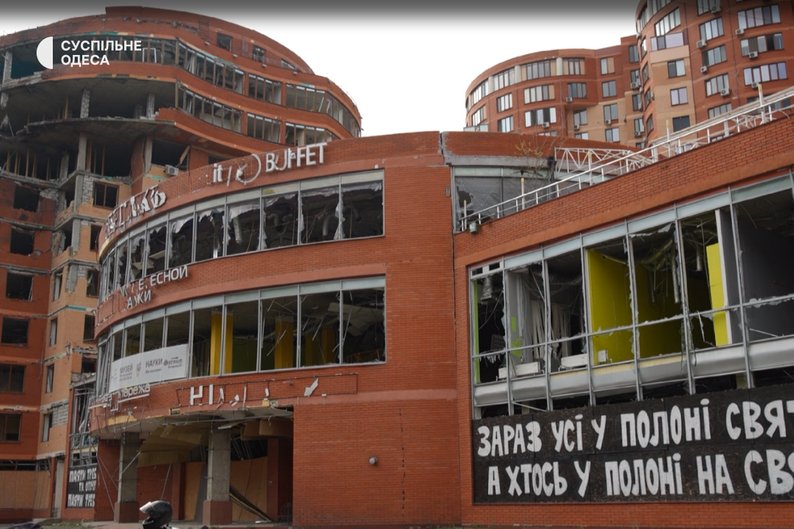
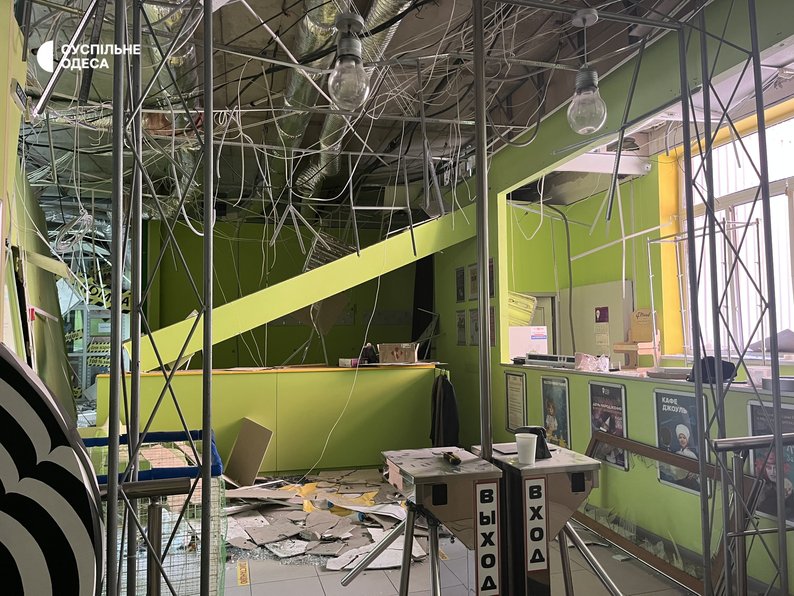
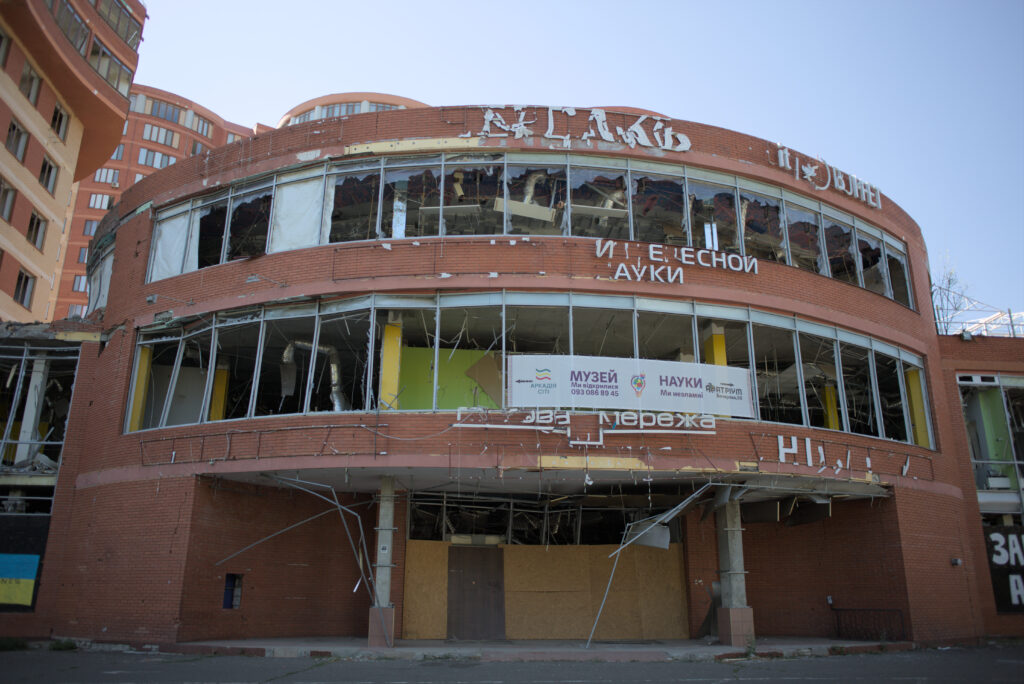
In 2022, the museum was completely destroyed by the Russian aggressor during another missile attack on the city.
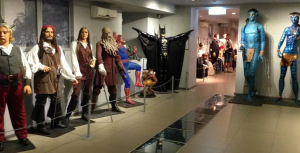
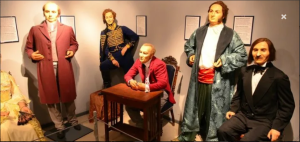
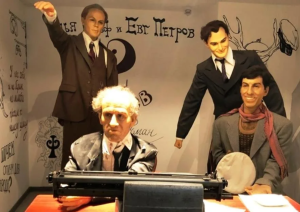
The history of this museum already spans more than ten years. It began with people who loved this city and created within it. Today the exhibition has been renewed and expanded, and visitors now have the opportunity to see not only historical figures, but also contemporary heroes from music, cinema, and animation.
The tour begins with an exhibition stand where visitors can not only observe but also touch the material from which the figures are made. Wax is a remarkable substance produced by bees. Humanity began working with it at the earliest stages of its history. People have always been drawn to the plasticity of this material and to the sensation of its unique “living” quality.
Since ancient times, wax has been associated with special and even magical meaning in the objects created from it. Its unique properties led ancient cultures to perceive it as a substance linking two worlds — the world of the living and the world of the dead.
The ancient Greeks created images of gods from wax as offerings or for religious ceremonies. Wax dolls were also made for children’s entertainment.
In Ancient Rome, plaster casts were taken from the faces of deceased nobles, from which wax masks were then cast. During funeral processions, these carefully painted masks were carried alongside the deceased. It was believed that such a mask granted spiritual strength to the departed, helping them safely reach the afterlife and protecting them from fear of evil spirits.
Today, highly qualified specialists from many professions take part in the creation of wax figures: art historians, historians, sculptors, mold-makers, wig specialists, makeup artists, decorators, and many others.

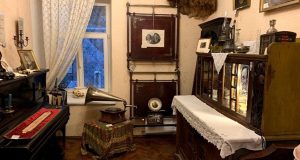
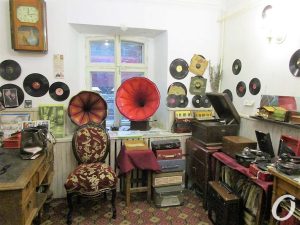
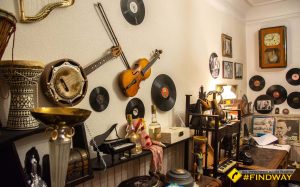
In this unusual museum, located in two small halls within the historic part of the city, history itself comes alive: here visitors encounter working devices for recording, reproducing, and transmitting sound.
The collection includes:
• mechanical music boxes;
• gramophones and record players;
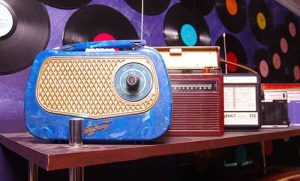
• radios with turntables;
• tape recorders;
• transistor radios;
• and many other sound devices.
Visitors can view a collection of gramophone records and vinyl discs, listen to rare recordings, and hear sound letters preserved on records, vinyl tapes, and wire recordings.
Especially interesting is the collection of accompanying historical materials: posters, placards, record labels, and logos of numerous sound recording companies and factories that succeeded one another over the course of an entire century.
The Museum of Sound also hosts:
• a live music club and musicians who perform there;
• a professional recording studio whose specialists help music lovers obtain exclusive and memorable audio souvenirs;
• a training center for young specialists — sound engineers and audio technicians.