Menu Close

Religious Buildings

Odesa has always been a city where the roads of different cultures, languages, and religions intersected. It is no coincidence that it is called the “southern pearl” — not only thanks to its architecture and the sea, but also due to the unique combination of spiritual traditions. Today, in 2025, Odesa preserves this diversity despite all the challenges of the time.
The religious map of Odesa resembles a colorful carpet, where ancient traditions are interwoven with modern quests. Here Orthodox and Catholics, Protestants and Jews, Muslims and Buddhists live side by side. Everyone finds their own place — whether in majestic cathedrals, in small prayer halls, or in personal reflections. Odesa remains a city where faith is an integral part of its multilayered cultural portrait.
In November 1992, the Odesa-Balta Diocesan Administration was registered with the state authorities.
The Odesa Diocese includes the city of Odesa together with the region. The Odesa Diocese borders the Vinnytsia Diocese and the Kropyvnytskyi Diocese, and in the east — the Mykolaiv Diocese. As of 01.01.2021, 48 clergymen serve in the parishes of the diocese.
The main church of the Odesa Diocese is the Cathedral of the Nativity of Christ in Odesa, which is an architectural monument and one of the oldest churches in the city.
The cathedral church of the Odesa Diocese of the Orthodox Church of Ukraine (until 2018 — UOC KP).
The church is part of the so-called Circular Building — the quarantine hospital of the Odesa port, built in 1804–1807 by Jean-François Thomas de Thomon. In 1814, a church was opened in the right wing of the hospital, where funeral services for the deceased were held. In the years of famine, it served as a shelter for destitute people.
During Soviet times, part of the church was occupied by a hospital. Only in the 1990s was the building returned and the church restored. Unfortunately, no documents have survived showing what it looked like before. The original wall paintings and iconostasis were destroyed, so the restoration of the church had to be carried out virtually from scratch: an altar was commissioned from masters in Zhytomyr, and the walls were repainted anew.
In 2013, the church received the status of a cathedral by order of the Patriarch of Kyiv and All Rus-Ukraine, Filaret. Since then, the Odesa Cathedral of the Nativity of Christ has become the central church of the Kyiv Patriarchate in Odesa region.
Although the construction of this shrine is still ongoing, it has already become a center of spiritual and social life. Regular services are held here, a Sunday school for children and adults operates, weddings and other rituals take place. The church preserves the Ukrainian Orthodox tradition and combines it with active community support.
A distinctive feature of this parish is the volunteer movement “Pokrova of Victory”, which operates at the church. This activity is continuous, as evidenced by publications on their Facebook page and the feedback of Odesa residents.
The Church of the Protection of the Most Holy Theotokos of the OCU is not only a spiritual shrine but also a space of service, solidarity, and mutual assistance.
Unnoticeably, among bushes and foliage in Tairova, stands the cozy Church of St. Seraphim of Sarov of the OCU. This is an Orthodox parish where parishioners value sincere spirituality and hospitality, and it is also visited by people from different parts of the city.
Inside, the church is small but atmospheric. Parishioners note that the atmosphere is warm, marked by simplicity, attentive care for guests, and compassion for those in need.
This church is an important point on the map of Odesa’s contemporary spirituality not because of the scale of the building, but because of the way it lives: through sermons, prayerful support, and a sense of community. For tourists interested in the modern life of the Orthodox community, it is worth visiting to see how faith in the city manifests itself in small things — in sincerity, in dialogue, in prayer.
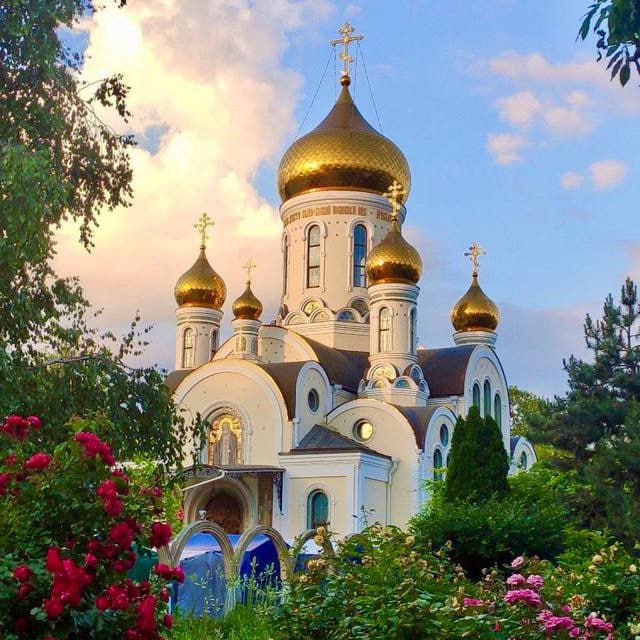
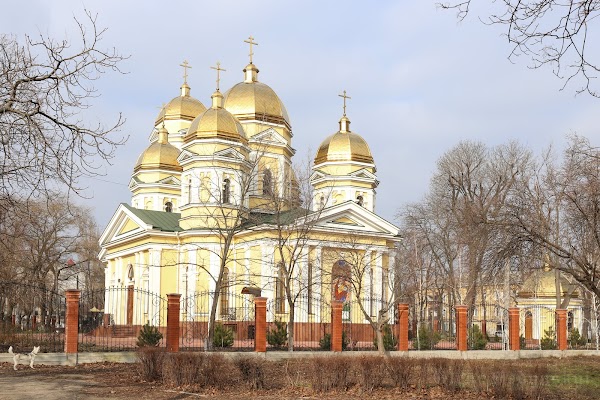
Amidst the greenery of the park stands the Holy Trinity Church, where anyone can come to pray or find peace of mind. Even before the Revolution of 1917, the Central Military Church of Odesa stood here. It was destroyed, and in its place the summer cinema “Sputnik” was built. Only after the collapse of the Soviet Union was the shrine revived: since 1997 prayers have once again been heard here. In front of the entrance stands a cross with the crucified Christ, reminding of faith and endurance.
Today the church is full of active life: not only are services conducted here, but refugees are received, aid is collected for the military, and repairs are carried out even during liturgies. However, the building, with an area of 880 square meters, can barely accommodate all the faithful. “After the victory, I believe we will begin the construction in full force,” says the rector, Father Vasyl.
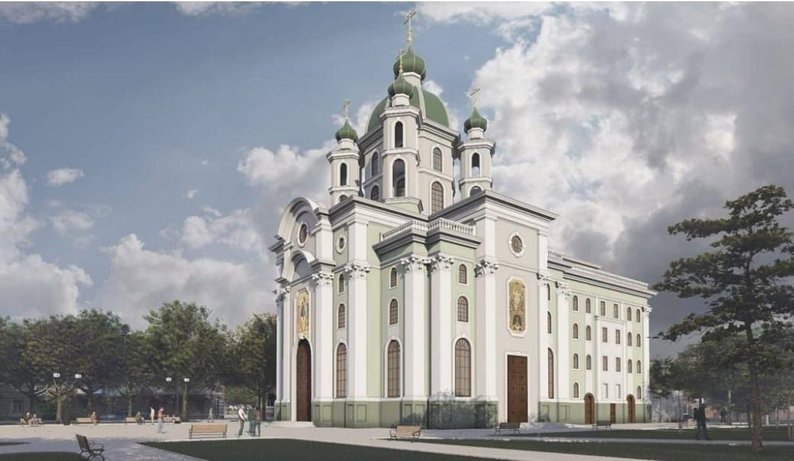
In 2025, the Odesa City Council made a historic decision — it granted permission for the allocation of a land plot for the construction of the cathedral of the Orthodox Church of Ukraine in Cosmonauts Park, where the Holy Trinity Church now stands. This project is already more than 25 years old: it was hindered by legal obstacles and the seizure of the land plot. Now, at last, the possibility for realization has opened.
The future church is envisioned not only as a place of prayer, but also as the administrative center of the diocese. According to preliminary sketches, it will be a majestic and modern building with a spacious square around it. Yet the greatest challenge lies ahead — securing funding. Whether the dream of the Odesa parish becomes a reality depends on the support of the community and benefactors.
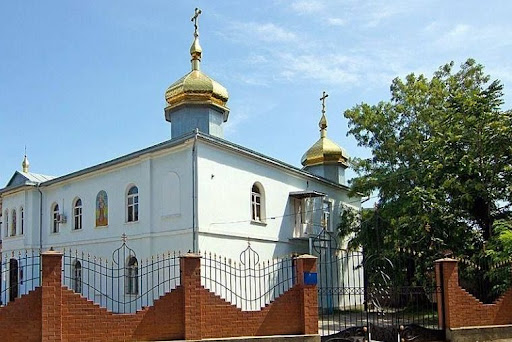
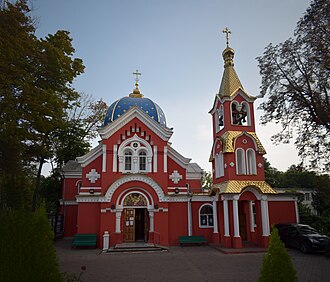
At the beginning of the 20th century, in Slobidka, near the hospital for the mentally ill, a small shrine was built — a church in honor of the Holy Great Martyr George the Victorious. With the arrival of Soviet power, its fate changed radically: within the walls of the shrine, an educational institution with the telling name “Liknep” (Elimination of Illiteracy) was established. After its closure in 1945, the building first served as a school, and from 1970 as the “House of the Young Technician.” When, in 1994, the children left the premises, the church fell into neglect and decline.
New life for the shrine began on June 11, 1999, when the city authorities leased it to the community of the Church of George the Victorious of the Ukrainian Orthodox Church of the Kyiv Patriarchate. Since then, step by step, spirituality has been revived here, and the ancient historical continuity restored.
Today the church functions as part of the Orthodox Church of Ukraine and continues to develop. The community is planning a large-scale reconstruction to restore the building’s original grandeur and to create proper conditions for worship.
Sacred Relics: the “Iveron” Icon of the Mother of God
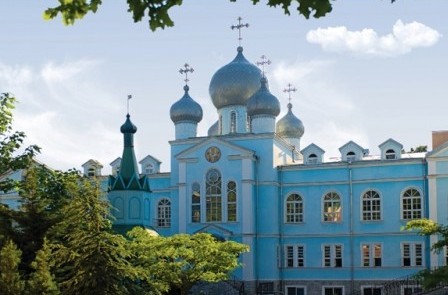
For 10 years now, the golden domes of the Holy Iveron Monastery have been shining near the “School Aerodrome” in Odesa. Once, in the steppe outskirts of Odesa, there was the women’s St. Michael’s Hermitage. The circumstances of its foundation have been erased from human memory over time. At the end of the 19th century, the Michael’s Hermitage was completely closed. Only the hermitage church remained active, where the few inhabitants of the surrounding hamlets gathered.
The history of the Holy Iveron Odesa Monastery, in its proper sense, begins in 1998. On May 19 of that year, a meeting of the Holy Synod of the Ukrainian Orthodox Church (Moscow Patriarchate) took place. At the meeting, the hierarchs decided to bless the opening of a new monastery in honor of the Iveron Icon of the Mother of God in Odesa.
At present, the monastery is developing intensively: major holy relics often visit the monastery, construction of a church in honor of St. Seraphim of Sarov is underway, a hotel for pilgrims has been built, and a Sunday school is functioning.
Sacred Relics: The Holy Shroud of the Lord Jesus Christ, The Icon of the Mother of God “The Nourisher”, Relics of Saint Gabriel of Athos
The monastery was founded in 1884 as a metochion of the Russian Athonite Elias Hermitage, intended to assist pilgrims traveling through Odesa to the Holy Land and Mount Athos. Here they were received, given shelter and lodging, helped with obtaining foreign passports, and assisted in purchasing steamship tickets. The flow of pilgrims grew, and with the blessing of His Eminence Archbishop Nikanor of Kherson and Odesa, the Holy Synod permitted the construction of a church and the expansion of the metochion’s territory. On November 10, 1894, the foundation of the church was laid. Two years later, on December 22, 1896, the church was consecrated. In 1994, the incorrupt relics of Saint Gabriel of Athos were discovered in the church.
Since 2004, major repair and restoration works have been actively carried out: in the altar, an icon of Christ Pantocrator was painted in the apse, as well as icons of other saints in the church. The monastery treasury is being replenished with new vestments, liturgical vessels are being acquired, icon cases are being renewed and gilded, and icons are being restored. The domes are under restoration, reconstruction and repairs of the brotherhood buildings and diocesan administration (which has been located at the monastery since 1997) continue. The monastic library is constantly replenished with new literature and periodicals.
At present, the Sunday school holds classes for children aged 3 to 17. The monastery also has a youth club “Orthodox Generation,” where members study the Holy Scriptures, hold discussions on current topics, watch intellectual films, and study Church Slavonic.
Sacred Relics: The miraculous relics of Saint Kuksha of Odesa, Relics of the Apostle Andrew the First-Called, The Icon of the Mother of God “Galaktotrophousa” (Milk-Giver), brought from Mount Athos, The Icon “The Appearance of the Mother of God to Saint Sergius of Radonezh”.
In the early 19th century, in the estate of the wealthy Moldavian landowner Alexander Teutul on the edge of a slope above the sea, a fire was lit in the evening. A small Greek vessel approaching Odesa mistook the flames for the light of a lighthouse, strayed off course, and ran aground. Several people perished.
In 1813, Alexander Teutul donated his estate (two plots of 25 dessiatinas each) to the Russian Orthodox Church. Soon after, an estate of the Kishinev hierarch was established there, and later a regular monastery. A stone church in honor of the Dormition of the Most Holy Theotokos and a lighthouse were also built. On June 1, 1824, the monastery was ranked as second-class.
With the arrival of Soviet power, the monastery property, treasures, and relics were confiscated to aid the starving, and the church was blown up.
The revival of the monastery began in 1944, and in 1946 the Odesa Theological Seminary was opened there.
Sacred Relics: A portion of the relics of Saint Panteleimon the Great Martyr and Healer, The Icon of the Most Holy Theotokos “It Is Truly Meet”.
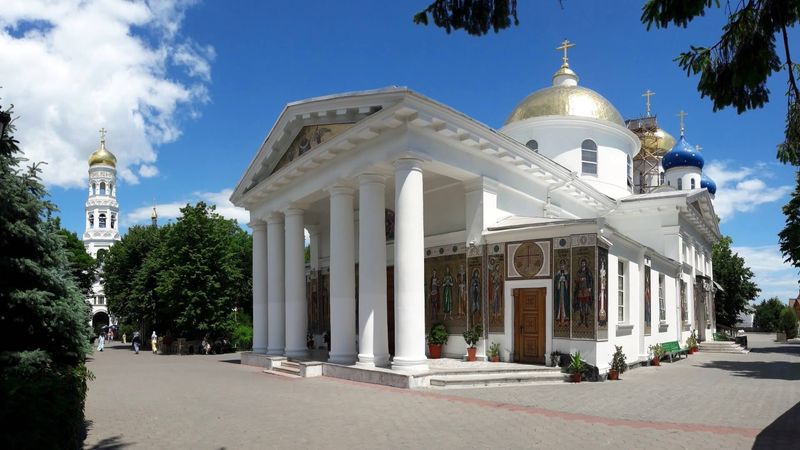
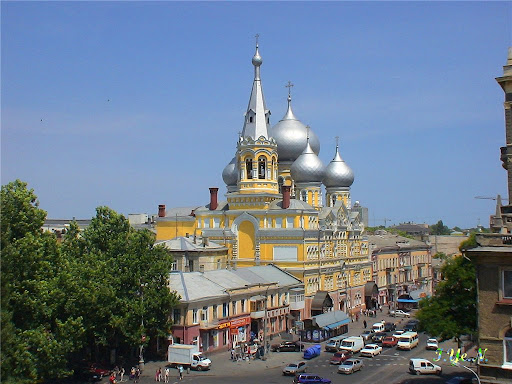
The Athonite metochion was founded in Odesa in 1876, as evidenced by numerous publications, including the 1883 “Guidebook” by E. Fesenko. The solemn consecration of the majestic five-domed three-story church took place before a large gathering of the faithful on December 28, 1895. The church was built of stone quarried from Mount Athos and brought to Odesa. From that time on, more than two thousand believers annually departed on pilgrimages from the metochion. The metochion provided significant assistance to each pilgrim: they were given lodging, food in the refectory, and assistance with necessary documents for the long journey. After the October Revolution of 1917, the Panteleimon Metochion, like the entire Church, entered a time of trials. In 1923, the church and the metochion were closed by the authorities. The church reopened during World War II, on June 15, 1943. Theological and pastoral courses were also opened, soon transformed into the Odesa Theological Seminary. However, the postwar period of theological and pastoral life of the Panteleimon Monastery proved short-lived. During the Khrushchev persecutions, in 1961, the church was closed again, and the seminary and brotherhood were transferred to the Holy Dormition Monastery in Odesa. Services at the Holy Panteleimon Church were resumed in 1990. In 1995, a men’s monastery was established here, and on August 15, 1995, after fifty years, monastic tonsure was once again performed. Diligent efforts to revive monastic life began. On December 8, 1996, Metropolitan Agafangel consecrated the main altar of the monastery in honor of Saint Panteleimon the Great Martyr and Healer.
Sacred Relics: The Miraculous Icon of the Herbolov Mother of God.
The Holy Archangel Michael Convent in Odesa has a 160-year history. It was established by notable figures of Odesa: Prince Mikhail Vorontsov and his wife Elizaveta Vorontsova, Countess R. Edling, philanthropist and writer A. Strudza, and others.
In 1835, Governor-General Count Mikhail Vorontsov built a church in honor of his heavenly patron, Archangel Michael, on wasteland near the sea on the outskirts of the city. In 1840, the Holy Synod decided to establish a women’s monastic convent at this church. The convent carried out significant charitable work: it ran a refectory for the poor, a hospital, and a school for orphaned girls.
In 1923, the convent was closed “as counterrevolutionary” for supporting Patriarch Tikhon and refusing to follow the Renovationist schism. In 1931, the Archangel Michael Cathedral and its bell tower were blown up.
During the occupation of Odesa in 1941, all churches in the city were reopened. On April 27, 1942, the premises of the convent were officially returned to the sisters. On September 3, 1944, the abbess, Mother Anatolia, was elevated to the rank of hegumeness. At that time, the convent housed more than 70 sisters. They worked in the convent hospital, at the mill, in the gardens, with livestock, baking prosphora, in workshops, and in the church.
In 1961, the convent was closed again by Soviet authorities, and its territory was handed over to the municipal tuberculosis hospital. The revival of the convent began in 1992. At that time, the monastery presented a miserable and desolate sight: the choir building lay in ruins, other buildings were half-destroyed, trees and grass grew through gaping holes in the rotting roofs. Signs of decades of neglect were everywhere. The convent rose from the ruins. Today, the convent has workshops for sewing vestments, producing church vessels, restoring icons, and embroidering with gold and beads. The convent runs a charitable refectory that feeds around 500 poor and needy people daily, providing assistance with love. On its territory, there is a House of Mercy, which shelters 80 destitute individuals.
The convent dedicates much effort to working with children, supporting kindergartens, schools, and the municipal boarding school for children with disabilities. Educational institutions of spiritual enlightenment are open: for people with disabilities, at a children’s sanatorium, and a Sunday school for parishioners. In addition to Sunday schools, educational work is carried out through a library, which contains many pre-revolutionary publications as well as modern editions.
The exhibition hall of the House of Mercy regularly hosts exhibitions and other cultural events. The convent also has a choir-conducting and gold embroidery department of the Odesa Theological Seminary, where female students from all over Ukraine study. The convent has two hermitages: the Nativity of the Theotokos Hermitage in Baranove village and the Ascension Hermitage in Odesa.
Sacred Relics: Relics of Saint Innocent (Borisov), Copy of the miraculous Icon of the Mother of God called Kasperovska, Copy of the miraculous Icon of the Mother of God called Iveron
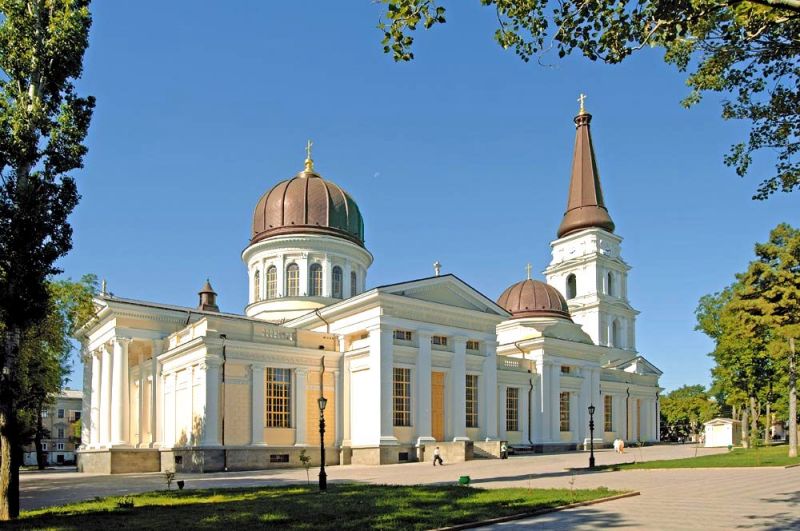
In August 1794, the solemn consecration of the city of Odesa took place, during which the site for the construction of a church in honor of Saint Nicholas the Wonderworker on Soborna Square was consecrated, and in 1795 the first stone was laid. The solemn consecration of the church took place on May 25, 1809. The church was built according to the design of engineer Vonrezant. In 1825 the project of the bell tower, developed by D. Frappolli, was approved, and in 1841 the architect D. Geidenreich designed the refectory part that united the bell tower and the old church. Partial reconstructions of the cathedral were carried out in the 1870s–1880s, and in 1894 a major renovation of the cathedral was carried out according to the design of architect L. Prokopovich.
In 1795 the construction of the church was financed by local landlords Ivanov and Schlegel, as well as by donations from the city authorities and from across the country.
On March 2, 1932, the Cathedral was closed by the authorities. In 1936, a powerful explosion completely destroyed first the bell tower and then the cathedral itself.
On April 23, 1999, by Resolution of the Cabinet of Ministers of Ukraine No. 700, the Odesa Transfiguration Cathedral on Soborna Square was included in the “Program for the Revival of Outstanding Lost Monuments of History and Culture of Ukraine”.
On September 5, 1999, the solemn consecration of the beginning of construction took place, and in the foundation of the cathedral a capsule was laid with a message to future generations of Odesa and the relics of Saint George the Victorious.
On January 6, 2005, the lower church of the Odesa Transfiguration Cathedral was consecrated in honor of Saint Innocent, the wonderworker of Odesa, with a solemn divine service…
El 5 de septiembre de 1999 se llevó a cabo la solemne consagración del inicio de las obras y la colocación en los cimientos de la catedral de una cápsula con un mensaje para las generaciones futuras de Odesa y con reliquias de San Jorge el Victorioso.
On June 21, 2010, the Primate of the Russian Orthodox Church Kirill Gundyaev consecrated the upper church of the Odesa Transfiguration Cathedral. At that time, Putin’s friend “proclaimed” to Ukrainians that “no grand walls and no large amount of gilding will save a person if he himself does not become a temple of God,” and that “it is better not to build temples at all if one does not live according to God’s laws.” And already in 2022 Patriarch Kirill blessed the Russian war against Ukraine and praised Russian invaders who went to fight against Ukrainians. In the speeches of Putin’s friend appeared phrases such as “victory over fascism,” “protection of the peoples of Rus’ from the West”, and other absurdities.
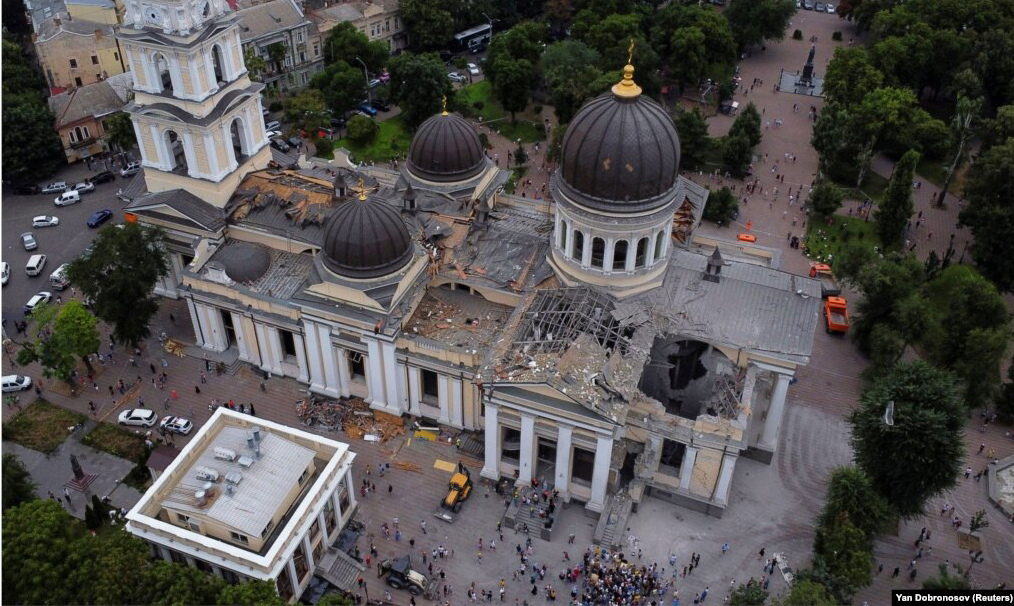
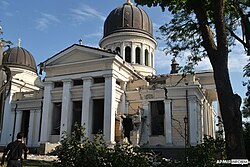
On the night of July 23, 2023, Russian occupiers shelled Odesa, heavily damaging the historic city center. As a result of the missile strike, the Transfiguration Cathedral also suffered significant damage. After the missile strike, a cleric of the Odesa Diocese of the UOC, Archdeacon Andrii Palchuk, recorded an emotional video in which he spoke about the destruction: “Russian beasts hit the cathedral that was built by all of Odesa. It hit directly into the altar, everything is destroyed into rubble. The cathedral is no more… Thank you, Russian brothers… Thank you, Your Holiness, for striking into the very heart of Metropolitan Agafangel. The Mother of God will not forgive you for this.” The Russians destroyed the ceilings of three lower floors, severely damaged the interior decoration and icons, and completely destroyed the service rooms of the lower part of the cathedral.
Sacred Relics: Miraculous Kasperovska Icon of the Mother of God, brought to Odesa for the first time in 1854 from the village Kasperov, Relics of the Righteous Jonah of Odesa
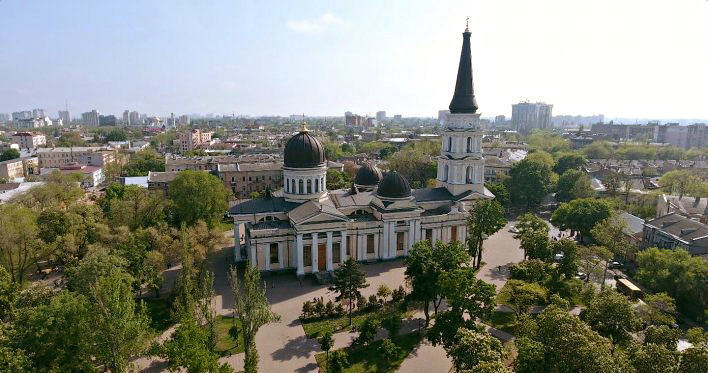
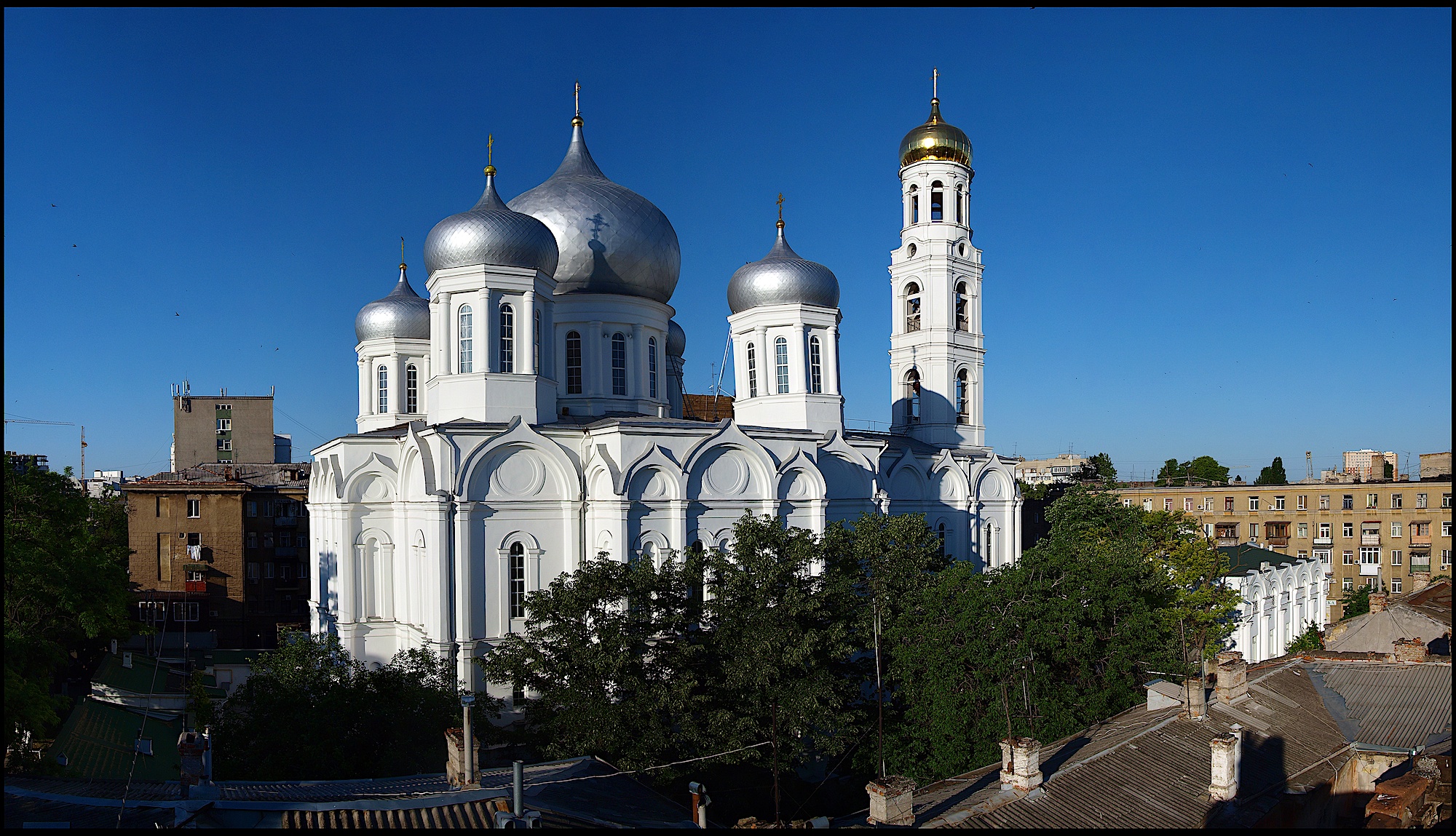
On the site of the modern cathedral, there was an Old Believers’ chapel, which was built and consecrated on July 7, 1814. In 1845, construction of a three-altar church began, and the current building was laid on July 17, 1855, by Archbishop Innocent (Borisov) of Kherson and Taurida. Funds for construction were provided by Odesa merchants Yakiv and Mykola Cherepennikov, and the project was developed by architect Louis Othon. Construction was completed in 1869, and on April 12 of the same year, the cathedral was consecrated by Archbishop Dimitry (Muretov) of Kherson and Odesa. On January 19, 1875, Archbishop Leonty of Kherson and Odesa consecrated the main altar of the lower Uniates’ church in the name of Saint Nicholas the Wonderworker — patron of sailors and travelers, and on January 30, he consecrated the second side altar in the name of the Three Holy Hierarchs: Basil the Great, Gregory the Theologian, and John Chrysostom. Later, residents of Moscow donated icons and liturgical items to the lower church of the Odesa Holy Assumption Cathedral.
At the end of the 1930s, under Soviet rule, the church was closed. During the German-Soviet war, the upper church was heavily damaged — a German bomb struck the central dome. The lower church was flooded with water up to 1.5 meters. In 1942, the Romanian authorities restored the functioning of the lower church, for which the water had to be pumped out over several days. After the end of hostilities, a significant role in restoring the cathedral was played by Archbishop Nikon, Metropolitan Boris, and Patriarch Alexy I Simansky.
In 2008, on the initiative and blessing of Metropolitan Agafangel of Odesa and Izmail, a major renovation of the building was carried out. The heating system was improved, and the cathedral was adorned with new wall paintings. The designers of the Upper Church paintings were Volodymyr Borisov and Rostyslav Antonov, while the artworks themselves were executed by artists Vitaliy and Danylo Khomnytsky. The Sunday school was also organized at this time. In 2010, the dome above the bell tower was gilded, and in 2012, the main dome was gilded.
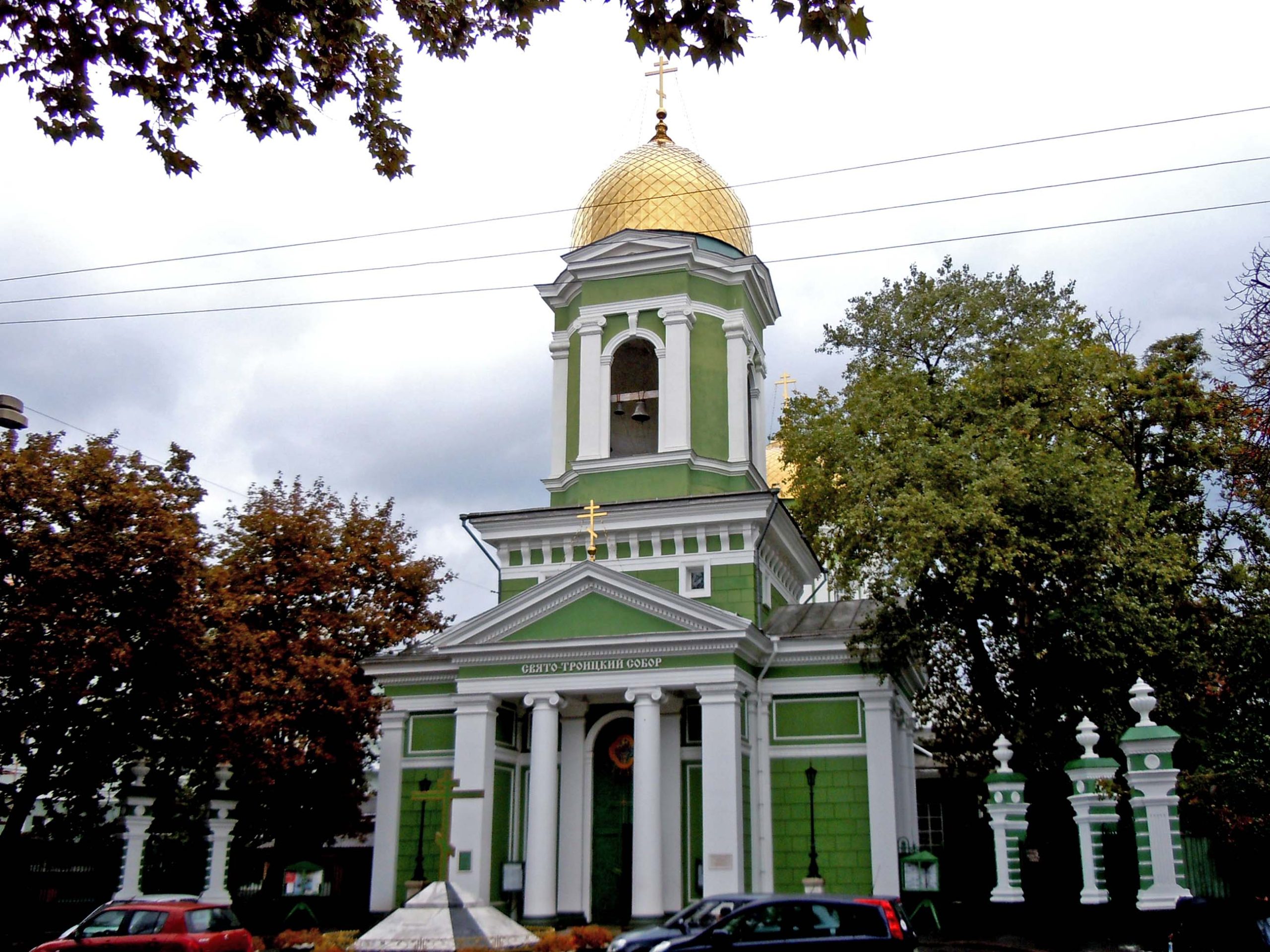
The foundation of the temple was laid in 1795 by Metropolitan Gavriil (Banulescu-Bodoni) of Katerynoslav and Taurida as one of four churches, intended for the Greek community of the city. Initially, it was a wooden church. On June 29, 1804, the solemn foundation of the stone church took place (Archbishop Athanasius of Novorossiysk). The project of the temple was developed by architect F. Frapolli. On May 28, 1808, the church was consecrated by Archbishop Platon of Katerynoslav and Taurida.
The first rector was Protopriest Ioann Rodes, who contributed to the church receiving two extensions, giving it a cruciform Byzantine-style shape with a single dome and a bell tower with a spire. In 1821, the remains of Patriarch Gregory V of Constantinople, executed by the Ottomans, were buried here; they were transferred to Athens in 1871. In 1997, a marble tombstone was consecrated in the northeastern corner of the church on the site where the saint’s relics had rested.
From 1900 to 1908, the church underwent reconstruction under architect A. Todorov.
Historical Names: 1808–1908 — Greek Trinity Church; 1908–1936 — Holy Trinity (Greek) Church; 1936–1941 — closed by Soviet authorities, used for grain storage (during this time the upper tier of the bell tower and dome were lost and were restored only in the 1990s); 1941–1956 — Holy Trinity Church (opened under Transnistrian authorities in the jurisdiction of the Romanian Church); 1956–1999 — Holy Trinity Church of the Alexandrian Compound; 1999–2006 — Holy Trinity Church of the Odesa Metropolia of the UOC (MP); Since January 4, 2006 — Holy Trinity Cathedral of the Odesa Metropolia of the UOC (MP)
In the same year, at the insistence of the Greek government, the word “(Greek)” was added to the plaque at the entrance. Since 2003, a Sunday school has operated at the church.
In 1979, the church was listed as an architectural monument of the Ukrainian SSR under state protection (No. 1459). In 2012, it was recognized as a national cultural heritage site, included in the State Register of Immovable Monuments of Ukraine (No. 150025-N).
In the 1880s, Odesa’s population exceeded 300,000. Residents of the Bliizhni Mlyny and Vorontsovka districts felt the need for a new church. In 1884, they petitioned Bishop Nikanor of Kherson and Odesa to construct a new temple. Initially, a temporary prayer house in the name of Saint Alexander Nevsky was established, serving residents of Bolharska, Malorosiiska, Khutorska, Syritska, and Stepova streets up to Kinna Square. The prayer house was located on Vygonna Street (now Zankovetska) at the site of the modern DSO “Lokomotiv.”. In spring 1885, parishioners requested a site for a permanent church. In September 1885, the plan for a church in the name of Saint Alexius, Man of God, was approved. The required amount for construction was 35,000 rubles. A significant contribution of 48,000 rubles was made by Colonel and prominent Odesa property owner I. S. Fedorovsky. The church was laid in 1887, and by mid-1888, construction was practically completed. The architect was A. D. Todorov. The three-altar church was built in the style of Classicism, with a beautiful iconostasis, stucco, and paintings in the Old Byzantine style. The church in honor of Saint Alexius was consecrated by Archbishop Nikanor on September 25, 1888.
With the advent of Soviet power, persecution of religion began, and Odesa churches were closed one after another. Holy Alexius Church functioned for another 15 years after the revolution. It was closed on March 20, 1932, and in 1936 the church was destroyed. Miraculously, a plaque commemorating benefactor I. S. Fedorovsky survived, as did the icon of Saint Alexius.
In 1942, during the Soviet-German war, the parish was restored at 15a Oleksiivska Square. The temporary church remained in operation until 1962, after which it was closed. The parish of Holy Alexius Church was restored in the 1990s, initially using premises of the venereology dispensary. In 2008, the church in honor of the Icon of the Mother of God “It is Truly Meet” was consecrated.
In spring 2001, a new church was laid on the site of the destroyed church in the center of Oleksiivska Square. The restored Holy Alexius Church was consecrated on September 15, 2013.
To perpetuate the memory of His Eminence Dmitry, Archbishop of Kherson and Odesa, the City Duma on February 20, 1884, resolved to construct, at the city’s expense, a church in the New Cemetery in the name of Saint Dmitry, Metropolitan of Rostov, whose feast day the Orthodox Church celebrates on September 21. This resolution also allocated 25,000 rubles for the construction of the church.
In June 1885, the commission responsible for the construction of the church signed a contract with the contractors—engineers Planovsky and Gainovsky—for the construction of the church according to the design of architect Georgy Dmitrenko. The laying of the church’s foundation and its consecration took place on July 14, 1885, in the presence of His Eminence Nikanor, Bishop of Kherson and Odesa.
The church building, executed in the Russian Yaroslavl style, featured many interesting architectural solutions. Construction proceeded quickly and continuously, and by June 11, 1887, the construction commission accepted the completed building. By the summer of 1888, the building was fully completed. The church majestically towered over the recently opened, in 1885, still almost empty New Cemetery. On October 1 (September 30), 1888, the consecration of the church, erected in memory of the late Archbishop of Kherson and Odesa Dmitry (Muretov), took place. The solemn consecration was performed by His Eminence Nikanor, Archbishop of Kherson and Odesa.
In 1936, the church was served by two hieromartyrs: Metropolitan Anatoly (Grisyuk) of Odesa and Archimandrite Gennady (Rebezo). The history of the church is also notable because it is the only Orthodox church in Odesa that was never closed, even during the Soviet era, thanks to the intervention of Academician Vladimir Filatov.
During the preparations for the city’s celebration day, Mayor Hryhoriy Marazli proposed to build, at his own expense, a church for the spiritual development of students of several city educational institutions. The location for the church was chosen on Staroporfankivska Street, in the alley between the city’s sixth-grade school and the Second Women’s Gymnasium. The church project was prepared by architect S. Landesman. The laying of the new church took place on August 9, 1894, and only on March 16, 1896, was the solemn consecration performed. The consecration of the church in the name of Saint Gregory the Theologian and the Holy Martyr Zoe (the names of Gregory Marazli’s parents) was performed by His Eminence Tikhon, Bishop of Elisavetgrad, in concelebration with Archbishop Justin of Kherson and Odesa.
In 1930, the church was closed by the Bolsheviks. However, during the Romanian occupation, some Odesa churches reopened, among them the Church of Gregory the Theologian and the Holy Martyr Zoe. In May 1961, the church was closed for the second time, after which its premises were handed over for use as a warehouse for the city’s bread plant.
On March 14, 1991, the church was returned to the Ukrainian Orthodox Church, after which it became part of the UOC MP. On February 6, 1994, it was reconsecrated after renovation by Metropolitan Agafangel of Odesa. In 2002, the church was painted by the Odesa iconographer S. Burda.
The cornerstone for the sacred building was laid in 1897, and the completed church was consecrated on October 31, 1900, by Archbishop Justin of Kherson and Odesa. Initially, its patrons were Saints Matthew and Eugenia. Among the possible authors of the church design are mentioned L. Wlodek and L. Prokopovich. The sacred object was established with funds from State Councillor Matviy Mavrokordato, who donated his nearby summer house for a school for the blind and decided to establish a small church within the institution. The cost of constructing the church amounted to 25,000 rubles.
Immediately after the October Revolution, when all summer houses on French Boulevard were expropriated, the church remained open. It was only closed in 1930, being repurposed as a club. The reopening of the sacred building occurred in 1942 when Odesa was under Romanian occupation. That year, the church was reconsecrated by the Pridnestrovian Metropolitan Visarion of the Romanian Orthodox Church, simultaneously giving the sacred object a new name in honor of Saints Victor and Visarion (his two patrons associated with his religious and secular name).
After World War II, by decision of Archbishop Nikon of Odesa, the building became the home church of the clergy of the diocese, who settled in the neighboring house. In 1957, the saints serving as patrons of the church were changed for the third time to Saints Paul and Natalia. Six years later, the church was closed again. Initially, it was turned into a museum of atheism, and later a cafeteria. The unrepaired church building gradually deteriorated. It was damaged several times by fires, and after one of them, the building was transferred to the Composers’ Union, which carried out reconstruction to create a chamber concert hall. However, it was not put into operation, because during the reconstruction process it was decided to restore its use for its intended purpose. On December 22, 1989, the church was consecrated for the third time, this time in the name of the Martyrs Adrian and Natalia. The consecration was performed by Metropolitan Leontiy of Odesa and Kherson. The adaptation of the building for religious purposes and interior additions took place under the guidance of the then abbot, Igumen Arkady (Taranov), parishioners, and monks of the Assumption of the Blessed Virgin Mary Monastery.
Special reverence in the church is given to the miracle-working icon of Saint Nicholas and the copies of the miracle-working icon of the Mother of God “Quick to Hear.” Both were painted in the Russian Monastery of St. Panteleimon on Mount Athos and transferred to the church by the Odesa Film Studio.
The parishioner of the church was the renowned academician V. P. Filatov.
The Roman Catholic Cathedral of Odesa, the main cathedral of the Odesa-Simferopol Diocese. It is designed to accommodate approximately 2,000 believers.
The construction of the church began in 1847 according to the design of architect Francesco Morandi. The project was further developed and completed by Polish architect Feliks Gonsiorowski, who finalized the building process.
The church was consecrated on August 16, 1853, by Bishop Ferdinand Kann. In honor of the consecration of the church, Doctor Renault presented an icon of the Mother of God — an original work by the famous 17th-century Florentine painter Carlo Dolci. In addition, Olga Potocka donated to the church a copy of Raphael’s painting “The Assumption of the Blessed Virgin Mary,” executed as an icon by the artist Fischer. According to the will of Mykhailo Mykulych, the cathedral received twelve marble statues of the Apostles of Italian craftsmanship, as well as four figures of the Evangelists. Pope Pius IX donated a marble baptismal font to the cathedral. The artists of Düsseldorf donated fourteen paintings of the Stations of the Cross in honor of the consecration of the church. The cathedral had 120 oak benches and six large bronze chandeliers. To the left of the entrance to the church hung an image of Saint Roch — the protector against epidemics, as well as a silver chandelier with the inscription in French “In memory of the plague of 1812,” in which an eternal flame burned.
In 1935 the communist authorities closed the cathedral and opened a Bulgarian-German club in it. Some valuable items were preserved because they were transferred to the Church of Saint Peter: the icon of the Assumption of the Blessed Virgin Mary, the fourteen paintings of the Stations of the Cross, the marble baptismal font, several rows of benches, and the confessional. At the beginning of the German-Soviet war, the Germans returned the cathedral to the Catholic community. But in 1949 it was again taken away from the people, the columns were demolished, the marble destroyed, several floors were built inside — the church was rebuilt into a sports hall.
In the 1980s–1990s a movement began for the return of the church to the community. On August 9, 1991, Father Prelate Tadeusz Hoppe received the keys to the church building. Since then, the church has been restored by the rectors of the cathedral — Fathers Ignacy Ryndzionka, Jan Dombal, and Viktor Shchavinsky. Memorial plaques were restored at the burial sites of O. Lanjeron and V. Lypskyi. In 2003 the icon of the Assumption of the Blessed Virgin Mary, the paintings of the Stations of the Cross, and the baptismal font were returned from the Church of St. Peter.
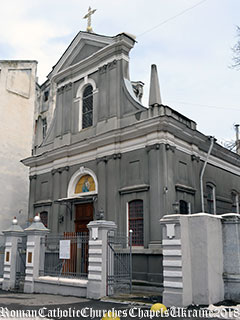
A Roman Catholic church in Odesa. For a long time, it existed as the only functioning Roman Catholic church in the city of Odesa and in the south of Ukraine. Since 2019 it has had the status of a minor basilica. The founder of the church was the descendants of the French Vassal family, who settled in Odesa at the end of the 18th century. One of the descendants of the Vassals — Petro Vassal — in 1911 purchased a plot of land on Havanna Street, where in 1912 he planned to build a concert hall according to the design of architect F. P. Nesturkh. However, he died before the construction could begin. His nephew and heir, Oleksandr Volodymyrovych Vassal, decided to build on the site of the planned concert hall a chapel in memory of Petro Vassal. In addition to him, significant funds for the construction were allocated by parishioners from noble families: the Ralli, the Frederiques, and others. The project of the church was developed by architect Arthur Gustavovich Lluix and civil engineer Karl Yakovych Mesner. The issue of construction was managed by Father Auguste Manillier, who personally conducted negotiations on the opening of the new parish with the Minister of Religions in St. Petersburg. On October 6, 1913, Bishop Josef Kessler of Tiraspol consecrated the newly built chapel in honor of the Holy Apostle Peter, in memory of Petro Vassal. Since that time, the church existed as a chapel for Catholic sailors (the church is located near the Odesa seaport). With the arrival of the Bolsheviks, religious persecution began. In the 1920s Father Auguste Manillier left Odesa, and Fathers Pietro Leone and Jean Nicolas were sentenced. Over the next thirteen years, all eight priests who remained in Odesa after the Civil War were repressed. In 1935 the Cathedral of the Assumption of the Blessed Virgin Mary was closed, and in 1936 the Cathedral of Saint Clement was blown up. Since then, the Church of St. Peter became the only Roman Catholic church not only for Odesa residents but also for Catholics throughout southern Ukraine.
In October 1941 German troops entered Odesa, and Odesa passed under Romanian administration. The Diocese of Tiraspol was restored with its cathedral in Odesa, and Bishop Mark Glaser, who had previously been rector of a church in Chisinau, became head of the diocese. The Cathedral of the Assumption of the Blessed Virgin Mary became the cathedral again. In April 1942 Father Pietro Leone, former chaplain of the Italian hospital in Odesa, became pastor of the parish of St. Peter. Relics — statues and icons — were returned from museums to the Assumption Cathedral, while the chapel of St. Peter remained empty. With the arrival of the Soviet troops, on May 21, 1945, the Roman Catholic community of the city was registered, and on May 23 a community council was established, but already on May 29, 1945, Father Pietro Leone and his vicar, the Frenchman Jean-Maurice Nicolas, were arrested directly in the street.
Only on September 2, 1947, did a new rector — Father Oleksandr Samosenko — arrive in Odesa. On November 23, 1949, the Cathedral of the Assumption of the Blessed Virgin Mary was again closed, and the Chapel of Saint Peter the Apostle received the status of a parish church. During Soviet times the chapel preserved the icon of the Assumption of the Virgin Mary and the icons of the Stations of the Cross by German masters, the marble baptismal font — a gift from Pope Pius IX, benches, the confessional, and other sacred items.
A new stage in the history of the church began in 1958 with the arrival from Vilnius to Odesa of the Salesian priest Father Tadeusz Hoppe. He took on the pastoral mission and settled in the basement of the church. Father Tadeusz Hoppe did much for the Roman Catholic community of the city: the number of parishioners increased significantly, new altars appeared in the church, and a new chandelier was lit. He succeeded in returning to the Catholic community of Odesa the Cathedral (Katerynynska Street), the parish house of the destroyed Cathedral of Saint Clement (Balkivska Street), and a hall for catechesis and meetings (Havanna Street). On November 10, 2003, Father Tadeusz Hoppe died, and on the anniversary of his death, a museum in his honor was opened in the basement of the church.
Father Tadeusz Hoppe belonged to the Congregation (Order) of the Salesians of Don Bosco (SDB). Since the early 1990s the Salesian community expanded, and with it the field of activity of its members. A new parish was founded in the Cathedral and the rescue of this sanctuary, which was in an emergency state, was carried out (1991–2002). In 1999 the building of a former kindergarten on Malynovskyi Street in the Cheryomushky district was purchased, where the Don Bosco Youth Center was opened, which includes a kindergarten, a primary school, a men’s dormitory, and an oratory for children and youth. Despite the fact that the Church of St. Peter was always open, since 1922 the Catholic community was deprived of ownership rights to the building of the church. After ten years of bureaucratic delays — on December 16, 2015, at a session of the City Council, the long-awaited decision was adopted — “To return the non-residential religious building (church) […] free of charge into the ownership of the Religious Community of the Roman Catholic Church of the Church of St. Peter in Odesa”.
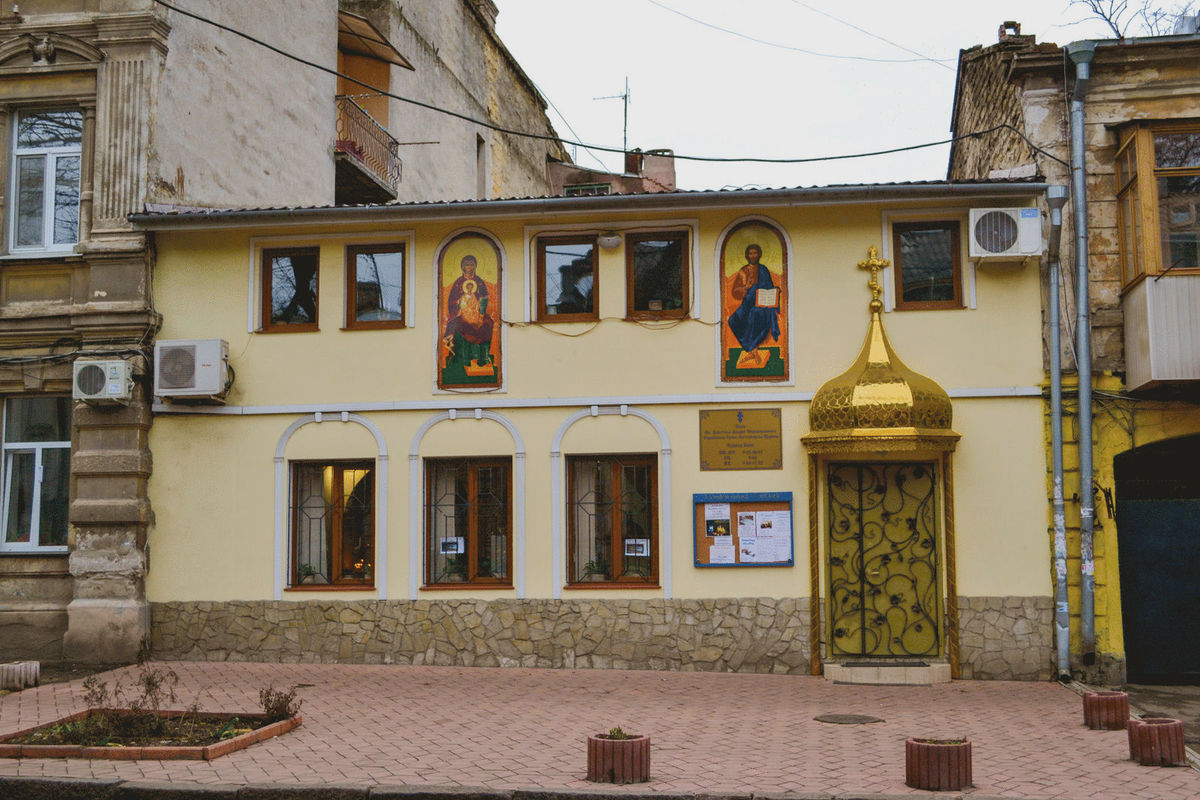
The parish of the Holy Apostle Andrew the First-Called was officially established in 2005, when on Gymnasialna Street in the city of Odesa a church-chapel was opened. The premises were purchased by Bishop Vasyl Ivasyuk. By the time the prayer chapel of Saint Andrew was opened, as early as 1994, the community of the Ukrainian Greek Catholic Church of Saints Borys and Hlib had already been registered. From that time, Divine Services were held in the private apartment of Mrs. Myroslava Hladina at 46 Filatova Street, as well as in the basement of the Roman Catholic Church of the Assumption of the Blessed Virgin Mary at 33 Ievropeiska Street.
The first solemn Divine Liturgy and the Rite of Consecration of the premises adapted as a prayer chapel at 22 Gymnasialna Street was performed by His Beatitude Lubomyr Cardinal Husar, concelebrating with Bishop Vasyl Ivasyuk, Exarch of Odesa, Bishop Stepan Menko, Exarch of Donetsk, and Bishop Vasyl Semeniuk, Archbishop and Metropolitan of Ternopil-Zboriv. The Church of the Holy Apostle Andrew the First-Called is the cathedral church of the ruling Exarch of Odesa, Bishop Mykhailo Bubnii.
It is worth noting that the parish has a catechetical school named after Metropolitan Andrey Sheptytsky, and catechesis of youth and adults, summer camps, and retreats are actively conducted. Prayer communities such as the “Apostleship of Prayer,” “Mothers in Prayer,” the Brotherhood of Our Lady of Perpetual Help, and the “Apostolate of a Good Death,” as well as a Bible club, the Blessing Community, the Knights of Columbus, and social ministry are functioning. The church preserves the relics of Saint Anthony of Padua and a copy of the Miraculous Icon of the Mother of God of Zarvanytsia.
Holy Relics: the relics of Saint Nicholas the Wonderworker
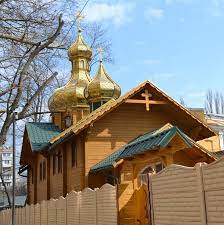
The church is located on the adjacent territory of the Southern Territorial Directorate of the Military Law and Order Service of the Armed Forces of Ukraine in the city of Odesa. The consecration of the site and the laying of the capsule for the construction of the first full-fledged church in the city of Odesa took place on June 12, 2017.
Many benefactors and donors from the city of Odesa, parishioners of the Cathedral Church of the Holy Apostle Andrew the First-Called and the Parish of the Ascension of the Lord, good people from various corners of Ukraine, and patrons from abroad contributed to the construction. Its erection was carried out by a team of five craftsmen from the town of Verkhovyna (Ivano-Frankivsk region), under the leadership of Mr. Mykola Illiuk. The work on building the church continued periodically for two years. The sacred structure was built in the Hutsul style out of spruce. On the territory of the parish, there is a catechetical hall, which is used for catechesis, youth meetings, choir rehearsals, parish meetings, conferences, and charity fairs. The parish is served by two priests.
The parish of the Ascension of the Lord in the Kotovsk district of the city of Odesa was founded on May 21, 2017. On this day, the consecration of the church-chapel took place.
The adaptation of the prayer chapel began in 2016. Thanks to the sponsorship of the charitable organizations Renovabis and Kirche in Not, as well as the personal donations of the faithful of the Ukrainian Greek Catholic Church in the city of Odesa, the premises of a store were purchased and transformed into a liturgical chapel.
Throughout 2016–2017, with the blessing of the Exarch of Odesa, Bishop Mykhailo (Bubnii), the adaptation of the chapel was overseen by the judicial vicar of the Odesa Exarchate, Father Doctor Mykola Slobodyan.
The parish has a catechetical school, and catechesis of youth and adults, summer camps, and retreats are actively conducted. Social ministry is also functioning. Every Saturday, with the efforts of the parishioners, charity meals for the homeless are organized on the parish grounds.
At the parish, the apostolate is carried out by the nun sisters of the Congregation of the Incarnate Word.
Odesa has long been a multinational city, and the Armenian community occupies a special place in it. Already since the 19th century, Armenians actively participated in the life of the city: they developed trade, culture, and education. Naturally, one of the main spiritual foundations of the community became the Armenian Apostolic Church.
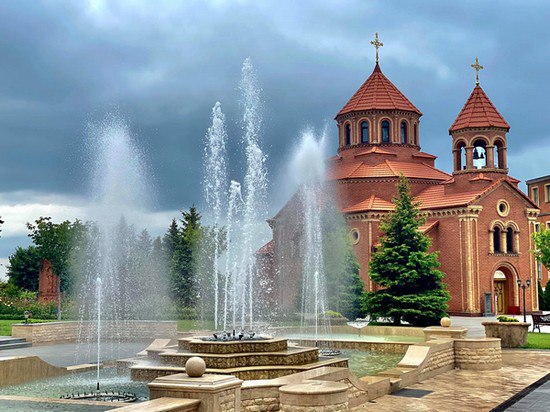
The first Armenian church in Odesa was built in 1844 with funds collected by the Armenian society of Odesa and was located at the intersection of Bazarnaya Street and Katerynynska Street. During the Second World War, the building was destroyed, and in its place a five-story residential building was constructed. In 1993, a plot of land was allocated on the Gagarin Plateau for the construction of a new Armenian church, and already in November 1995 the church, which received the name of Saint Gregory the Illuminator, was consecrated and opened its doors to parishioners. The church named after Saint Gregory the Illuminator was consecrated by the Supreme Patriarch, Catholicos of All Armenians, Garegin I.
In November 2008, next to the Church of Saint Gregory the Illuminator, the Armenian Cultural Center was opened, which was named after the well-known Odesa scholar Levon Kalustyants. This is not only a beautiful building but also a center of the cultural life of the community. Here are located a Sunday school, a Sunday kindergarten, an ethnographic museum, a library, various clubs, and classrooms for teaching national crafts.
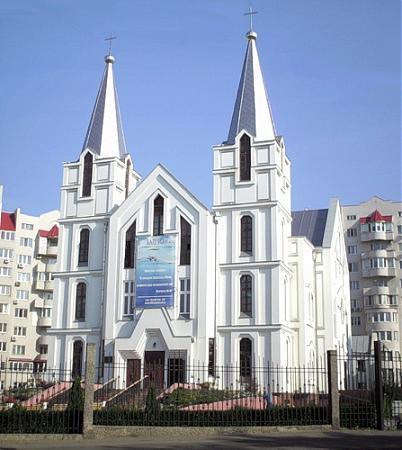
The main church of the Lutheran community in Odesa. Also known as the “Odesa Kirche”.
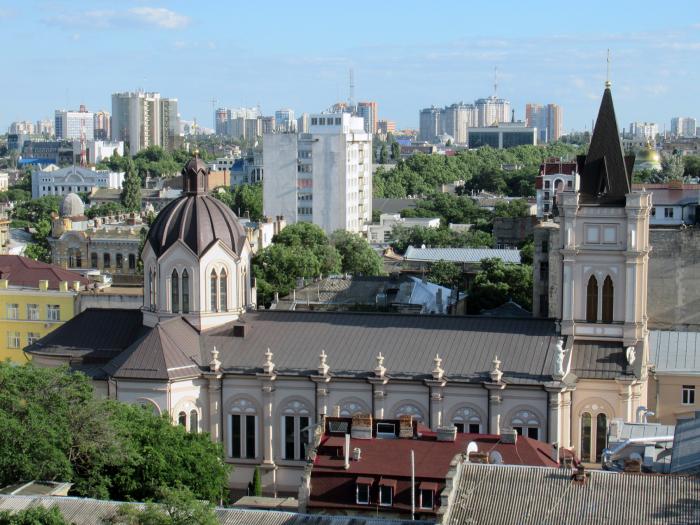
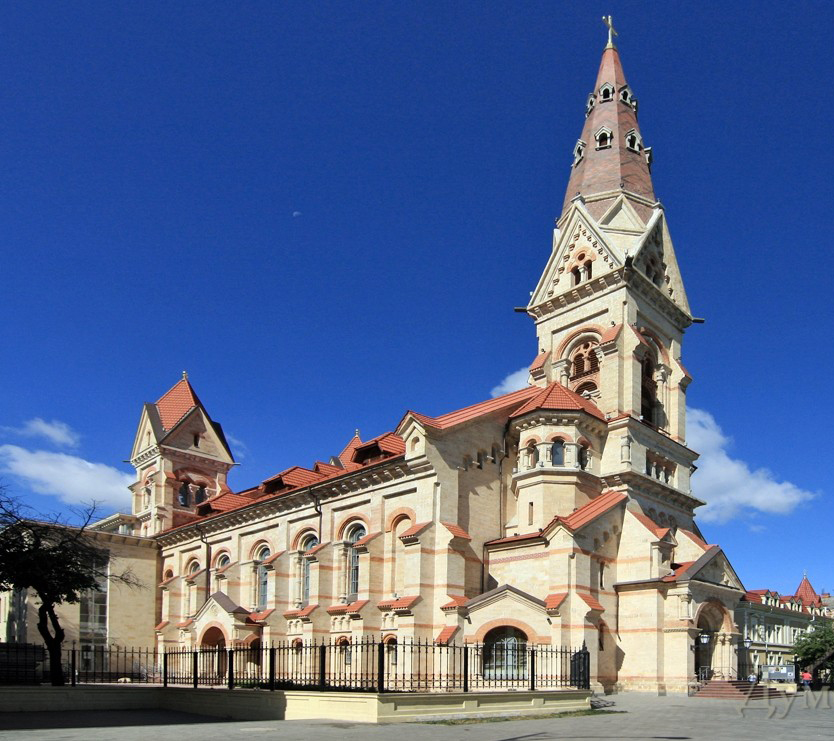
As early as the time of Empress Catherine II, a campaign was launched to attract German colonists to the Russian Empire. Some of them received land in the newly conquered territories that had belonged to the Ottoman Empire, south of the lands of the province of Ukraine. A compact settlement of German colonists also existed in Odesa. For the city’s Lutheran community, the first Lutheran Kirche was built and consecrated in 1827. Its architect-builder was Francesco Boffo. The opening ceremony was held on October 9, 1827. This date is considered the founding date of St. Paul’s Church.
The growth of the religious community led to the need for reconstruction of the church at the end of the nineteenth century. It turned out that the condition of the building was unsuitable for reconstruction. In order to save funds, in the summer of 1894 it was decided to keep part of the foundations and the first tier of the tower, which had not been built from artificial stone but from so-called “wild stone.” The project of the new church was carried out by the architect of German origin Herman Scheurembrandt, one of his assistants was the future architect A. Minkus, and the contracting work and consultation were carried out by the Swiss-born architect Christian Sveder. On June 12 (24), 1895, the ceremonial laying of the church took place. According to the project, the church was to accommodate 1,500 people. The new Lutheran church had three bells. The opening ceremony was held on June 25 (July 7), 1897. At that time, St. Paul’s Church was the third-largest Lutheran church after those in St. Petersburg and Moscow.
A distinctive feature of both the old and the new Lutheran churches was that the main entrance faced the northeast, which was determined by the location of the plot.
Until 1942 the Kirche served as a church. In the postwar years, it housed a gymnasium, a library, and a concert hall. In 1976 the building was damaged by fire. During Soviet times the abandoned church stood empty and unused.
Only during the independence of Ukraine did the religious community return to the ruined church. In 1992 the destroyed building was handed over to the German Evangelical Lutheran Church of Ukraine.
The long period of neglect led to through cracks in the walls, the complete destruction of the nineteenth-century interior, and severe damage to the foundations in the altar part. Research of the building revealed destruction and prompted the “shortening” of the church in this part during restoration. According to the conditions of restoration, the walls of this part were dismantled and, using the old bricks, a building for the modern German Cultural Center was constructed. Located behind the historical Kirche, the new building does not spoil its main façade. Two small annexes disappeared, one of which had been a coal storage room, the other a furnace for heating the building. For seismic safety reasons, the walls were reinforced with reinforced concrete piles, and the bell tower on the façade was strengthened with a stabilizing metal frame. The new doors of the church were reconstructed according to historical photographs. The restoration and repair work lasted five years. The church received a new ceiling and a roof covered with tiles. The historical facades were restored according to the project of architect Oleksandr Holovanov; one of the restorers was Tamara Huselnykova.
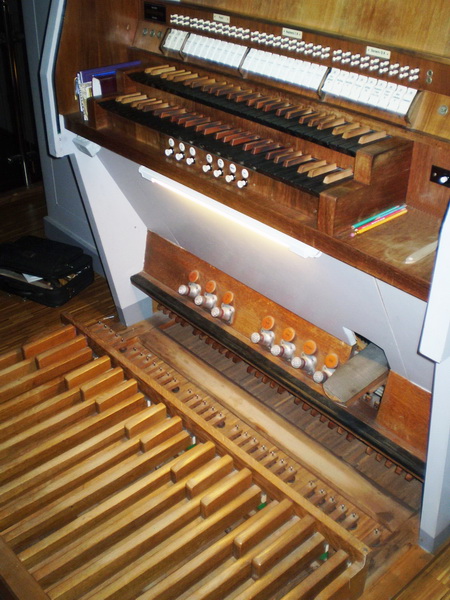
The Organ
Thanks to generous donations, even before the completion of construction, a new organ by the company “E.F. Walcker” from Ludwigsburg, Württemberg, was installed in the church.
At the entrance of the newly restored church there is a memorial plaque in honor of Pastor Vogel and the former organist Theophil Richter, father of the famous Soviet musician Sviatoslav Richter. Both the pastor and the organist were tortured during Stalinist repressions.
The current organ was also received by the church as a gift from the religious community of the Cross of the Lord from the city of Nuremberg. The concert organ was built in 1964.
In 2001 a small organ with six voices was installed in the community’s small meeting hall. This compact organ by Alfred Fuhrer has five stops in the manual and one in the pedal, but it completely fills the meeting room with sound and fully meets the needs of worship.
The Bells
The Kirche received new bells. All of them are named:
Christ’s Bell, the largest — 1,000 kg. The bell was a gift to Odesa from the German twin city of Regensburg;
Apostle Paul’s Bell — 690 kg;
Apostle Peter’s Bell — 480 kg;
Virgin Mary’s Bell — 280 kg.
The bells were created in the city of Passau, Germany, at the Rudolf Perner foundry. On February 27, 2010, the consecration and installation of the bells of St. Paul’s Church took place.
The first church with an organized structure was formed in Odesa in 1884 from a small group of believers, under conditions of constant oppression by the authorities of Tsarist Russia. The first gatherings of believers took place in a small building located in the historic district of Odesa “Slobidka.” From the first days of its existence, Sunday and festive services in the church were accompanied by a choir of ten people.
After the decree on freedom of religion was issued in 1905, thanks to active evangelistic work the community expanded and rented a hall at 11 Khersonska Street for worship, which accommodated up to one thousand people. In 1907 the first presbyter of the church became the well-known evangelist and theologian Vasyl Pavlov, who made great efforts not only for its development but also for the preaching of the Gospel and the unification of all believers baptized upon faith. However, with the beginning of the First World War, under the pretext of “combating German influence,” the evangelical-Baptist churches in Odesa were closed, and active ministers were exiled to Western Siberia.
In 1917, after the fall of the Russian autocracy, the establishment of Soviet power, and the proclamation of the separation of church and state, the church resumed active evangelistic activity and continued to expand. But from 1929 the political situation in the Soviet state changed, and persecution and repression began against evangelical Christians. From 1932 arrests, executions, and exiles began, both of ministers and ordinary church members, and in 1937 all evangelical churches of Odesa were deregistered and closed. Believers continued illegal gatherings in small groups in homes.
In the late 1930s, and later during the Romanian occupation of Odesa and the first postwar years, the city’s believers received permission to gather in the premises of the Lutheran Kirche. In 1950 the authorities moved the community of the Odesa ECB church from the Kirche to the premises of a former indigo workshop at 34 Serova Street, which the believers themselves converted into a house of prayer. In the first years gatherings in the new house of prayer were held without a presbyter, under the leadership of the choir director and composer N. Vysotsky. In the hall designed for 400 seats, 1,000–1,200 people gathered for services. The church held meetings in this building until the collapse of the USSR.
In 1992 the construction of a new house of prayer of the church on Kartamyshivska Street was started, and its solemn opening took place in 1996
The First Odesa ECB Church actively develops various types of spiritual ministry: preaching, music, prayer, evangelism, children’s ministry, and others. The church holds regular services with the participation of both its own preachers and preachers from other churches of Ukraine and the world. Representatives of the diaspora from the countries of America and Europe, as well as Baptists from various churches of the world visiting Odesa, regularly preach at the services. Services are broadcast on Odesa regional television channels, on the satellite channel “CNL-Ukraine,” and live on the church’s official website. In addition, video archives of sermons and services are available on the church’s websites.
The musical ministry of the church is represented by four choirs, each including representatives of a certain age category: a children’s choir; the first youth choir; the second youth choir “Perlynka”; the main choir. Thanks to the efforts of the choir directors, the professionalism of the church’s choral ministry gained recognition not only among evangelical churches but also at public music art competitions. The church also periodically hosts festivals of choirs of the churches of Odesa and Odesa region, as well as various concerts of sacred music.
Evangelistic ministry is carried out both in the church and in various public institutions and on the streets of the city. As part of the celebration of the 130th anniversary of the origin of Baptism in Odesa in 2006, a series of public events was held (open house days, the “STOP Drugs” campaign, evenings of Christian films, concerts of sacred music, and others), to which the residents of the city were actively invited. Open Easter services are periodically held in the Odesa Sports Palace. Outings are also organized to other settlements of the region and Ukraine. Church members carry out constant missionary work in small churches of Odesa region. In addition, the church actively participates in the creation and establishment of new churches in the city and region. During the morning Sunday service, classes are held in the children’s Sunday school, attended by more than two hundred children. In summer, camps for spiritual upbringing and recreation are held with children and youth. Prayer ministry has also become widespread and popular thanks to the periodic holding of night and morning prayer services, both for youth and for all church members.
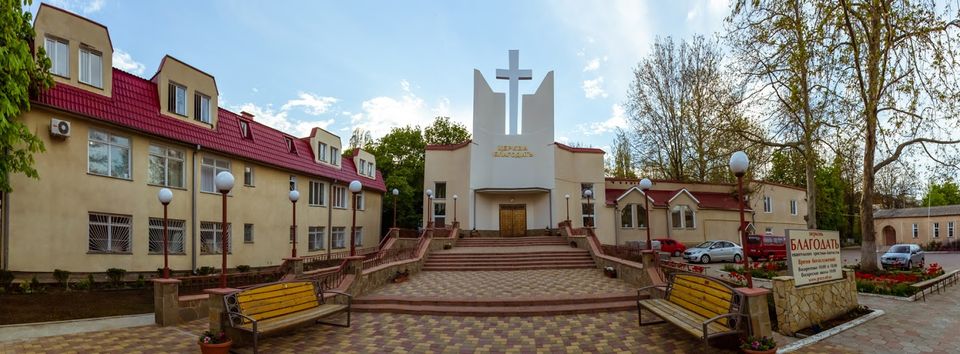
It arose in the early 1990s, when many believers sought to revive spiritual life after years of Soviet prohibitions. The community grew, and soon the need arose for its own house of prayer. Today the church is not only a place of worship but also a space for learning, fellowship, and support. Bible lessons, youth meetings, musical concerts, and charitable events are held here. The church pays special attention to family values and the upbringing of children. A Sunday school operates, where children study the Holy Scriptures in an accessible and interesting way. “Grace” actively supports social initiatives: assistance to the needy, care for the elderly, support for internally displaced persons. During the years of war the parish became a center of the volunteer movement. Food, clothing, and medicine are brought here for those in need. The atmosphere of sincerity and community makes the church open to all, regardless of age or life experience. Its doors are always open to those who seek faith, comfort, and warmth.
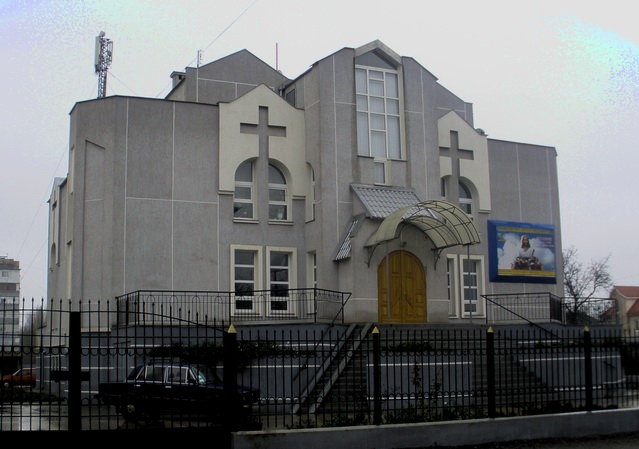
It was founded by believers who sought to spread the principles of the Gospel and a healthy lifestyle. Worship services take place in a warm atmosphere of prayer, singing, and preaching. Special attention is given to the study of the Bible and personal spiritual growth. For children, a Sabbath school with interactive classes operates. Young people gather for meetings to discuss faith, ministry, and life challenges together. The church actively promotes healthy eating, rejection of harmful habits, and harmony of body and spirit. Believers participate in social projects and help those in need. During the war the community joined the volunteer movement: they collect things, food, and medicines. An atmosphere of brotherhood and goodwill reigns here. The faithful are convinced that true faith is manifested in acts of mercy. The church has become a meeting place where people find hope and support. It is open to all who seek peace and spiritual renewal.
The history of Odesa is impossible without the Jewish community. Synagogues and Jewish cultural centers still remain a part of the city landscape. Judaism here is not only a religion, but also a cultural phenomenon that has influenced architecture, music, and even the humor of Odesa.
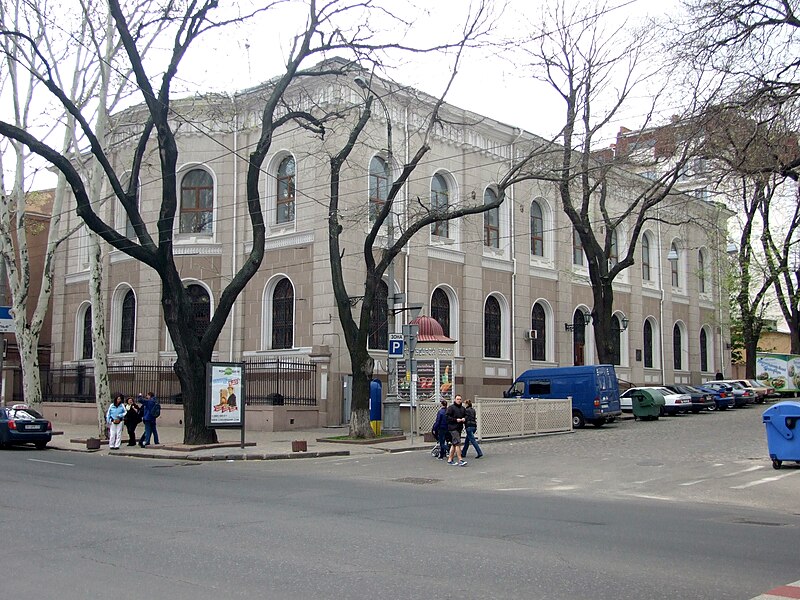
The community was officially organized already in 1798, and the first synagogue was built. In 1850, the construction of the modern Or-Sameach Synagogue began, according to the project of architect Franz Morandi. In 1855, after the completion of the construction, the synagogue received the status of the main synagogue of the city of Odesa.
A tragic period in the life of Odesa Jews began with the arrival of Soviet power. In 1919, a Decree on Religion was issued, according to which all property and documentation of the community were transferred to the state authorities, and in 1923, “at the request of the workers,” the synagogue was closed. At first, the building housed a zoological museum, and later — a children’s musical theater.
After the end of the Second World War, the building was transferred to the Odesa Pedagogical Institute; in the building of the synagogue, the Faculty of Physical Education was located. The interior premises of the synagogue underwent significant changes: the prayer hall was transformed into a basketball court and divided into two floors, the side openings were closed, and the women’s and choir balconies were turned into auditoriums.
In 1996, the building was transferred to the Odesa Jewish Religious Community, and in September 1996, on the holiday of Rosh Hashanah, the Jews of Odesa prayed in the main synagogue of the city for the first time in many years. From 1996 to 2008, the building was subject to reconstruction, the bimah was restored, and a mikvah was built. In 1998, a yeshiva was opened at the synagogue. On March 9, 2008, a Jew from Great Britain, Ari Shimmel, on the day of his 80th birthday and the bar mitzvah of one of his grandsons — Nathaniel — donated a new Torah scroll to the synagogue. In June 2008, the restoration of the synagogue façade was completed.
Today, daily and festive prayers are held here, and several hundred parishioners gather. On major holidays, not only residents of Odesa but also believers from Bilhorod-Dnistrovskyi, Izmail, Chornomorsk, and other cities of Ukraine come here.
The building houses the reception office of the Chief Rabbi of Odesa and the Odesa region, as well as the reception office of the board of the Odesa Jewish Religious Community. The Odesa Jewish University, a network of educational programs, including schools, cheders, and the paired study program of traditions “Hevruta”, also operates here.
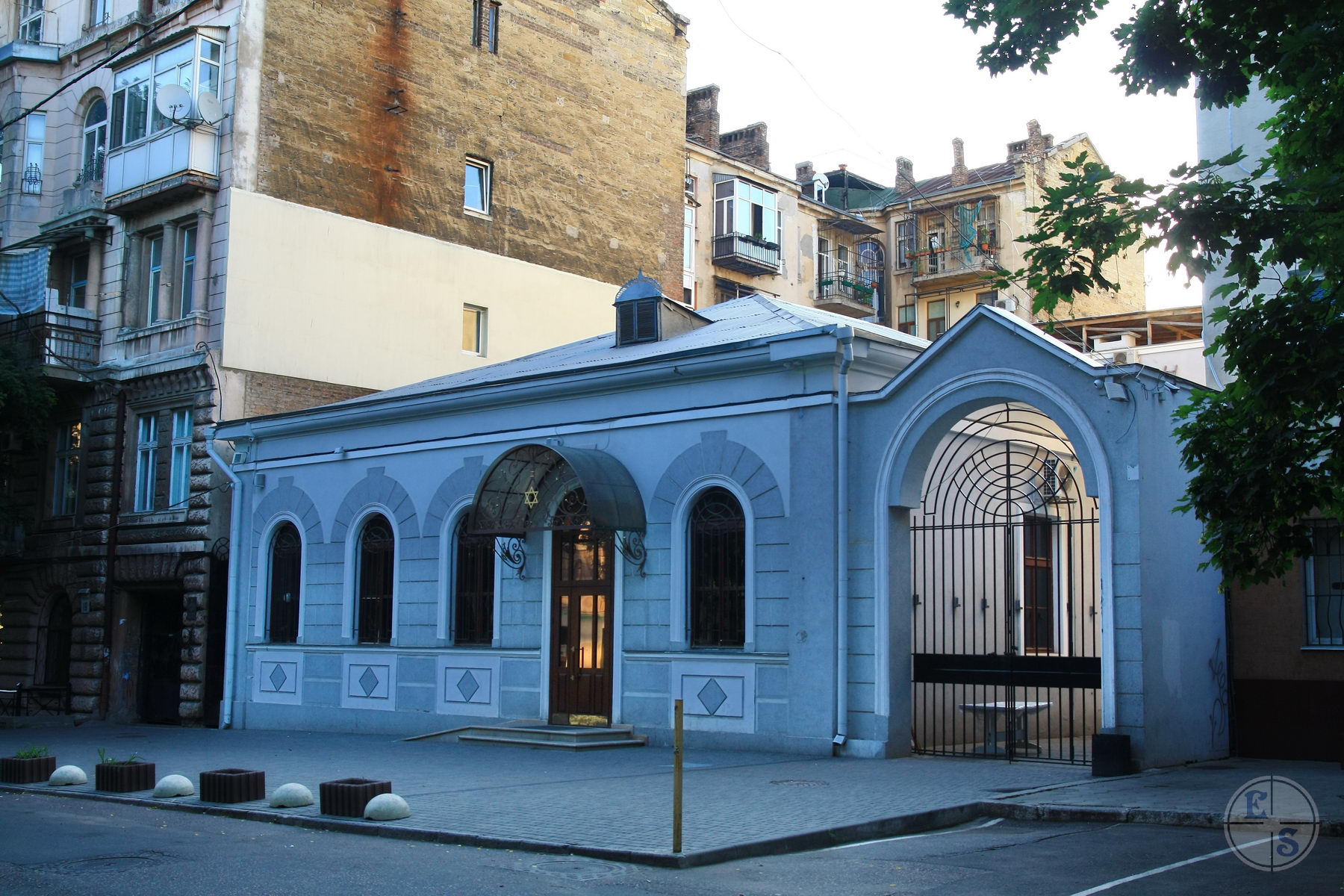
The history of the synagogue is inextricably linked with one of the oldest Jewish charitable societies in Odesa — “Malbish Arumim” (Hebrew מלביש ערומים — “The One Who Clothes the Naked”), which was established back in the 1820s. The purpose of the society was to provide clothing for poor members of the Jewish community. Funds for the purchase of clothing came from the so-called “box tax” (a tax on the sale of kosher meat), as well as from voluntary donations.
From the second half of the 19th century, the society and its prayer house, known as the “tailors’ synagogue,” were located at 21 Remisnycha Street (later and until 2024 — Osypova Street, then Vadym Korzhenko Street). In 1893, with the funds of merchant Moisey Kark, a new one-story building was erected for the needs of the society.
After the establishment of Soviet power, approximately in 1920, the synagogue was closed, and the charitable society “Malbish Arumim” was liquidated. The synagogue building was turned into a warehouse. During the Second World War, during the occupation, the building repeatedly suffered manifestations of antisemitism.
In 1992, after the restoration of Ukraine’s independence, the building was returned to the Jewish community of Odesa. In 1997–1998, thanks to the efforts of the then Chief Rabbi of Odesa and the Odesa region, Ishaia Gisser, a comprehensive reconstruction of the synagogue was carried out. The restored house of prayer was named “Beit Chabad,” which means “House of Chabad” — in honor of the Chabad-Lubavitch direction in Hasidism.
Today, in the building, in addition to the synagogue, are located the board of the Odesa religious community “Shomrei Shabbos,” the editorial office of the weekly newspaper of the same name, and a kitchen for preparing kosher food. The synagogue is an important center of Jewish community life in Odesa.
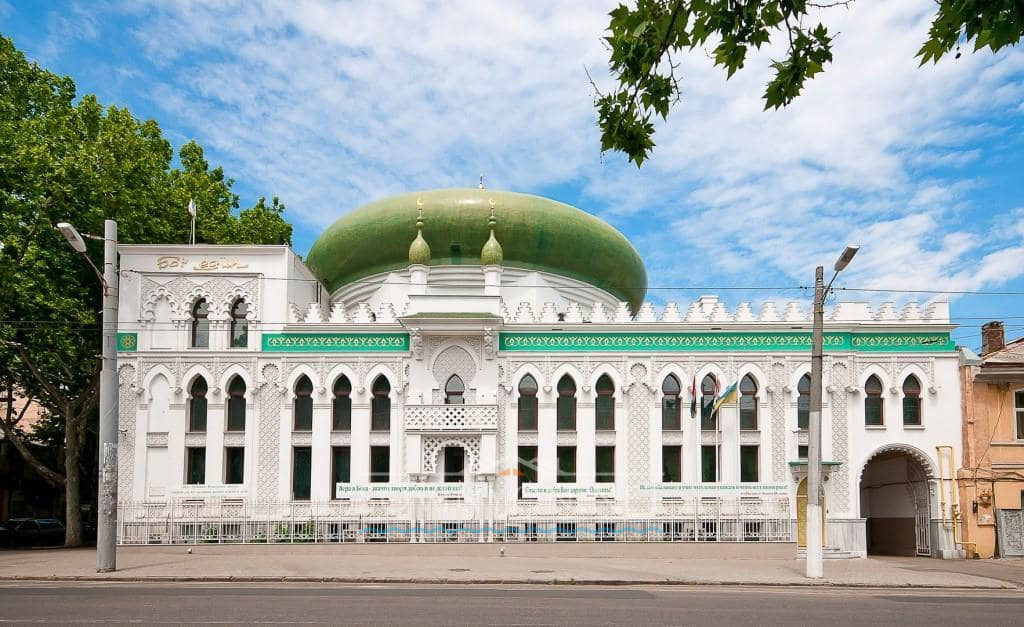
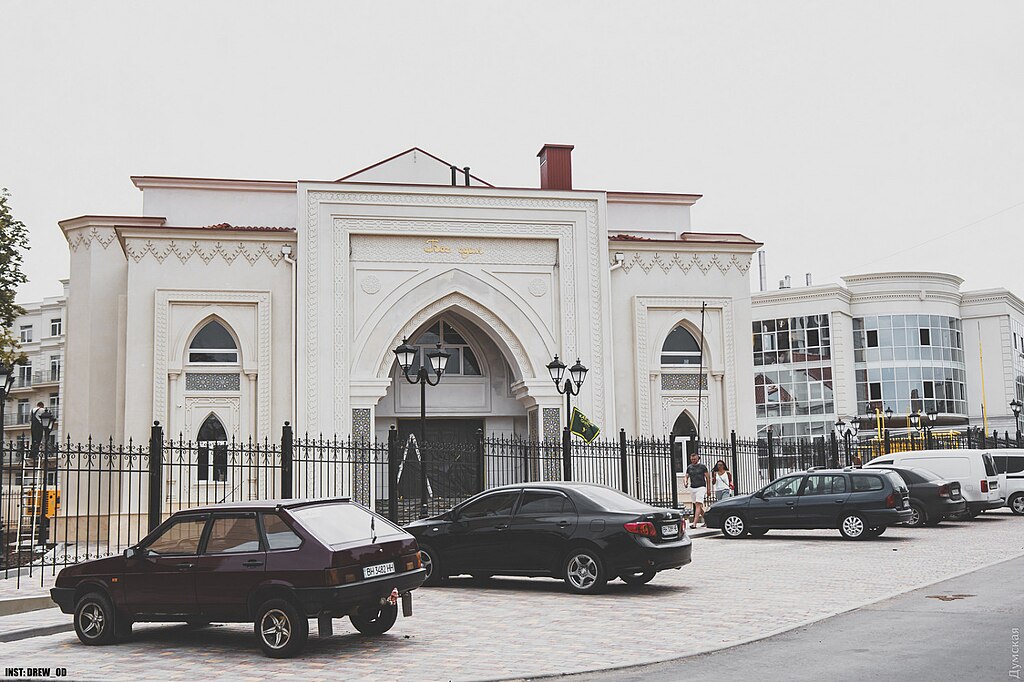
The mosque building houses the Arab Cultural Center.
The mosque was opened in 2001. The building was constructed with funds provided by Ukrainian businessman of Syrian origin, Adnan Kivan. The mosque operates a free school and library for learning the Arabic language for all people, regardless of age, citizenship, or religion. The center is open daily from 11:00 to 17:00, except on Fridays. Visitors must remove their shoes before entering the prayer hall, and women are provided with headscarves.
The building project was developed by the Odesa architectural and restoration bureau Arkhproekt-MDM.
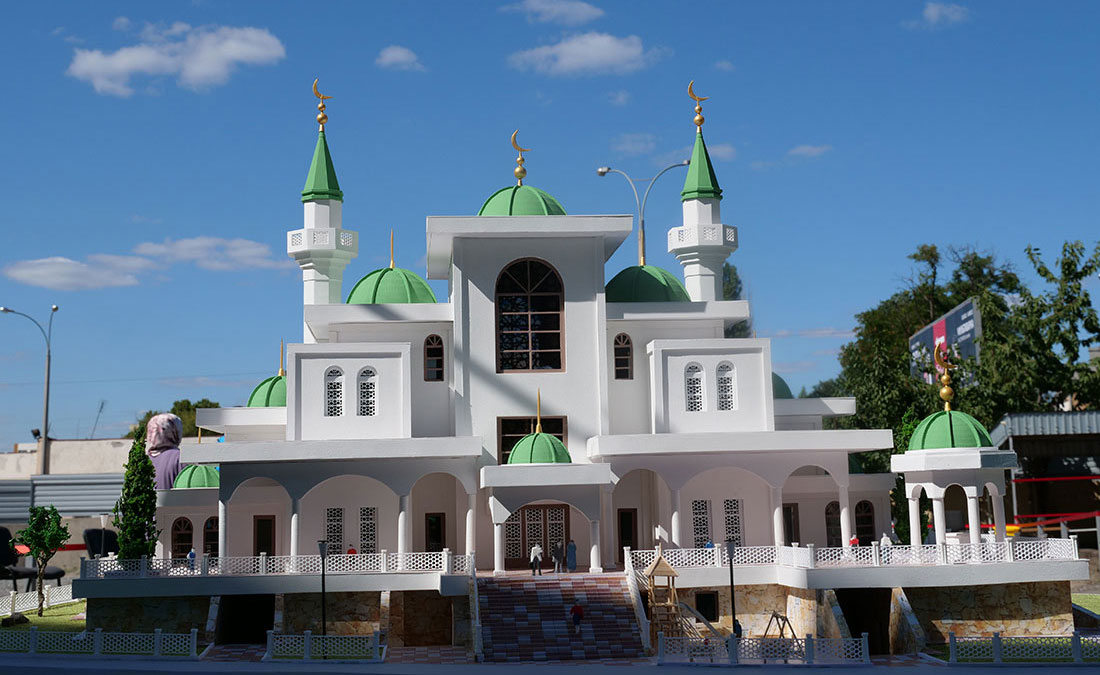
The first cathedral mosque in the city of Odesa is currently under construction.
On September 3, 2021, the construction of a new Cathedral Mosque began at the site where a Muslim community prayer house previously stood. The event was ceremonial and attended by the Mufti of Ukraine, Ahmed Tamim, representatives of state authorities, and members of the diplomatic corps. The Muslim community in Odesa is one of the largest in Ukraine, yet for over 20 years it did not have a purpose-built religious building capable of fully meeting its spiritual needs.
The mosque will accommodate more than a thousand worshippers. Architecturally, the Cathedral Mosque will resemble Al-Masjid an-Nabawi in Medina. The mosque will feature two minarets.
Mosque and Islamic center of Odesa.
On August 6, 2018, Adnan Kivan, head of the KADORR corporation, opened the second Eastern Cultural Center in Odesa at Velykyi Fontan. The first Friday prayer was attended by over a hundred worshippers and guests from different regions of Ukraine.
The new cultural center occupies 2,000 square meters — it includes a prayer hall with separate levels for men and women, conference and classroom rooms, and a meeting hall. Two of the three floors are designated for worship. The first floor houses administrative and technical rooms, as well as a wudu (ablution) room.
The mosque is named after Adnan Kivan’s father, Ahmed Suleiman Kivan
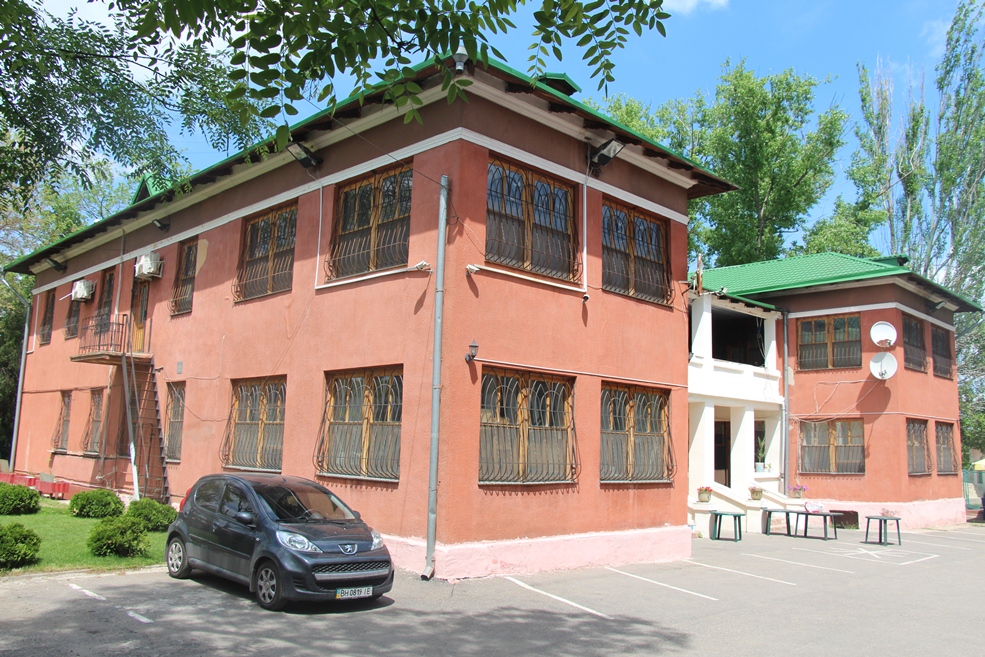
Mosque and cultural organization in the city of Odesa. This center was the first opened in Ukraine by the Alraid organization. The Odesa Islamic Cultural Center is one of nine Islamic cultural centers located in major cities of Ukraine. Daily prayers and Friday Jumu’ah prayers are held in the prayer hall. For Muslims, the center offers Quran reading groups and lectures on the fundamentals of Islam. During the holy month of Ramadan, the center regularly hosts communal iftar meals, and on the holidays of Ramadan Bayram and Kurban Bayram, festive events are organized.