Monuments to Historical Figures
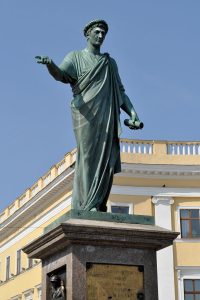
Monument to the Duke De Richelieu
Dedicated to Armand Emmanuel Sophie Septimanie de Vignerot du Plessis, Duke de Richelieu. It is a bronze statue of Richelieu accompanied by three brass bas-reliefs symbolizing agriculture, commerce, and justice. The Duke of Richelieu (1766–1822) was born in France into one of the most famous aristocratic families in Europe (everyone knows the cardinal famous from The Three Musketeers). When the French Revolution broke out, Richelieu, remaining loyal to the royal authority, emigrated to Russia and entered service there. He took part in the storming of Izmail in 1790, for which he received an order and a personalized sword. In 1803, Richelieu became the mayor of Odesa, and in 1805, the governor-general of the so-called Novorossiysk Territory. Richelieu managed to temporarily lift taxes for the citizens of Odesa. Under his leadership, the trade activity of the Odesa port flourished. Among Richelieu’s initiatives were promoting trade, increasing the population, improving agriculture, creating industry, and developing education, science, and culture. After Napoleon’s defeat in 1814 and the restoration of the Bourbon monarchy, the Duke returned to Paris and became France’s Minister of Foreign Affairs and Prime Minister. He died at the age of 56 in Paris, much to the sorrow of the people of Odesa. His contribution to the city’s development is invaluable.
The monument itself was erected in 1827 (other sources say 1826 or 1828). Locals simply call it “The Duke.” The word “Duke” in both French and English means “герцог” (herzog). The statue and bas-reliefs were cast in bronze in St. Petersburg. The pedestal was designed by the prominent St. Petersburg architects A.I. Melnikov and F.K. Boffo. The sculptor was I.P. Martos. Richelieu is depicted slightly taller than life-size. The monument still shows traces of bullets and even a cannonball embedded in the pedestal. During Soviet times, there were plans to replace the Duke’s statue with a monument to Kotovsky. Fortunately, this never happened..
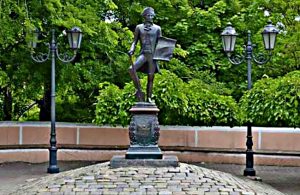
Monument to De Ribas
Don José (Joseph) Pascual Dominic de Ribas (1749/1751–1800) was a Spanish nobleman by birth, and a Russian military and statesman. He was born in Naples and died in Saint Petersburg. Since 1769, he served in the Russian military. He actively participated in Russia’s wars against Turkey, which resulted in Crimea and later Bessarabia becoming part of the Russian Empire. For his role in the storming of Izmail, Suvorov called de Ribas the “Danube Hero,” and Catherine II gifted him a diamond-encrusted sword and an estate with 800 serfs in the Polotsk province. After another Russo-Turkish war, the territory between the Bug and Dniester rivers was annexed by Russia. In 1793, Rear Admiral de Ribas was appointed commander of the entire Black Sea rowing fleet, and on May 27, 1794, as Vice Admiral, he was named chief overseer of the construction of the port and city of Khadjibey (renamed Odesa in January 1795). De Ribas developed the construction plan for the port in Khadjibey together with de Vollant, choosing the location because of its bay where the sea rarely freezes. His project took everything into account, including financial costs. On August 22, 1794 (old style), the foundation was ceremoniously laid for the port, a shipyard, two merchant piers, and two churches dedicated to the protectors of sailors, St. Nicholas and St. Catherine. In honor of I.M. de Ribas, the city’s main street was later named Deribasivska. Interestingly, de Ribas had an opponent, Vice Admiral Mordvinov, who advocated for building the port near Ochakov. De Ribas managed to persuade Catherine II to support his plan. Thus, Odesa owes its very birth as a port and major city to him—without him, it might have remained a small town at best.
The monument stands at the very beginning of the street that bears his name and was erected on September 2, 1994. The sculptor was A.V. Knyazik, and the architect was V.L. Glazyrin.
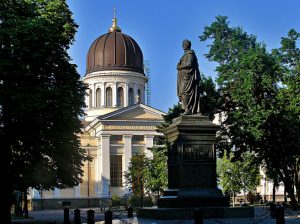
Monument to Count Vorontsov
Mikhail Semyonovich Vorontsov (1782–1856) was a great military and statesman, governor-general of Novorossiya and Bessarabia from 1823. He spent his childhood and youth in England, where his father, Count S.R. Vorontsov, lived for over 40 years. Having received an education and upbringing befitting an English lord, Vorontsov returned to Russia in 1801 to begin his service. From 1802, he participated in the Russo-Turkish and Russo-French wars. In 1812, he commanded a division in Bagration’s army and was wounded at the Battle of Borodino. Between 1815 and 1818, he commanded the occupying corps in France, where he met Countess E.K. Branitskaya; they married on April 20, 1819, in Paris. In 1823, he was appointed governor-general of Novorossiya and Bessarabia, a position he held for 21 years. He devoted great effort to the economic development of these regions, especially Odesa and Crimea, as well as organizing navigation on the Black Sea.
He died the same year, on November 6, in Odesa, where he was buried in the nearby cathedral.
His authority, love, and respect from his compatriots were so great that soon after Vorontsov’s death, at an extraordinary meeting of the Society of Agriculture of Southern Russia, of which he was president, the unanimous decision was made to erect a monument in his honor. Many people contributed to the fundraising for the monument, initially raising 37,000 rubles, with donations ranging from several thousand to just a few rubles. The monument’s design was created by the famous sculptor F. Brugger, with architect F. Boffo. The monument consists of a pedestal, a bronze statue, and three bas-reliefs depicting the Battle of Craonne, the capture of Varna, and agriculture and trade, which flourished under Vorontsov’s patronage. The inscription was to read: “To the Most Illustrious Prince Mikhail Semyonovich Vorontsov, grateful compatriots. 1863.” Today, the front of the pedestal simply reads: Vorontsov. The bronze figure stands 3.2 meters tall, with the total monument height exceeding 8 meters. Vorontsov’s likeness is strikingly realistic thanks to the sculptor’s use of the last portrait painted by Berlin portrait master Franz Krüger. The monument was unveiled on November 8, 1863.
In the 1930s, when it was decided to demolish the monument along with the Transfiguration Cathedral, the attempt failed — the chain attached around the monument and connected to a powerful tractor simply snapped. Thus, the monument has remained in place for over a century!
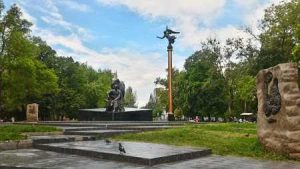
Monument to Otaman Holovaty
Monument to Otaman Holovaty, 1999.
A bronze sculpture of the otaman resting on a bench, with a grazing horse nearby, and an angel hovering above. Sculptor – A. Tokaryov, architect – V. Hlazyrin.
Starobazarnyi Square
Anton Holovaty was one of the otamans of the Host of Loyal Black Sea Cossacks, who fought alongside Russian soldiers against the Turks during the capture of Khadzhibey. This military formation was created by the Russian government in 1787 from units of the Zaporizhian Host (primarily former Zaporizhian Cossacks). The territory assigned to this Host lay between the Southern Bug and Dniester rivers.
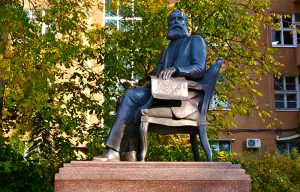
Monument to Hryhoriy Marazli
The monument to the famous Odessa Mayor Hryhoriy Hryhorovych Marazli was unveiled on Hretska Square on September 2, 2004. In 2008, it was relocated to a new site and today stands on Marazliivska Street.
The monument’s creators are Odessa sculptor A. Knyazik and architect M. Murmanov.
Marazli led the Odesa City Council for 17 years (1878–1894) and was renowned not only as a public figure but also as a philanthropist and educator. Hryhoriy Marazli (July 25, 1831 – May 1, 1907) served as Odesa’s mayor from 1878 to 1895.
During his tenure, the Opera Theater was built, permission was granted to establish a park—now the Taras Shevchenko Central Park of Culture and Recreation. Under his leadership, Odesa saw the introduction of gas street lighting, the appearance of horse-drawn trams (konka), and the opening of a health resort at Kuyalnyk.
After Marazli’s death, his remains were laid to rest in the Greek Holy Trinity Church, but in the 1930s, his ashes were exhumed and discarded…
Monument to the “Founders” of the City
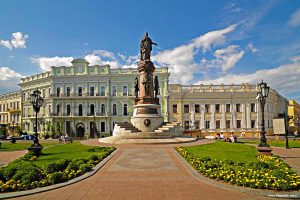
In 1894, it was decided to erect a monument to those who “founded” and built the city. Among them was Empress Catherine II, who, according to legend, gave Odesa its name. Below her stand figures of other prominent individuals who directly participated in transforming the Turkish town into a city — de Ribas, Prince Potemkin, Count Zubov, and engineer de Volan. The monument to Empress Catherine II and her associates was officially unveiled in 1900. Sculptors: M. Popov, B. Edwards, L. Mentsione. Architect: Yu. M. Dmytrenko. In 1901, at the Paris Architectural Conference, Catherine Square with the standing monument was recognized as the best integrated architectural complex in Europe. In 1920, Catherine Square and the street were renamed Karl Marx Square. The bronze figures of Catherine and her associates were dismantled and transferred to the local history museum, while the pedestal of the former monument was used for a statue of Karl Marx. However, this statue did not stand long, as it was toppled by a strong wind. Later, a flower bed occupied the center of the square. In 1965, a monument to the sailors who participated in the 1905 mutiny on the battleship Potemkin was erected there. In 2007, the Odesa City Council decided to restore the lost monument to the founders of Odesa. The Potemkin monument was moved to Customs Square, near the port entrance. The new monument precisely replicates the original one that stood on the square since 1900. The new bronze figure of Russian Empress Catherine II was created by Kyiv sculptor O. Chernoivanov, based on preserved photographs, while the figures of her associates were the original ones kept at the Art Museum. The monument was reopened on October 27, 2007
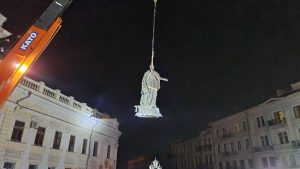
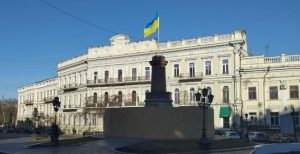
In 2022, after the treacherous invasion of Ukraine by the Russian aggressor began, the fate of the “Founders of Odesa” monument was decided by Odesa residents through electronic voting, which ended on October 20. The majority of votes — 3,914 — favored the option to “completely dismantle the monument”. On the night of December 28–29, the monument to Catherine II at Catherine Square was dismantled. The removal began around 11:00 PM and lasted nearly three hours. First, the sculptures of the favorites were removed and lifted by crane onto a truck. Then the same was done with the statue of Catherine II. After dismantling, the sculptures were delivered to the Odesa Art Museum, where they will remain for now under the decision of the executive committee of the Odesa City Council dated November 30, 2022..
Monuments to Soldiers, Victims, and the Fallen
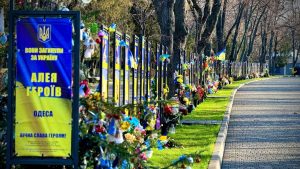
Heroes’ Avenue
Heroes’ Avenue in Taras Shevchenko Park is a place of living memory dedicated to the contemporary defenders of Ukraine who gave their lives for the country’s independence in the war against the Russian aggressor.
The memorial was officially inaugurated on 29 August 2024, on the Day of Remembrance of the Defenders of Ukraine. Unlike traditional monuments, this Avenue is a dynamic project: it consists of a large number of informational panels installed along the park’s central pathway. Each panel presents a portrait, a name, years of life, and a brief account of the soldier’s military service. Represented here are service members of the Armed Forces of Ukraine, the National Guard of Ukraine, border guards, and volunteers — men and women who rose to defend their homeland.
The creation of the Avenue was the result of joint efforts by the city authorities and the families of the fallen heroes. For many residents of Odesa and visitors to the city, this place has become a point of reflection on the true price of freedom. Passing by the smiling faces in the photographs, people stop, lay flowers, or simply remain silent, paying tribute to the sacrifice of their fellow citizens.
The Avenue is constantly expanding with new names. As of 2025, the number of panels has increased significantly, reflecting a tragic yet heroic chapter in the contemporary history of Odesa. It is not only a memorial, but also a space of gratitude that reminds us that heroes live on as long as they are remembered. Located in the heart of the city’s most popular park, Heroes’ Avenue has become an organic part of everyday life in Odesa, reminding residents thanks to whom the city remains free.
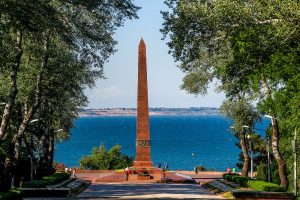
Monument to the Unknown Sailor
On May 9, 1960, the Monument to the Unknown Sailor was unveiled in the Central Park of Culture and Leisure named after Taras Shevchenko. The sculptor was M. Naruzetskyi, and the architects were H. Topuz and P. Tomilin. It was erected in honor of the soldiers of the Coastal Army and the sailors of the Black Sea Fleet who heroically defended Odesa in 1941. The obelisk, made of red granite, cast iron, and bronze, stands 21 meters tall. At the foot of the obelisk, surrounded by a bronze wreath, burns the Eternal Flame. A bronze submachine gun and sailor’s cap are cast into the base.
Since 1968, an honor guard has been posted at the monument.
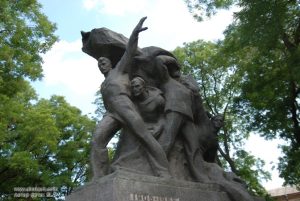
Monument to the Sailors of the Battleship “Potemkin”
On September 28, 1898, a new battleship was ceremoniously laid down at the Nikolaev Admiralty Shipyard in the city of Mykolaiv. It would become the most powerful vessel in the Black Sea Fleet. In terms of tactical and technical characteristics, the squadron battleship Knyaz Potemkin Tavrichesky was the most advanced of its class. It was commissioned in May 1905.
The mutiny broke out just a month later, in June. The official Soviet version, long taught to schoolchildren, claimed that the immediate cause was spoiled meat intended for the sailors. However, modern research has shown this was merely a pretext. Conditions aboard the Imperial Navy’s ships—including food, treatment, and living standards—were not as dire as once believed. The true reasons for the uprising lay in the broader social context: widespread dissatisfaction in the Russian Empire, a growing demand for reform, and the oppressive political regime. Even if the sailors were well-fed, they could not ignore the suffering of their families back home. After the massacre of peaceful demonstrators on January 9, 1905, sailors increasingly feared they would be ordered to fire on their own people. This growing political awareness and unrest led to the mutiny.
Revolutionaries had been planning a large-scale uprising in the Black Sea Fleet for the autumn, but events aboard Potemkin unfolded earlier than expected—on June 14. That evening, Potemkin, accompanied by a destroyer whose crew also rebelled, sailed to Odesa, where a general workers’ strike was taking place. The following morning, the sailors brought the body of Hryhoriy Vakulenchuk—one of the mutiny’s leaders, who had been shot by an officer—to the Platonov Mole. Crowds of Odesans streamed down the streets, stairways, and paths to the port. These events were famously depicted in Sergei Eisenstein’s 1925 film Battleship Potemkin. Since then, the city’s grand boulevard steps have been known as the Potemkin Stairs.
The monument depicts the moment just before the execution of the mutineers aboard the Potemkin, as sailors throw off the tarpaulin used to cover them before the planned shooting, preparing to attack the officers. Notably, Eisenstein later admitted that the scene with the tarpaulin was an artistic invention. A former naval officer advising the film crew objected to it, explaining that in real executions, a tarpaulin was laid under the prisoners to keep the deck clean—not over them.
The monument was unveiled on July 25, 1965, originally placed on what is now European Square (formerly Catherine Square), where monuments to Catherine II and Karl Marx once stood, and later a flowerbed. On October 14, 2007, due to the restoration of the Catherine II monument, the Potemkin memorial was moved to Customs Square (Mytna Ploshcha). The sculptor was V.A. Bohdanov; architects: M.M. Volkov and Yu.S. Lapin.
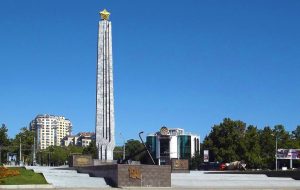
Memeorial “Wings of Victory”
The “Wings of Victory” Memorial was unveiled in 1984 to mark the 40th anniversary of Odesa’s liberation from Romanian-German occupation. A gray marble stele is crowned with a golden star, commemorating the title of “Hero City” awarded to Odesa in 1965. Sculptor: N. Konishchev. Architects: V. Myronenko, V. Korohod, V. Shynkarenko..
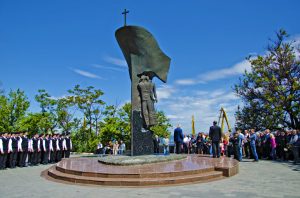
Monument to the Dead Sailors and Ships
First of all, this monument reminds us of the catastrophe “Nakhimov”, which happened in 1986. However, the monument reminds of passenger and cargo ships, evacuated from the besieged Odessa troops and residents, and many others.
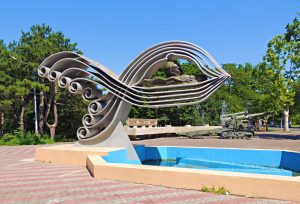
Monument to Submariners (Stepan Dzhevetsky)
The monument to Stepan Dzhevetsky, the creator of the submarine in Odesa, was unveiled in Victory Park in 2004 during the 41st International Submariners Congress and has since become an integral part of the city. In this way, Odesans restored to the city the name of the scientist who designed and tested one of the world’s first submarines in Odesa’s harbor.
The monument to Stepan Dzhevetsky in Odesa is strikingly unusual and avant-garde, immediately drawing attention.
The monument, designed by architect V. Myronenko and sculptor A. Kopyev, depicts Stepan Dzhevetsky surrounded by stylized waves symbolizing a submarine. In an avant-garde realist style, the sculptor created the image of a man who dedicated his life to the sea, the sky, and invention.
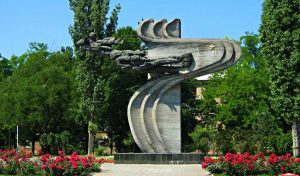
Monument to the Hero Pilots of the 69th Fighter Regiment
Architect: V. Mironenko; sculptors: V. Patorov, M. Yeremenko. Year: 1984. It is located at Heroes of the Air Square, at the 5th Station of Velykyi Fontan, on the site of a former military airfield.
During the first months of the German–Soviet War (1941–1945), the aviation regiment suffered heavy losses not only in aerial combat but also on the ground, because the Nazis knew the exact location of the airfield.
A decision was made to build a well-camouflaged airfield within the city, on the vacant land of Chubaivka (at the 5th Station of Velykyi Fontan).
An enormous amount of work was completed within a single week, carried out mainly by women and teenagers. Hidden beneath camouflage nets, the airfield remained invisible to enemy aircraft.
Twelve pilots of the regiment, including the regiment commander Lev Lvovych Shestakov, were awarded the title of Hero of the Soviet Union.
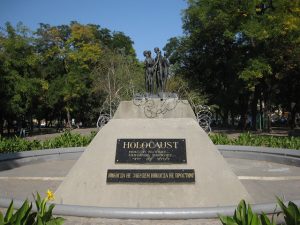
Monument to the Victims of the Holocaust
Sculptor Tsereteli, Z., architect V. Glazyrin. Plan, an initiative of the family Maniovič. Prokhorovsky square.
The Holocaust (holocaustum – “burnt”, “burnt sacrifice” – biblical Greek texts) called the planned extermination of Jews by the Nazis during the Second world war.
On January 27, the world community celebrates the international day of remembrance of the victims of the Holocaust.
Once in 1933, Hitler became Chancellor of Germany, officially began to appear laws and events occur that limit the rights of those who had not Aryan or related to her by blood. Burned books by Jewish authors, Jews were forbidden to participate in the cultural life of the country, to marry Aryans, Jews were deprived of German citizenship.
In 1938, the world was shocked by the events of Kristallnacht, when it was destroyed about a thousand synagogues, many Jews were killed or maimed, thousands sent to concentration camps…
September 1, 1939 Germany invaded Poland, and on September 21, came the order on the conclusion of the Polish Jews in the ghetto.
Since the summer of 1941 the Nazis began to solve the “Jewish question” in the Soviet Union: according to official figures killed 1 200 000 Soviet Jews.
Decent people of various nationalities, risking his own life, tried to save the Jewish population, condemned by the Nazis to death. After the war many of them were awarded the title “Righteous among the Nations”.
Besides the Jews, according to the policy of the Nazis, total annihilation was to be Gypsies, the handicapped, retarded, gay… Partly had to be destroyed Ukrainians and Russians. Survivors were instructed to “trust” the work in the field and look after pets.
Monuments to Figures of Art and Science
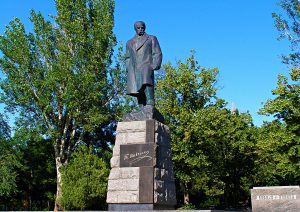
Monument to T. Shevchenko
1966.
Sculpture – marble, pedestal – granite. ESculptors: A. Bilostotsky, O. Suprun; Architect: H. Topuz.
PShevchenko Park, from the side of Marazliivska St. (corner of Sabansky Lane).
On a large square stands a nine-meter monument to the Kobzar. Around it is a granite parapet. On the granite stele are engraved the poet’s life dates (1814–1861) and a stanza from “Testament”:
And me in the great family,
The family new and free,
With kindly and quiet word
Remember, do not forget.
Earlier, another, more modest monument to T. Shevchenko stood on the site in front of the library and chess pavilion (burned down in the 1980s), near the Langeron Arch.
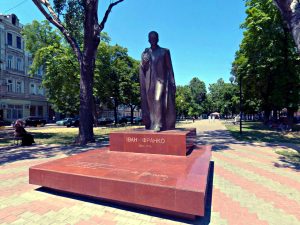
Monument to I. Franko
The first monument in Southern Ukraine to the famous Ukrainian writer and politician Ivan Franko was solemnly unveiled in Odesa in 2006. The unveiling was initiated by the Department of Culture of the Regional State Administration and the Odesa City Executive Committee.
A competition for the best monument project was held by the Department of Culture and Tourism. The proposal of sculptor B. Rumyantsev and architect N. Rumyantsev was recognized as the best.
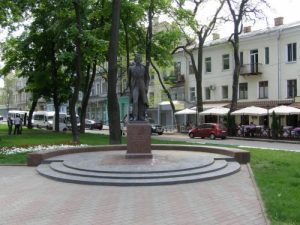
Monument to Adam Mickiewicz
At the intersection of Nina Strokata Street (until 2024, Bunina Street) and Heroes of Ukraine Avenue (until 2024, Oleksandrivskyi Avenue) stands the monument to Adam Mickiewicz, the outstanding Polish poet, a figure of the national liberation movement, and a true Romantic. This monument is not only an ornament of the city, but also a symbol of the deep cultural ties between Ukraine and Poland, recalling the period when fate brought this literary genius to the shores of the Black Sea.
The poet’s stay in Odesa in 1825 was involuntary: the tsarist authorities sent him there as punishment for his participation in patriotic circles. However, the nine months he spent in the so-called “southern capital” became one of the most productive periods of his creative life. It was precisely in Odesa that Mickiewicz led an active social life, experienced romantic feelings, and found inspiration in the seascapes. His impressions of Odesa became the basis for his celebrated cycle Crimean Sonnets, which became a masterpiece of world literature.
The idea of honoring the poet emerged as early as the end of the nineteenth century, but it was only realized in 2004. The authors of the project were sculptor Oleksandr Kniazyk and architect Markoz Murmanov.
The bronze figure of Mickiewicz, approximately three meters high, is installed on a granite pedestal. The poet is depicted in a dynamic pose, as if he had paused for a moment during a walk, with a cloak over his shoulders stirred by the sea breeze. His gaze is directed into the distance, conveying a sense of creative search and the slight melancholy characteristic of exile. The monument has organically become part of the city’s architectural ensemble and has turned into a favored meeting place for Odesa’s intellectual community and the Polish community.
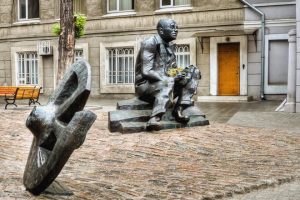
Monument to I. Babel
Isaac Babel (1894–1940) – Odesa-born writer and playwright of Jewish origin.
The writer’s fate was tragic. He was arrested in 1939, tortured, and executed in the NKVD dungeons. His execution list bore the signature of Joseph Stalin, who had a personal animosity toward Babel. In 1954, he was posthumously rehabilitated. With the active support of K. Paustovsky, who admired Babel and left warm memories of him, Babel was reinstated in Soviet literature after 1956. However, even after rehabilitation, his works were subjected to strict censorship.
The monument was unveiled on September 4, 2011, on Sviatoslav Karavanskyi Street, opposite the house at 17 Rishelievska St., where the writer lived until 1924.
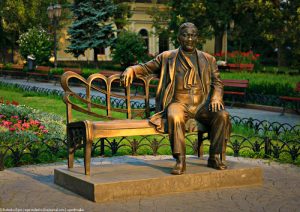
Monument to L. Utyosov
Leonid Utyosov (1895–1982) – stage artist, People’s Artist of the USSR (1965). Born in Odesa, he performed on stage from 1911. Founder, leader, and soloist of the first Soviet jazz ensemble “Tea-Jazz” (later the State Variety Orchestra of the RSFSR), with which he starred in the film “Jolly Fellows” (1934).
His real name was Leizer (Lazar) Vaysbein. Utyosov was born and lived at 11 Trykutny Lane, which after his death was renamed Utyosov Lane.
The monument to Leonid Utyosov was unveiled on September 2, 2000 (City Day). Sculptor: A. Tokarev, Architect: V. Glazyrin (the same team that created the monument to Utochkin a year later nearby).
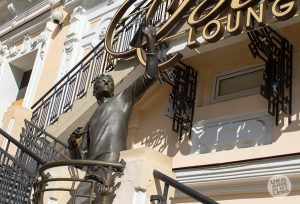
Monument to S. Utochkin
Serhii Utochkin (1876–1916) – one of the first Russian aviators, footballer, cyclist, auto and motorcycle racer of the early 20th century. He practiced fifteen sports! For 14 years he achieved victories in national and international cycling competitions, while excelling in boxing, fencing, running, swimming, and football (he was the first Russian player in the Odesa British Athletic Club team). Known as the “Academician of Sport” (as Korney Chukovsky called him), Utochkin was also an extreme sports pioneer. He once drove a car down the Potemkin Stairs from the boulevard to the port. He was the first to bring roller skates and a motorcycle to Odesa. Legend has it he even rode a motorcycle across the arches of the Humpback Bridge!
But his greatest passion was aviation. On October 1, 1907, Utochkin made his first balloon flight. By December of that year, he was already flying over the Egyptian pyramids. On March 31, 1910, he flew an airplane for the first time, becoming the second aviator in the Russian Empire (after Mykhailo Yefimov). He performed around 150 flights in total.
He died of pneumonia on New Year’s Eve, 1916 (January 13, new style) in St. Nicholas Hospital. Buried in St. Petersburg at the Nikolskoe Cemetery of the Alexander Nevsky Lavra.
The monument to Serhii Utochkin was installed on September 2, 2001, opposite the City Garden near the former Utoch-Kino cinema. Sculptor: A. Tokarev, Architect: V. Glazyrin.
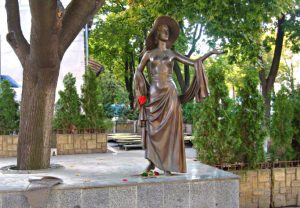
Monument to V. Kholodna
Vira Kholodna (1893–1919) – famous silent film actress. She starred in dozens of films (exact number unknown, at least fifty) and achieved immense popularity.
In 1918, as part of D. Kharitonov’s film expedition, she came to Odesa from Moscow. She died there, allegedly from influenza during the worldwide Spanish Flu pandemic. However, there are theories that she was poisoned either by White Guards or by the French due to her sympathy for the Bolsheviks. The truth remains unknown, since her embalmed body, buried in a chapel at Odesa’s First Christian Cemetery, disappeared during the cemetery’s destruction in 1933.
She was buried from the Transfiguration Cathedral. The monument is located at the site of the Papudov house, where she died.
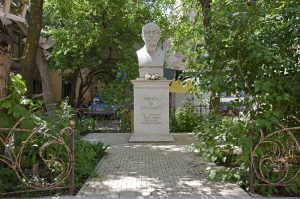
Monument to L. Zamenhof
The monument to Ludwik Zamenhof, creator of the Esperanto language, is the first and only one in Ukraine. It stands in a courtyard at 3 Deribasivska St. in Odesa. Installed in 1959. Sculptor: Mykola Blazhkov.
In 2008, under the city’s monumental art program, the bust was restored. The monument is valued by Esperanto speakers; foreign delegations and tourists visit it, and local Esperantists gather annually to mark Zamenhof Day.
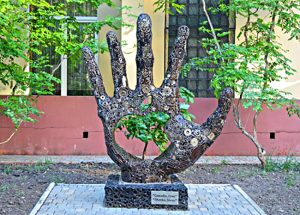
Monument to Steve Jobs
On October 5, 2012, an unusual monument appeared in Odesa near the dormitory of the Odesa State Academy of Technical Regulation and Quality. It is a two-meter-high palm made of metal parts with a cutout in the middle, repeating the Apple logo associated with Steve Jobs (1955–2011).
The pedestal bears the inscriptions in two languages: “Спасибі, Стів” and “Thanks, Steve.” The unveiling date coincided with the anniversary of Jobs’s death. Sculptor: K. Maksymenko. Several hundred kilograms of metal parts were used. This was the first monument to Steve Jobs in Ukraine. At night, it is illuminated, and free Wi-Fi is available nearby.
Monument to A. Pushkin
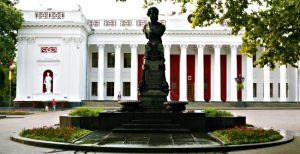
The first monument to Alexander Pushkin in Ukraine, and the second in the Russian Empire, was unveiled in Odesa on Primorsky Boulevard in 1889. Sculptor: J. Polonskaya; Architect: A. Vasiliev. The bronze bust sits on a granite pedestal.
To mark the 50th anniversary of his death, it was decided to erect a monument. Fundraising delays postponed completion: the foundation stone was laid on February 2, 1887, and by October 1888 the monument was nearly finished, but the unveiling took place only on April 16, 1889
A large plane tree grows nearby, which city legend claims was planted by Pushkin himself, though in fact it was likely planted around the time the monument was erected.
Since 2022, following Russia’s treacherous attack on Ukraine, public debate has been ongoing about dismantling or relocating the monument as a relic of the Russian imperial past and a cultural symbol belonging to the aggressor.
Sculptures and Compositions
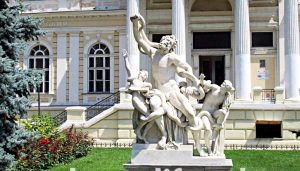
Sculptural Group “Laocoon and His Sons”
In Greek mythology, Laocoön was a priest and prophet from Troy. He was the one who warned the Trojans not to accept the Trojan Horse – the gift of their enemies – for which he was punished. Athena, who protected the Danaans, in anger sent terrifying serpents to kill Laocoön along with his two sons.
The original sculpture “Laocoön and His Sons” was created in 200 BC in the ancient city of Pergamon in Asia Minor. It was cast in bronze. In the second half of the 1st century BC, talented sculptors from the island of Rhodes – Agesander and his sons Athenodoros and Polydoros – created a copy in white marble, which has been preserved to this day in the Vatican. It was there that Odesa mayor Grigoriy Marazli first saw it. The sculpture so impressed him that he ordered a copy for himself, which in 1870 was installed at his dacha. Later, the sculpture was moved and decorated Preobrazhenska Street. Since 1971, however, the sculpture “Laocoön and His Sons” has stood in its familiar location – in front of the Odesa Archaeological Museum. The sculpture, admired by tourists and locals alike, is made of Carrara marble and is an exact copy of the world masterpiece.
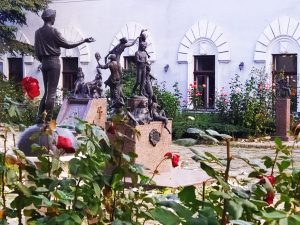
“Sculpture Garden” of the Literary Museum
The Sculpture Garden of the Odesa Literary Museum is a phenomenon without analogues. The Sculpture Garden conveys the unique image of ever-youthful Odesa, a city that absorbed the traditions of great cultures and illuminated them with a sunny smile. Each year it is visited by about one hundred thousand tourists..
In addition to sculptures of literary heroes and geniuses, the Sculpture Garden also features the famous Polovtsian stone figures – ancient statues created by the peoples of the Black Sea region a thousand years ago.
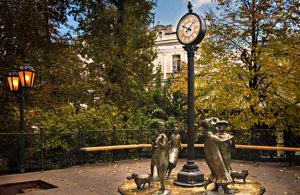
Сomposition “Odesa Time”
Time in Odesa flows differently than in other cities. Odesa time is measured not so much by minutes as by the distance between meetings, events, summers, arrivals and returns of friends. It has its own periods and rules.
Human figures, child-sized, symbolizing Odesa residents of different generations, nationalities, and occupations; alongside them, an Odesa cat and a small dog named Zhulka – all of them, through the efforts of children and adults, can start spinning in a dance around the clock – the symbol of life’s transience, where carefree childhood is replaced by happy youth, maturity gives rise to the wisdom of old age, time’s infinity and humanity’s ability to accelerate its flow.
There are things that unite people who think completely differently, that make adults a little like children and allow children to break the rules. There are events where past and future meet.
Sculptor – M. Reva. 2015.
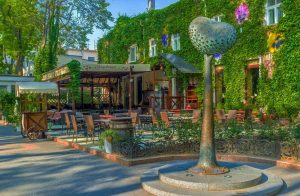
Composition “Tree of Love”
The monument was ceremoniously unveiled in the City Garden on February 14, 2006 – Valentine’s Day. Author – sculptor M. Reva.
The three-meter composition, weighing a ton, is shaped like a tree with a crown resembling a heart. On its patinated bronze crown, 210 polished bronze hearts protrude like ripe fruit. Several hearts have “fallen” to the ground and lie at the base of the trunk. The sculptor explained: “The tree is the foundation of life: its roots are the past, its crown is the present.” On the trunk of the tree, the word “love” is inscribed in 65 languages of the world. According to local belief, if a couple in love holds hands and touches the tree trunk, their love will be as strong as bronze.
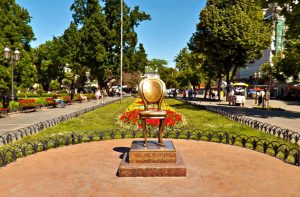
Monument to the Twelfth Chair
There are probably very few citizens of the former USSR who, if they have not read the novel The Twelve Chairs, have at least not seen the film adaptation of this work by Ilya Ilf and Yevgeny Petrov, two Odesa humorists. Their real names were Yehiel-Leib Aryevich Faynzilberg (1897–1937) and Yevgeny Petrovich Kataev (1902–1942) – the brother of another famous Odesa writer, Valentin Kataev. It is hardly necessary to retell the plot of this novel and the main adventures of Ostap Bender…
The monument to the Twelfth Chair from the novel was unveiled on April 1, 1999. Architect – M. Reva.
It should be noted that the monument is located on the smallest square in the world – Ostap Bender Square.
During the tourist season, long lines form at the monument, as visitors wish to take a photo sitting on the chair – it is said that the “chair” brings luck and financial prosperity.
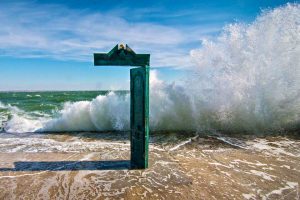
Installation “Doors of Happiness” (“Domus Solis”)
According to the author’s idea, the sun enters Odesa every morning at dawn through these doors. The doors are installed on Langeron Beach near the Club Hotel, behind the NEMO Beach Club complex. They are a bronze copy of old Odesa doors that in the 19th century adorned the front entrance of one of the city’s houses, proudly greeting residents and guests.
Sculptor – M. Reva. 2015.
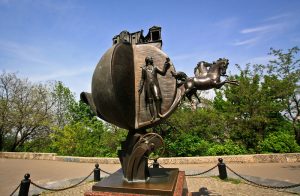
Monument to the Orange
The monument depicts an orange with one slice removed. Yet Odesa residents call it the “Monument to the Bribe.” And not without reason. Behind it lies a story.
In 1796, Catherine II died. Her son Paul I, as is known, disliked his mother. As soon as he came to power, he made every effort to do the opposite of her policies, determined to undo all her achievements. In particular, construction of the new city and port on the Black Sea coast was frozen.
Legend has it that the cunning Odesa residents decided to win Paul’s favor with a gift of delicacies. The city magistrate resolved that once the first shipment of oranges arrived in port, three thousand of the finest were to be sent immediately to His Imperial Majesty. The trick worked: Paul softened and allocated 250,000 rubles for port development. The city was saved! Thus, Odesa bought its survival with a “bribe” of 3,000 oranges.
The monument was originally installed on Lanzheronivska Street, but due to stylistic mismatch with nearby architecture, it was later relocated to a quieter and more fitting location. In 2007, it was moved to the Boulevard of Arts (later Zhvanetsky Boulevard, since 2024 – Naval Forces Boulevard).
Unveiled on September 2, 2004. Sculptor – A. V. Tokarev, architect – V. L. Glazyrin.
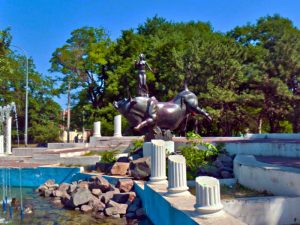
Composition “The Abduction of Europa”
The composition “The Abduction of Europa” was a gift to Odesa, erected in September 1994 by architect V. N. Chepelyeva and sculptor A. P. Tokarev. It was initiated by the Kyiv District Executive Committee. The “architectural and artistic composition” is located at the 9th Station of the Fountain Road.
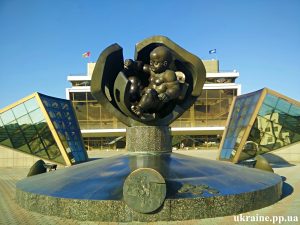
Composition “Golden Child”
The composition “Golden Child” by sculptor Ernst Neizvestny was his gift to Odesa. It was unveiled in 1995 and stands in front of the Marine Passenger Terminal. The monument symbolizes a tree from whose fruit emerges a child. Locals, in true Odesa fashion, gave it a nickname – “kinder surprise.” At first unusual, the monument has grown beloved, with its miraculous infant regarded with sympathy. As many have noted, it even resembles Buddha – the child’s face radiates tranquility and peace.
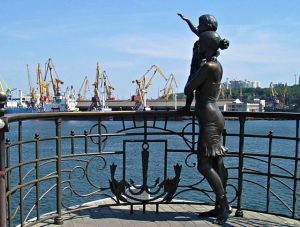
Monument “Sailor’s Wife”
The bronze sculpture was unveiled at the Marine Terminal in 2002. Sculptor – O. Tokar.
The composition depicts a graceful young woman holding a child who stands on the parapet. Both mother and child gaze out at the sea, awaiting the return of the sailor husband and father. The ornate metal parapet, decorated with floral ornaments and the coat of arms of Odesa, curves around the figures, giving the illusion of a balcony or ship’s bow.
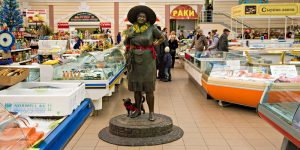
Monument to Aunt Sonya
Bronze Aunt Sonya, in a wide-brimmed hat and apron, clutching a bundle of fish to her chest, stands at the very center of the fish row of Odesa’s Privoz Market. She cannot go unnoticed.
“I had the idea to create Aunt Sonya long before the market’s reconstruction”, said sculptor Igor Ivchenko. “I imagined her as a retired fishmonger. She comes not only to sell fish but to see people and be seen. She represents Odesa grandmothers, who uphold our civilization and Odesa itself”.
To capture the image, the sculptor visited the market, observed and photographed local vendors. When the statue was first installed, the sellers immediately gathered around, debating which of them it resembled.
The sculpture, by Igor Ivchenko and Illarion Stadnik, was installed in the new fish pavilion of the Privoz Market and unveiled in 2006.