Menu Close

Theatres, Philharmonic Hall, Circus

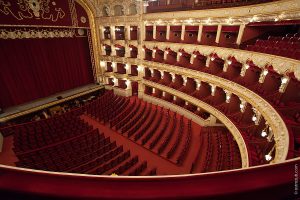
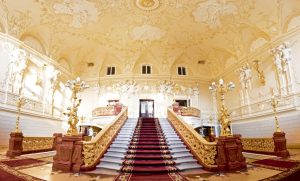
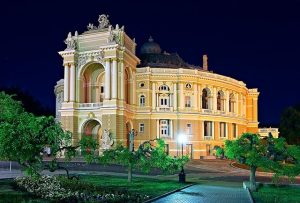
One of the most famous cultural landmarks in the world and a true symbol of the city, the Odesa Opera House stands alongside the renowned Vienna State Opera and other masterpieces of European architecture. Since the moment of its construction, the theatre has been regarded as the “prima donna” among monuments of the world’s cultural heritage. Its architecture, technical features, interior layout, and exterior decoration place it among the finest theatres in Europe and the world.
The project was designed by the Viennese architects Ferdinand Fellner and Hermann Helmer, creators of remarkable theatre buildings in many European cities. Construction lasted three years and was completed in September 1887. The theatre has repeatedly topped national and international rankings. The prestigious magazine Forbes included the Odesa Opera House among the eleven most interesting architectural landmarks in Eastern Europe. In 2022, the theatre received the “Opera Oscar,” the highest distinction of the International Opera Awards, in the category of Best Opera Company. Recently, as part of the “Historic Centre of the Port City of Odesa,” the theatre was also inscribed on the United Nations Educational, Scientific and Cultural Organization (UNESCO) World Heritage List.
The beauty of its architecture is matched by the excellence of its artistic content. World-renowned Ukrainian and international performers have appeared on the Odesa stage, including Solomiia Krushelnytska, Ivan Patorzhynsky, Mykhailo Hryshko, Zoya Khrystych, Borys Rudenko, Pavlo Virsky, Ihor Moiseyev, Mariia Lytvynenko-Wohlemuth, Mykola Ohrenchych, Roman Serhiyenko, Titta Ruffo, Mattia Battistini, Montserrat Caballé, and many others. It was here that such beloved operas as The Barber of Seville by Gioachino Rossini, Lucia di Lammermoor and The Elixir of Love by Gaetano Donizetti, and Tosca by Giacomo Puccini were first performed in Ukraine.
Today the theatre’s repertoire includes more than eighty productions: world masterpieces of opera and ballet, works by Ukrainian composers and choreographers, and exclusive concert programs. The theatre also hosts the international arts festival “Velvet Season at the Odesa Opera,” which over the course of seven years has brought together participants from twelve countries within Ukraine’s cultural space. In addition, the theatre offers a special educational and artistic program for young audiences, as well as an alternative art venue known as “Bel-etage-impreza”.
The international reputation of the Odesa National Academic Opera and Ballet Theatre is further confirmed by the numerous tours of its company around the world, including performances in Italy, Spain, Poland, the Netherlands, Belgium, the United States of America, Japan, China, Greece, Portugal, Moldova, and many other countries.
The theatre opened on 7 November 1925 with the premiere of Polumyari, staged after a play by Anatolii Lunacharsky. At that time it was called the Odesa Ukrainian State Drama Theatre. Among its founders were prominent artists, including the directors Marko Tereshchenko, the theatre’s first artistic director, and Vasyl Vasylko, as well as the actors Yurii Shumsky, Petro Nyatko, Nataliia Uzhvii, Liudmyla Matsievska, Andrii Kramarenko, Oleksandr Lutsenko, Ivan Tverdokhlib, and others.
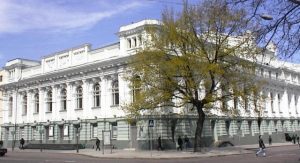
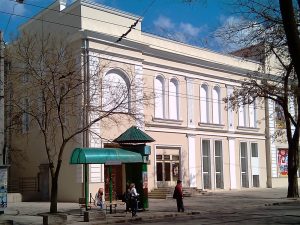
On the occasion of its fifth anniversary, the theatre was renamed the Theatre of the Revolution and moved into the building of the Sibiryakov Theatre, a historical and architectural landmark dating from the early twentieth century. In 1995 the theatre was named after Vasyl Vasylko, an outstanding Ukrainian actor, stage director, playwright, historian, and theorist of theatre art. Over the course of different periods, he led the theatre for a total of twenty years, staged about thirty productions, and trained an entire generation of theatre artists.
In 2006, in recognition of its outstanding artistic achievements, the ensemble was granted the status of an Academic Theatre. The Vasylko Theatre has participated in and received awards at prestigious national and international theatre festivals. It is also known for its tours in Canada, Egypt, Poland, and Romania.
Its repertoire is distinguished by originality and by its pioneering presentation of new names in drama, new themes, and innovative expressive techniques on stage. In order to encourage the artistic development of the company, the theatre’s management invites leading stage directors from Ukraine and abroad to collaborate on its productions.
The theatre’s repertoire policy has always been characterized by boldness and consistency in the search for new artistic solutions. Its program features outstanding works of both national and world drama. Productions of plays by William Shakespeare, Friedrich Schiller, Fernand Crommelynck, Ivan Franko, Mykola Hohol (Nikolai Gogol), and Ivan Nechui-Levytskyi, as well as works by contemporary Ukrainian and international playwrights, have become significant cultural events not only in Odesa but throughout Ukraine.
The theatre’s repertoire includes works of many genres, including drama, comedy, musicals, and poetic performances.
The theatre is widely recognized as the initiator of numerous cultural, educational, charitable, and artistic initiatives. It is an important center of national culture in southern Ukraine.
Continuing the finest traditions established by its distinguished predecessors, the artists of the Vasylko Theatre continue to explore new dimensions of both Ukrainian and world classical drama, discovering new authors, works, and themes. The company brings together talented actors of several generations. In addition to the main stage, experimental performance spaces operate actively, including the creative workshop “The Spectator on Stage” and “Stage 38.” During more than ninety-five years of continuous artistic activity, the theatre’s ensemble has demonstrated a strong civic stance, a high level of creative professionalism, as well as courage and innovation in its artistic exploration.
The Odesa Academic Drama Theatre is one of the oldest theatres in Ukraine. It was founded in 1926 through the merger of the Odesa theatre company “Masodram” and the Regional Drama Theatre named after Taras Shevchenko. Under the artistic leadership of the chief director Anatolii Hrypych, the theatre immediately gained recognition with major premieres such as Sunset by Isaac Babel, The Good Soldier Švejk, Beethoven, and Eugene the Unfortunate by Ernst Toller, among other productions.
In the 1930s Hrypych was succeeded by Avraam Trepliov, who built the theatre’s repertoire on outstanding works of both national and international drama. One of the most notable premieres of that period was The Mother by Karel Čapek. During the years 1941–1944 the theatre was evacuated because of the Second World War, but after its return it quickly regained its place within the theatrical life of Ukraine. Many outstanding performers appeared on its stage, and their names have become part of the history of Ukrainian theatre.
In 2009 the theatre was granted Academic status, a distinction awarded in Ukraine to cultural institutions recognized for their high artistic achievements.
Today the Odesa Regional Academic Drama Theatre remains an important center of cultural life for both the residents of Odesa and visitors to the city.
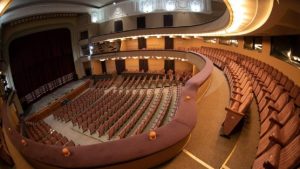
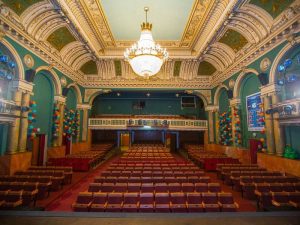
Today the Mykhailo Vodyanyi Odesa Academic Theatre of Musical Comedy is one of the most modern and technically well-equipped performance venues in the city. However, the history of the theatre began not in Odesa but in the city of Lviv in 1947. A young artistic troupe presented a variety of performances and quickly gained recognition. In 1953 the company was transferred to Odesa.
Productions devoted to the city and its residents soon became the theatre’s true calling card, and audiences across the country became familiar with its artists. In 1981 the Odesa Musical Comedy Theatre moved from a small stage to a large building specially constructed for the company. In 2006 the theatre was awarded Academic status in recognition of its artistic achievements.
The theatre has always been a pioneer in its genre. Alongside classical operettas, its repertoire includes musicals, rock operas, musical comedies, and fairy-tale performances for children. Today the company possesses tremendous creative potential. Its repertoire includes classical operettas such as Die Fledermaus, Silva, and Maritza; musicals including Chasing Two Hares, Oscar, Along Deribasivska Street…, The Canterville Ghost, Some Like It Hot, An Ordinary Miracle, and The Night Before Christmas; rock operas such as Romeo and Juliet and Moses; as well as performances created especially for young audiences.
The Mykhailo Vodyanyi Odesa Academic Theatre of Musical Comedy is filled with creative energy. It continually sets new artistic goals, grows, experiments, and strives to share its love, optimism, and vitality with its audience.
The history of circus buildings in Odesa begins in 1857, when the entrepreneur Jean Godfroy constructed the city’s first circus, which was rather modest in its equipment. Soon afterward, a wooden circus with a canvas roof appeared under the name “Hippodrome.” In the 1860s, during the tour of the French circus company led by Güteman, a large stone building was erected in Teatralnyi Lane. After the tour ended, the building was transformed into the Mariinsky Theatre, where opera, drama performances, and circus programs were presented. In the summer garden known as “Hermitage,” on the opposite side of the Stroganivskyi Bridge, a large round wooden structure was built to host touring circus companies.
During a tour in Odesa, the circus entrepreneur Albert Salamonsky and his troupe were so impressed by the city on the shores of the Black Sea that he decided to establish a permanent circus there. In 1879, the first Odesa circus opened at 37 Koblewska Street. It was located in a stone building designed according to the standards of contemporary architectural art, equipped with central heating and capable of accommodating four thousand spectators. The long history of the Odesa State Circus begins with this building, which functioned for ten years.
After the building was dismantled in 1889, the well-known Odesa entrepreneur and brewery owner Wilhelm Santsenbaher decided to construct a new circus building. The new circus opened in 1894 at 25 Koblewska Street with a tour by the famous Ferroni Brothers Circus Company. According to the design of the engineer A. Geldfand, a twelve-sided building twenty meters high was constructed and crowned with a dome covered with a double layer of iron, which provided better insulation in both warm and cold weather. Because of its numerous metal structures, designed and manufactured in Germany, it became known as the “Iron Circus of Santsenbaher.” The building could accommodate up to two thousand three hundred spectators.
After Wilhelm Santsenbaher died in the same year the circus opened, the property was inherited by his brothers. However, because they were occupied with other affairs, they paid little attention to the circus, and its condition gradually declined. Over time, the ownership of the building changed several times.
After the revolutionary events of 1917, the building of the Odesa Circus became the property of the municipal council. In 1925 the Odesa Circus received the official status of a state institution.
Throughout its existence, the circus arena has hosted many outstanding masters of circus art who have performed here repeatedly.
The Odesa Regional Philharmonic occupies a prominent place among the leading concert organizations of Ukraine. Each year it presents to its audiences significant works of world musical culture as well as remarkable creations from the contemporary Ukrainian and international music scene.
The predecessor of the Philharmonic was the Odesa Philharmonic Society, founded in 1842. Its members included not only musicians but also prominent public figures of the city, writers, and military officers. The society organized charity concerts and provided financial support to young artists at the beginning of their careers. In the 1840s the Wieniawski brothers performed here, and the great composer, pianist, and conductor Ferenc Liszt gave six concerts. From 1925 onward the society began organizing concerts of symphonic music.
The Odesa Philharmonic was founded in 1931. In the same year the Odesa Philharmonic Symphony Orchestra was officially established. Its first conductor was Leonid Mohylevskyi, a professor at the Odesa Conservatory, the founder of a renowned dynasty of Odesa musicians and the grandfather of the pianist Yevhen Mohylevskyi. Over the years the orchestra has been led by distinguished conductors such as Alexander Glazunov, Oskar Gauck, Kirill Ivanov, Kurt Sanderling, Nathan Rakhlin, Yuri Simonov, Saulius Sondeckis, Yuri Temirkanov, and Evgeny Svetlanov. Among the celebrated soloists who have appeared with the orchestra are Vladimir Horowitz, Emil Gilels, David Oistrakh, Mstislav Rostropovich, and Leonid Kogan.
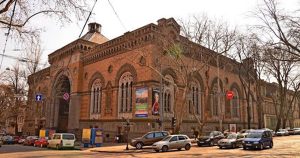
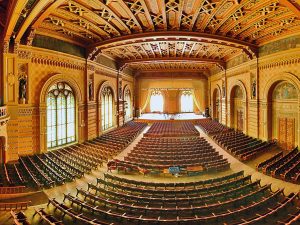
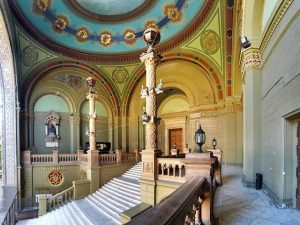
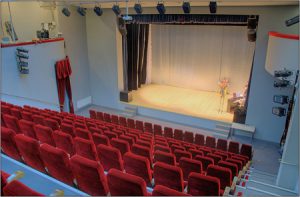
The Philharmonic is located in the historic center of Odesa. Since 1946 it has occupied one of the most beautiful buildings in the city: the former New Merchants Exchange, built in 1899 according to the preliminary design of the Viennese architect Viktor Prochaska and later redesigned in the Italian Gothic style by the renowned architect Alexander Bernardazzi. The wooden ceiling of the concert hall is made of Lebanese cedar without a single nail and is gilded and painted. The walls are decorated with six panels created by the Saint Petersburg artist Nikolai Karazin. The auditorium, which seats one thousand spectators, is notable for its beauty and outstanding acoustics and is considered one of the finest concert halls in Europe.
No other cultural institution plays such a significant role in the artistic life of the region as the Philharmonic. It organizes tours by performers from other cities and actively participates in prestigious international music festivals and competitions such as Two Days and Two Nights of New Music, Odesa Dialogues, Odesa Guitar Autumn, White Acacia, Danube Spring, Richterfest, David Oistrakh Days in Odesa, the International Piano Competition in Memory of Emil Gilels, and the International Violin Competition in Honor of David Oistrakh, among many others.
Today the stage of the Philharmonic hosts performers and ensembles of the institution itself, as well as the Odesa National Philharmonic Orchestra under the direction of the Honored Artist of Ukraine, Hobart Earle. The Philharmonic is the principal concert organization of the city. Preserving and developing the finest traditions of musical culture is its great mission.
The Yuri Olesha Odesa Youth Theatre is one of the oldest and most beautiful theatres for young audiences in Ukraine. It has been operating since 1930 and, over the decades, has received numerous international awards, including the Scarlet Sails Prize of the International Festival of Theatres for Young Audiences and recognition at the international arts festival GLORIA. Dozens of distinguished performers have appeared on its stage, including many who have been awarded the honorary title People’s Artist of Ukraine, a state distinction granted to artists for exceptional achievements in the performing arts.
The Odesa Youth Theatre is known for its diverse repertoire, which combines classical productions with innovative and unconventional performances. Its program includes entertaining plays for younger children as well as serious theatrical works designed for teenage audiences.
The theatre regularly participates in artistic competitions and festivals, runs a family-oriented educational program entitled “Let Us Go to the Theatre,” and organizes public readings of dramatic works open to audiences.
The Odesa Puppet Theatre is one of the oldest puppet theatres in Ukraine. It was founded in 1932 and is located in the historic center of Odesa at 15 Pasteur Street. Over more than eighty years of existence, the Odesa Academic Puppet Theatre has become one of the most recognized institutions of puppet art both in Ukraine and abroad. Numerous memorable productions have been created here, many of which have become classics of the genre. The skill and talent of the theatre’s company have been acknowledged at many festivals and competitions.
Puppet theatre in Odesa has developed its own traditions and distinctive performance style, characterized by the high level of mastery of the actors as well as by striking and unique stage designs.
For many children in Odesa, the puppet theatre becomes their first encounter with what is called “the theatre.” It is an excellent introduction that prepares young audiences for the “adult” theatrical performances they will discover later in life. Through puppets, the actors tell children stories that teach kindness, honesty, love, friendship, nobility, and justice, helping them better understand themselves and the world around them. Here the puppets resemble real people: in the hands of true masters they come to life, rejoice, feel sad, argue, and reconcile. Yet every story ends happily, to the great delight of the young spectators.
The theatre was founded by the All-Ukrainian Public Organization “Congress of Bulgarians of Ukraine.” Its company consists primarily of Bulgarians from the region of Bessarabia, as well as residents of Odesa who have united around a common goal: the revival of Bulgarian theatre in the city. It is described as a revival because a Bulgarian theatre existed in Odesa only for a short period before 1940.
In May 2013, the Odesa Bulgarian Drama Theatre presented its first premiere: The Bus by the Bulgarian playwright Stanislav Stratiev, directed by Ihor Ravytskyi. In May 2014, the theatre presented its second premiere, The Decameron, based on the work by Giovanni Boccaccio, also directed by Ihor Ravytskyi. These productions have received several international awards. Performances are also staged in the Bulgarian language.
The “Theatre on Nizhynska” first opened its doors in 2012 with the premiere of the already legendary play Bichki v tomate (Fish in Tomato Sauce). The production masterfully recreates on stage the atmosphere of a traditional, and somewhat stereotypical, Odesa courtyard: laundry hanging on clotheslines, a small table for playing dominoes, and evening gatherings of neighbors whose windows overlook the courtyard.
Since then, this quintessential Odesa story has delighted audiences more than three hundred times, and the theatre has become a place where every spectator can find something to their taste.
Visitors are offered an excellent opportunity to immerse themselves in the vibrant and multifaceted world of human emotions and the extraordinary local color of Odesa. The performances allow the audience to smile sincerely at everyday situations, recognize familiar faces—or even themselves—in the characters on stage, and appreciate the remarkable talent of the theatre’s actors.
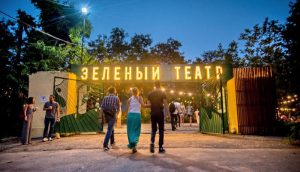
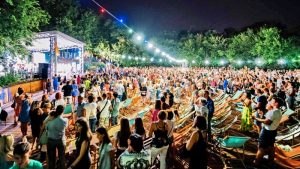
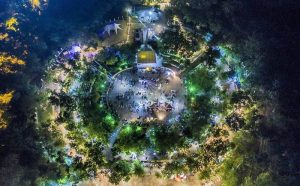
The Green Theatre is the first and only open-air amphitheatre in Odesa, built in the 1930s. In the twentieth century, the stage of the Green Theatre hosted some of the brightest stars of its time. Despite this rich cultural history, the venue entered the twenty-first century in a state of abandonment and ruin.
Fortunately, in 2015 the Ukrainian entrepreneur and philanthropist Yehor Hrebennikov, together with the charitable foundation Impact Hub Odessa, initiated a project to revive and modernize the theatre.
The renewed Green Theatre—affectionately called simply “the Green” by Odesa residents—combines a contemporary cultural concept that includes a concert stage, an open-air cinema, a lecture and conference venue, children’s areas, coworking spaces, a food zone, an urban garden, spaces for social initiatives, and much more. Each year the venue welcomes nearly 500,000 visitors from around the world, and the Green Theatre has become a unique place for leisure, work, education, and inspiration.
Over the course of five seasons, hundreds of nationally and internationally recognized performers have appeared on the stage of the Green Theatre.
Special mention should be made of the theatre’s film program, which has become one of the main platforms in Odesa for enthusiasts of independent and auteur cinema. Each season approximately fifty events are held as part of the program, including national premieres of international festival hits, film festivals such as OIFF (Odesa International Film Festival), KISFF (Kyiv International Short Film Festival), and Docudays UA (International Human Rights Documentary Film Festival), premieres of contemporary Ukrainian films, and the traditional free Monday screenings. These screenings form an educational program that includes world cinema classics as well as experimental films.
The theatre is also known for its ecological and social initiatives. The space hosts projects dedicated to recycling, as well as campaigns for the collection of plastic waste and used batteries.
In the twenty-first century, the Green Theatre has become a major public space which, within only five years, welcomed nearly three million visitors.
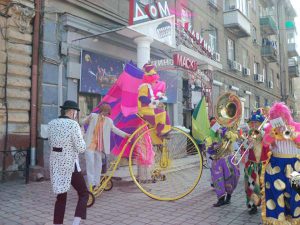
On 28 March 2003, a unique cultural center was opened in Odesa: the theatre of the comic troupe Maski, called “House of Clowns.” It is located in the building of the former Druzhba Cinema. The theatre’s opening coincided with the premiere of the poetic comedy Othello, written by Borys Barskyi and directed by Heorhii Deliiev, which became another cultural gift to both residents and visitors of the city.
Since then, it has become a wonderful tradition to delight audiences every year with new productions such as Dinner Show, Nocturnal Symphony, Orpheus and Eurydice, the poetry evening of Borys Barskyi, and the troupe’s traditional comedic performances.
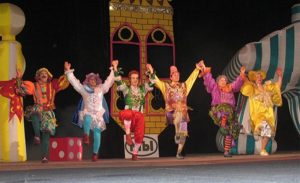
Permanent participants in the stage projects of the House of Clowns include the dance theatre “Deft Feet” and the clown corporation “Animo”.
Soon afterward, the Maski troupe, together with film critic and cinema enthusiast Yan Yusym, opened the Maski Cinema within the House of Clowns. Since then, it has screened daily selections of the best auteur and international festival films.
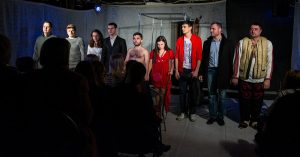
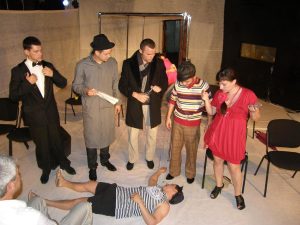
The Theatrical Laboratory “Theatre on Tea” is the only private repertory chamber theatre in Odesa. Its company consists of young actors and directors who also work in state theatres as well as in the film and entertainment industries.
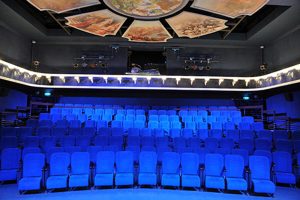
The theatre represents a continuation of the now nearly disappeared model of the House of the Actor, where productions were directed by various directors with completely different artistic approaches. What unites them is an intimate stage designed for an audience of approximately fifty people, where spectators and actors are positioned as close to one another as possible.
The Theatrical Laboratory “Theatre on Tea” was founded in 2010 by graduates of the Odesa Theatre Lyceum. During its first months of existence, the company was joined by young actors and directors from Odesa and Kyiv. The youngest members of the troupe are graduates of the theatre’s own training school.
The theatre’s motto is: “We are a school, a laboratory, a theatre. We learn, we search, we want to speak with you”.
At present, the theatre is actively developing its own artistic method and theatrical language that can be understood by both contemporary audiences and future generations. For the members of the company, theatre is a form of living communication—an experience in which everyone is present together, rather than each person remaining separate.